Here’s what each stone can take and why yellow and blotchy marks appear. We also cover what to do if it already happened.
Know the stone first
- Limestone is a calcite-based stone. Indiana limestone is built from shell fragments. The National Park Service warns that acidic cleaners can be extremely damaging to acid-sensitive stones such as limestone and marble. They etch and dissolve them.
- Bluestone is a sandstone. New York’s environmental agency describes it as layered sandstone that splits into thin, smooth slabs. It lists iron in its makeup. In the U.S. it’s only produced commercially in south-central New York and northeast Pennsylvania.
- Flagstone describes how a rock splits, in smooth, even layers used for paving. It’s not one rock type. Find out what rock yours actually is before choosing a cleaner.
Not sure? Check your installer’s paperwork, or ask a stone yard. One homeowner on a pressure-washing forum was told by a contractor that their patio edging was sandstone. The homeowner washed it hard and found out afterward it was limestone.
Why stone goes yellow
One washer on a pressure-washing forum had a limestone house turn yellowish after a bleach wash. Would it fade back on its own? There are several possible causes.
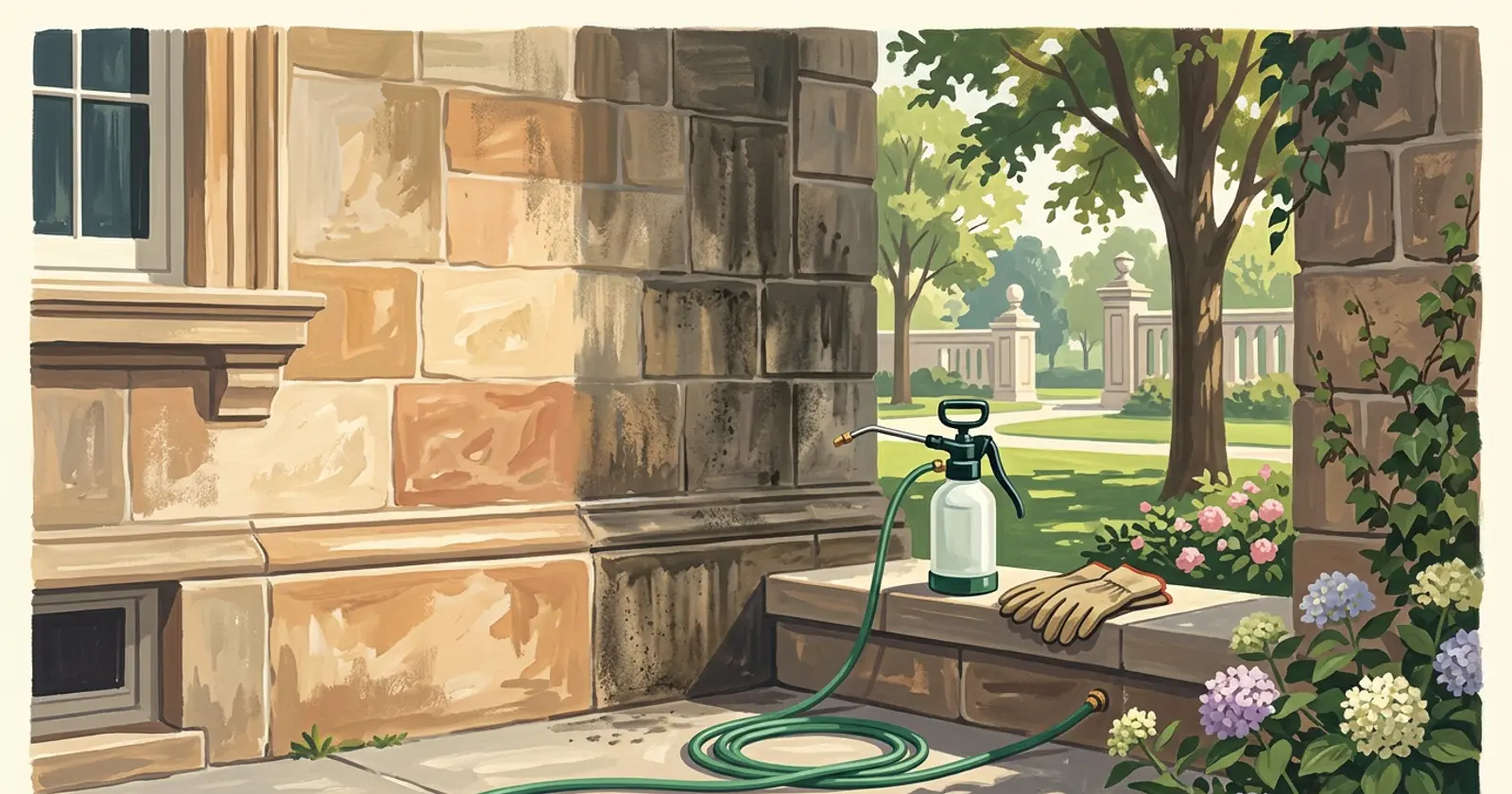
Iron in the stone. The limestone industry’s trade institute is based in Bedford, in Indiana’s quarry country. It explains that the stone holds tiny iron-bearing minerals. They turn toward light yellow as they oxidize in the ground. The Park Service adds that stones can hold iron particles that react with a cleaning agent and stain. It says alkaline cleaners can stain sandstones containing iron. That matters for bluestone, too.
Iron in the water. The Park Service notes some water supplies carry traces of iron and copper that can discolor masonry.
Alkali stain from behind. The institute describes a “light golden to dark brown” stain caused by alkali-charged moisture moving through the stone. It comes from the back or bottom of the stone, not from water on the face. The alkali usually comes from nearby concrete. So think about limestone caps and edging set against concrete.
The Park Service also warns about some strong alkaline cleaners. They can leave disfiguring brownish-yellow stains and deposit salts that are hard to rinse out.
Why stone goes blotchy or rough
Blotches and rings can be leftovers, not damage. A new washer on a trade forum asked about spots on bluestone after a light bleach wash. A reply suggested dirty water had settled and dried, or tannin stains. It said a stronger mix would likely clear them. On another forum, a homeowner found rings on a patio after a hired wash. Replies pointed to lichen colonies exposed once the dirt was gone.
Rough or etched stone is pressure damage. The Park Service says that water at too high a pressure can easily etch marble and other soft stones.
What each stone can take
| Stone | Acid cleaners | Alkaline cleaners | Pressure | Problems people report |
|---|---|---|---|---|
| Limestone | Avoid; etches and dissolves | Preferred type, but test and rinse well | Start low; hose pressure often works | Yellow cast, rough or etched patches |
| Bluestone (sandstone) | Some sandstones tolerate it, others etch; test | Can stain stone that contains iron; test | Start low | Spots and blotches after a wash |
| Flagstone | Depends on the rock | Depends on the rock | Start low | Same as whichever stone it is |
The institute’s own guidance for new limestone work is gentle. Ordinary hose taps often deliver enough pressure. If more scrubbing is needed, it allows no more than 1,200 psi. Use a wide-angle nozzle held at least a foot from the stone. Hand-scrubbing with fiber brushes and mild soap is fine. It also says muriatic acid should not be used at strengths that discolor the stone. Strong acids used to clean brick will burn and discolor limestone. For stone memorials, see how to clean a headstone gently.
For older masonry, the Park Service is stricter. Start at 100 psi or below, even with a garden hose. Generally go no higher than 300 to 400 psi.
If it already happened
- Stop. Don’t hit it again with stronger bleach or acid. The institute says inept cleaners probably do more damage to fine older buildings than years of exposure to corrosive air.
- Let it dry fully. The Park Service says cleaning tests should be judged only after the masonry has dried completely.
- Test small. The Park Service says a test area can start as small as six square inches. Try one remedy at a time in a hidden spot.
- Match the fix to the cause. For a yellow cast, one forum reply blamed iron in the stone and suggested a rust-removal product. Test any remover on a hidden spot first. Rings that look like lichen may need a different treatment. Etching can’t be washed back. You can live with it, ask a stone pro about refinishing or replace the worst pieces.
If a hired washer did it, document it first. Our guide to telling wash damage from damage that was already there walks through the photos and timeline.
What to ask before hiring
- What stone do you think this is, and how will you confirm it?
- What pressure, nozzle and distance will you use on it?
- What’s in your mix, and will you rinse until it’s clear?
- Will you do a test spot and let it dry before doing the rest?
Our questions to ask a house washing company cover insurance and the rest of the call. If the problem is white haze rather than yellow, see white haze on brick, pavers or stone. For concrete pavers, see what a paver clean, sand and seal includes. Here’s how we check every claim: our methodology.
Sources
Based on 8 sources · How we price
- Indiana Limestone Institute of America, Indiana Limestone Handbook, 22nd edition: indianalimestone.org/wp-content/uploads/22nd-edition-handbook.pdf
- National Park Service, Preservation Brief 1, Cleaning and Water-Repellent Treatments for Historic Masonry Buildings: nps.gov/orgs/1739/upload/preservation-brief-01-cleaning-masonry.pdf
- New York State Department of Environmental Conservation, New York State Oil, Gas and Mineral Resources 2020 (Bluestone Fact Sheet): extapps.dec.ny.gov/docs/materials_minerals_pdf/minfactsht.pdf
- Encyclopaedia Britannica, Flagstone: britannica.com/science/flagstone
- Community discussion, r/pressurewashing, “Yellowing limestone” (2025): reddit.com/r/pressurewashing/comments/1phhyg6
- Community discussion, r/pressurewashing, “Accidentally pressure washed limestone - is this fixable?” (2025): reddit.com/r/pressurewashing/comments/1lcx0sl
- Community discussion, r/pressurewashing, “Circular Stains on Stone Patio after Pressure Washing” (2025): reddit.com/r/pressurewashing/comments/1jyx37m
- Community discussion, PressureWashingResource forum, “Bluestone Spotting” (2026): pressurewashingresource.com/community/t/bluestone-spotting/40834