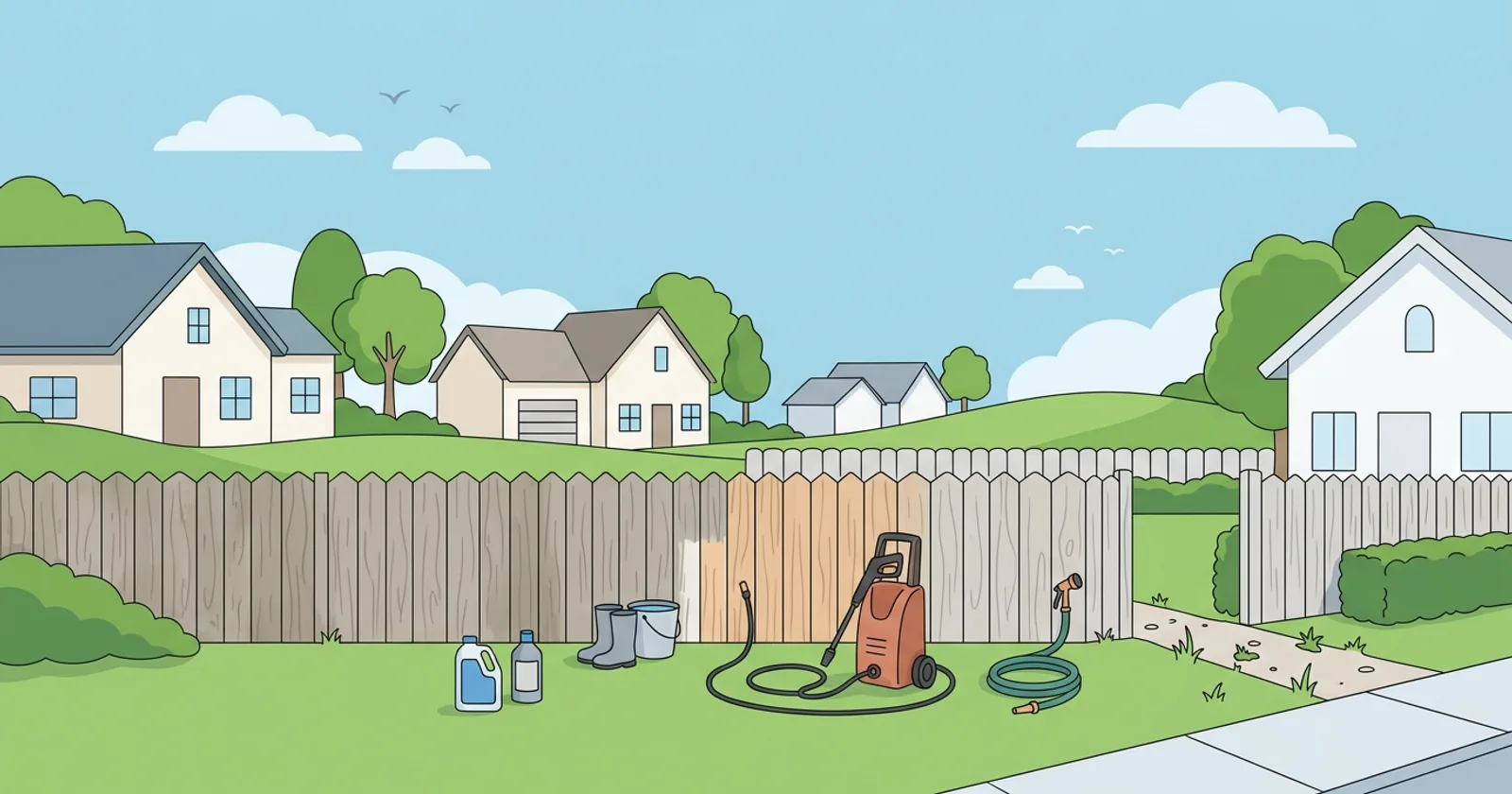
A washer on a pressure washing forum asked how to price a 140-foot cedar fence, 6 feet tall. Here’s how the published numbers play out on a fence like that, what to do about the side you can’t reach, and which cleaner is kinder to the wood.
What washers publish
These four washers post fence prices, each in a different way:
| Provider (area) | What the page says | Per linear foot |
|---|---|---|
| The Pressure Wash King (Charleston, SC) | $1.00 per linear ft, each side, wooden privacy fence (add-on to a house wash) | $1.00 per side |
| ATX Clean Pro Wash (Austin, TX) | Cedar fence cleaning starts at $199 for up to 50 linear feet | $3.98 at 50 ft |
| JCS Refresh (Washington) | $2.50 to $5.00 per linear ft for a 6-foot fence; doesn’t say one side or both | $2.50 to $5.00 |
| Fence Defense (Plano, TX) | Soft wash plus stain, $0.65 to $0.75 per sq ft (2021 post) | $3.90 to $4.50 per side, stain included |
The Plano figure is per square foot. On a 6-foot fence, each foot of length has 6 square feet per side, so that’s $3.90 to $4.50 a foot, and it includes the stain.
For the 140-foot fence, one side at $1.00 a foot is $140, and both sides are $280. At $2.50 to $5.00 a foot, it’s $350 to $700. Short fences can hit a minimum instead: the Austin company’s $199 starting price covers up to 50 feet. For siding, driveways and other jobs, see our pressure washing cost guide.
What moves the price
- One side or two. The single biggest factor. Ask for it in writing.
- How gray it is. A light mildew wash is quicker than restoring wood that has turned silver.
- Access. Shrubs, a dog run or a locked gate on the other side slow the crew down.
- Stain afterward. Clean-and-stain packages cost more but include the prep. Our deck prep guide covers the dry time before stain, and it applies to fences too.
The neighbor’s side
Most privacy fences show you one face, and the other face belongs to the yard next door. If only your side gets cleaned, the two sides won’t match, but you also pay only for half the wood. One Texas washer’s price page notes that some homeowners clean only their side, and others split the cost with the neighbor so both sides get done.
Who owns a shared fence, and who has to maintain it, isn’t something we can answer for you. It depends on your property survey, local rules and, in many neighborhoods, HOA covenants. Check those first, then talk to the neighbor before any crew steps into their yard. They’ll want to know the plan anyway.
HOAs care about fences too. A Texas homeowner on an HOA forum got a violation notice over fence stains they blamed on their own sprinklers. If yours is spotted the same way, our sprinkler rust stains guide explains the cause, and our HOA notice guide covers what to check before you hire.
Bleach vs oxygen cleaner
Both kill mildew. The difference is what they do to the wood.
The USDA Forest Products Laboratory recommends cleaners with sodium percarbonate or other oxygen bleaches because they’re gentler. It warns that chlorine bleach “may cause excessive pulping of the wood to give a fuzzy surface.” Even a bleach maker’s own outdoor guide says to avoid using its solution on unfinished wood. The lab notes that many fences are left to weather naturally, with no finish at all.
One oxygen wood cleaner we checked lists sodium percarbonate as 75% to 100% of the powder on its safety sheet. Its data sheet calls the mix harmless to nearby plants and says to let it foam for 10 minutes. That matters on a fence, where there’s lawn and garden bed on both sides. Our cedar siding guide goes deeper on how each cleaner affects the wood.
Gray wood is a different problem. The Forest Products Laboratory says that within about 2 months of sun, all woods turn yellow or brown, then gray. One oxygen cleaner’s data sheet says it restores weathered-gray wood, and oxalic acid brighteners remove rust streaks from nails and dark tannin stains. One brightener label says to rinse grass and plants first, cover bare aluminum, and coat a fence from the bottom up.
A homeowner on a pressure washing forum couldn’t get heavily grayed boards clean with a small electric washer without holding the nozzle dangerously close, and worried about furring the wood.
Go easy on the pressure. The same oxygen cleaner’s label says 500 to 1,000 psi for cedar and redwood, moving along the boards. Too close or too hard and the soft wood turns fuzzy. Our deck prep guide covers how to fix fuzz once it’s there.
In hot climates, clean early
Austin averages about 123 days a year above 90°F, according to NOAA’s 1991–2020 normals. Heat matters here because cleaners shouldn’t dry on the wood. The oxygen cleaner’s label says to wet the wood first if it’s hot to the touch, the bleach maker says to avoid direct sun, and the Forest Products Laboratory says it’s best to work on a cool, cloudy day. In a hot summer, that means mornings, one shady run at a time.
Once it’s clean, the lab says semitransparent penetrating stains are the preferred fence finish because they soak in and don’t crack or peel. For how we check every number, see our methodology.
Sources
- The Pressure Wash King, pricing: pressurewashpainting.com/pricing
- ATX Clean Pro Wash, How Much Does Pressure Washing Cost in Austin, TX? (2026): atxcleanprowash.com/2026/05/23/pressure-washing-cost-austin-2026
- JCS Refresh, Fence Pressure Washing Cost: jcsrefresh.com/pressure-washing/fence/cost
- Fence Defense, How Much Does It Cost to Stain a Fence Per Foot?: fencedefenseplano.com/best-fence-staining/how-much-does-it-cost-to-stain-a-fence-per-foot
- Always Shine-N, Pressure Washing Prices: alwaysshine-n.com/pressure-washing-prices
- USDA Forest Products Laboratory, Installation, Care, and Maintenance of Wood Shake and Shingle Siding (FPL-GTR-202): fpl.fs.usda.gov/documnts/fplgtr/fpl_gtr202.pdf
- USDA Forest Products Laboratory, Finishing Wood Exteriors (Agriculture Handbook 647): fpl.fs.usda.gov/documnts/usda/ah647.pdf
- Clorox, How to Clean Mold and Mildew in Outdoor Spaces: puerto-rico.clorox.com/en/how-to/disinfecting-sanitizing/how-to-clean-mold-and-mildew-in-outdoor-spaces
- Rust-Oleum, Wolman DeckBrite Wood Cleaner & Coating Prep technical data: testors.com/-/media/618F8EB8DF564EB6889DD3ACADBF83F8.ashx
- Rust-Oleum, Wolman DeckBrite safety data sheet: rustoleum.com/MSDS/ENGLISH/16001.pdf
- Rust-Oleum, Wolman Deck & Fence Brightener technical data: rustoleum.com/-/media/2FE31C3AC69C46E9BCBB25F88234143C.ashx
- NOAA NCEI, 1991–2020 annual climate normals, Austin Camp Mabry (USW00013958): ncei.noaa.gov/data/normals-annualseasonal/1991-2020/access/USW00013958.csv
- Community discussion (r/HOA, fence violation over sprinkler stains): reddit.com/r/HOA/comments/1jgglst
- Community discussion (r/pressurewashing, grayed fence and an electric washer): reddit.com/r/pressurewashing/comments/1t6rj1u