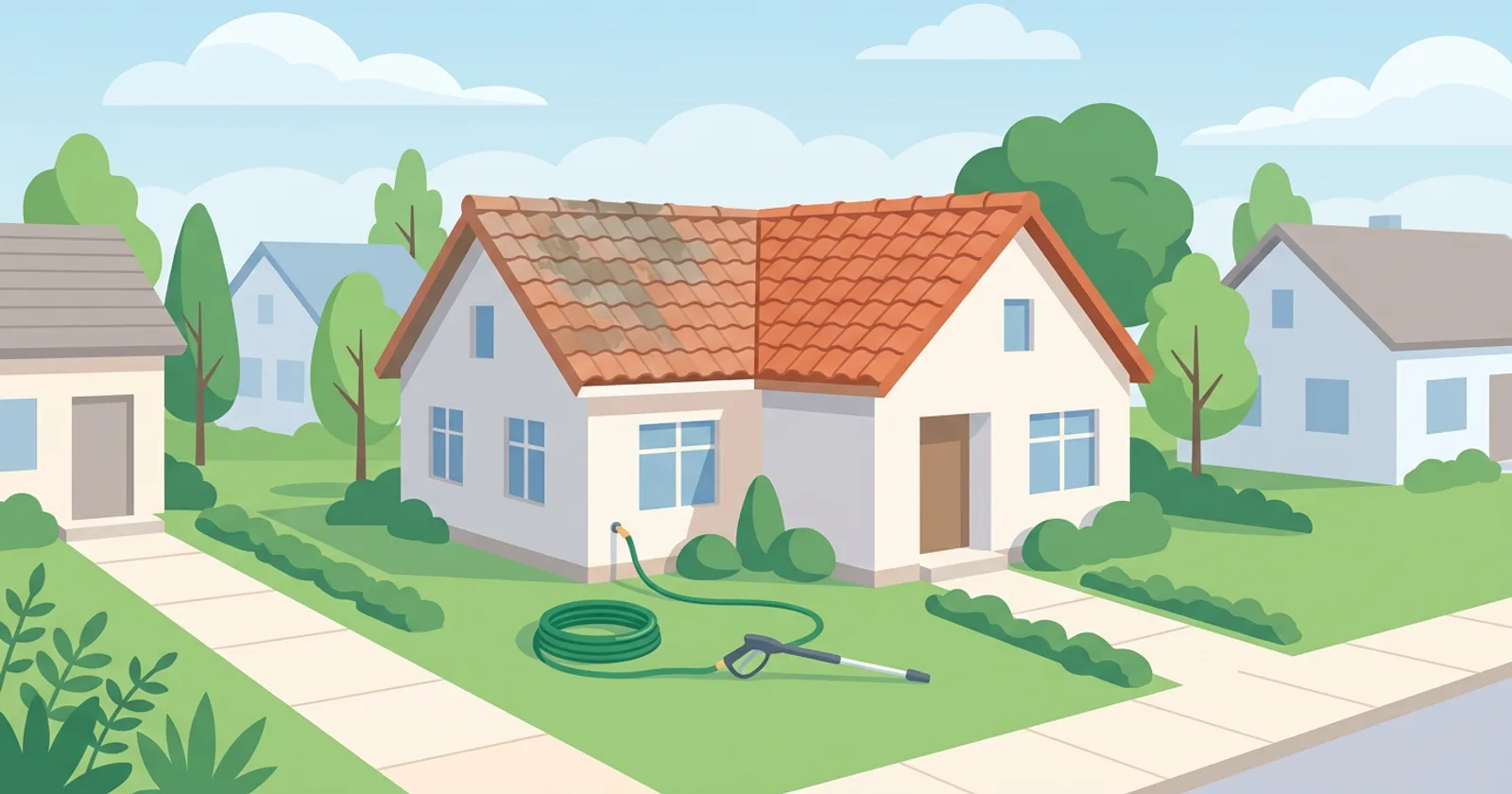
This month, a newer washer on a trade forum asked how to clean a concrete tile roof installed in 1994. The tiles were worn, and the washer had heard many different answers. Experienced pros told him, kindly, to pass on the job.
If you own a tile roof, you’ve probably heard the same mixed messages. “Never pressure wash tile.” “Just spray it and let it sit.” Here’s what the people who make the tile actually say.
Clay and concrete aren’t the same
The tile industry group’s FAQ says clay tile with a matte or glazed finish is “essentially maintenance-free.” Concrete tile is “very low maintenance” too. It rarely needs treatment, though a pro can do low-intensity pressure washing if you want.
The bigger point: growth on tile is cosmetic. The group’s technical expert says algae, moss and dirt don’t affect the tiles or their ability to protect your house. An HOA may require cleaning, he notes, but the roof itself doesn’t need it.
What tile makers allow
| Source | Tile | Method | Warnings |
|---|---|---|---|
| Tile Roofing Industry Alliance (expert answer) | Concrete and clay | Pressure washing by a qualified pro; diluted chlorine optional, plain water often works | Stay at or below 1,300 psi to avoid surface damage |
| Eagle Roofing (concrete tile maker) | Concrete | Water first, at no more than 1,200 psi; cleaner only in the most diluted form | Cleaner must suit concrete; some products change the tile’s pH or etch it |
| Ludowici (clay tile maker) | Clay | Soft washing; it suggests hiring a softwash pro | No high pressure near laps and flashings; don’t spray under tiles, wash upward or let cleaner dry |
The clay maker adds one more useful tip. If the first pass doesn’t lift the growth, apply more cleaner and repeat. Don’t reach for more pressure.
So “never pressure wash tile” isn’t quite right. “Never blast tile” is.
What breaks tiles: feet
The makers’ warnings focus as much on feet as on water. One concrete tile maker says tile makers often don’t warrant breakage from foot traffic. That’s why it suggests hiring a licensed, bonded roofer instead of climbing up yourself.
For pros, that maker says to step on the bottom three inches of each tile, where the tile below supports it. Keep your feet parallel to the ridge and stay off hips and valleys to avoid breaking cut tiles. The clay maker gives similar advice: walk on the 2- to 3-inch headlap where tiles overlap.
Some Southern California crews say they use foam pads or foam-bottomed boards to spread their weight. Ask about this before anyone goes up.
Wet tile is slippery. The concrete tile maker says a confident pro “will always wear fall protection.” Federal rules for residential construction call for fall protection for workers 6 feet or more above a lower level (29 CFR 1926.501(b)(13)).
Chalky tiles after a wash
On a concrete tile roof, a white, chalky bloom can be efflorescence. Free lime in the cement reacts with water and air and leaves a white deposit. One concrete tile maker says it’s only on the surface and that rain will wash it away over time.
The industry group’s FAQ says tile color can also soften naturally after long exposure. Its expert warns that pressure above 1,300 psi can damage the tile surface. If your roof looks blotchy after a wash, our guide to telling wash damage from wear that was already there can help.
When to leave old tile alone
- The stains don’t bother you. By the makers’ own account, growth on tile is a looks problem.
- Tiles are already cracked or brittle. Every step risks more breaks. One maker says broken tiles should be replaced quickly so water and sun can’t reach the underlayment. Get a roofer first, a washer second.
- The crew can’t explain its method. A clear answer about pressure, cleaner and footing matters more than a low price.
In the desert, timing matters
The clay maker warns against letting cleaner dry on the tile, since it can leave streaks and a sticky residue. In Phoenix, that’s a real risk. NOAA’s 1991–2020 normals give the city about 111 days a year at 100°F or hotter, with an average summer high near 105°F. Ask for an early-morning start or a cooler-season booking so the crew can rinse before anything dries.
What it costs, and what to ask
Published prices vary. One Phoenix washer lists tile roof cleaning at $500 to $1,200 or more. One Southern California roof cleaner lists concrete tile at $0.50 a square foot, plus $0.25 for clay. That works out to about $1,000 for 2,000 square feet of concrete tile, or $1,500 for clay. An Orange County–Los Angeles firm puts concrete tile around $0.72 a square foot and clay up to about $0.93. See pressure washing costs for other surfaces.
Before you hire, ask:
- What pressure will you use on the tile, and what cleaner?
- How will you walk the roof? Pads or boards?
- Who pays for tiles you crack?
- Will you take photos before and after?
- Will you rinse, and when?
Our questions to ask a house washing company covers insurance and the rest. If you’re still deciding whether to clean at all, see is roof cleaning worth it. How we check facts: our methodology page.
Sources
- Tile Roofing Industry Alliance, Tile Roof FAQs: tileroofing.org/faqs.html
- Eagle Roofing, Ask a TRI Expert: Can chlorine be used to clean mold off roof tiles? eagleroofing.com/2016/11/can-chlorine-used-clean-mold-off-roof-tiles
- Eagle Roofing, How to Properly Clean Your Concrete Tile Roof: eagleroofing.com/2019/03/how-to-properly-clean-your-concrete-tile-roof
- Eagle Roofing, How to Properly Walk on a Tile Roof: eagleroofing.com/2025/03/how-to-properly-walk-on-a-tile-roof
- Eagle Roofing, Efflorescence and How It Affects Your Concrete Tile Roof: eagleroofing.com/2017/05/efflorescence-affects-concrete-tile-roof
- Ludowici, FAQs (Cleaning, Part 1): ludowici.com/resources/faqs
- OSHA, 29 CFR 1926.501, Duty to have fall protection: osha.gov/laws-regs/regulations/standardnumber/1926/1926.501
- NOAA NCEI, 1991–2020 annual/seasonal climate normals, Phoenix Sky Harbor (USW00023183): ncei.noaa.gov/data/normals-annualseasonal/1991-2020/access/USW00023183.csv
- Valley Pro Power Wash, Roof Cleaning Phoenix AZ: valleypropowerwash.com/roof-cleaning-phoenix-az-cost-tile-roofs-tpo-roofs
- First Class Roof Cleaning, roof cleaning prices: firstclassroofcleaning.com
- KC Power Clean, Tile Roof Cleaning Orange County & Los Angeles: kcpowerclean.com/roof-cleaning
- Community discussion, PressureWashingResource forum, Concrete tile cleaning questions (Oct 2026): pressurewashingresource.com/community/t/concrete-tile-cleaning-questions/41188