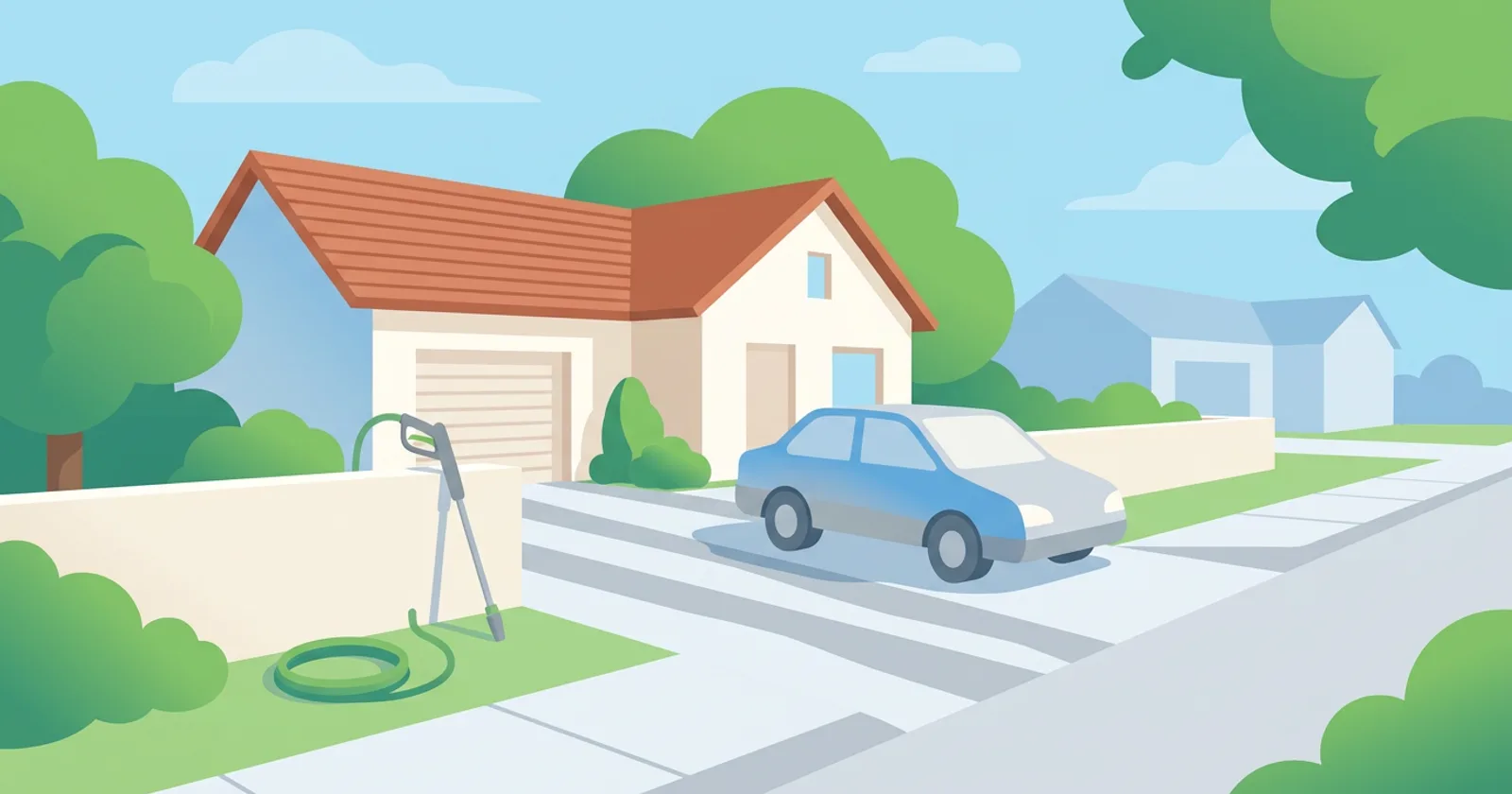
You paid for a clean driveway and got a zebra: light and dark bands from the garage to the street. Here’s what happened, whether it fades, and how to ask the crew to make it right.
Why the stripes appear
Think of a pressure washer wand like a single crayon. The crew is trying to color a whole driveway with one narrow tip, sweeping back and forth. Wherever the passes don’t overlap evenly, a ribbon of grime stays behind.
The light bands are where the spray scoured the surface; the dark bands are where it glanced or missed. Usually, more dirt simply came off in some paths than others.
One pressure washer maker sums up the problem: with a regular nozzle you move it up and down, so cleaning comes out uneven. It calls holding the nozzle at the same distance all the time “humanly impossible.” Another maker’s driveway guide warns that stopping and starting can leave uneven lines.
This is exactly what happened to one homeowner on a pressure washing forum. Their longtime landscapers offered a driveway wash on the side, and the crew left what the owner called “hundreds of streaks.” One reply blamed the crew for using a wand for everything instead of a surface cleaner, and another agreed.
Wand marks vs. surface cleaners
A wand is a precision tool. It’s great for corners, edges and oil spots, but clumsy on a big flat slab.
A surface cleaner looks like a small round lawn mower. Inside, a bar with a nozzle at each end spins under water pressure. Because the housing holds the nozzles at a fixed height, makers say it removes the streaks and uneven cleaning a wand leaves. Two consumer models list a cleaning path of 11 and 12 inches. That’s like swapping the crayon for a paint roller.
Surface cleaners can stripe too, though. One surface cleaner manual says that if striping or swirl marks appear, slow down. If they continue, the nozzles may be clogged. A pro would know to check both.
What you’re seeing, and whether it fades
| What you see | Likely cause | Will it fade? | What fixes it |
|---|---|---|---|
| Straight light and dark bands | Wand passes that didn’t overlap evenly | Not reliably; the dark bands are still dirt | Re-clean the whole slab with a surface cleaner |
| Swirls or stripes after a surface cleaner | Moving too fast, or clogged nozzles (per a surface cleaner manual) | Not reliably | Slower, overlapping passes; clear the nozzles |
| Dark blotches the day after | Slab may not be fully dry yet | May lighten as it dries | Wait a dry day or two before judging |
| Faint lines that don’t wipe away | Possible etching, per pros in one community thread | Not reliably | Ask a pro to look; see our damage guide |
The dark blotches row comes from a real case. In March 2026, a washer in Central Illinois cleaned a driveway, porch and walks and post-treated them. Two days later, the customer texted a photo of spotty, dark patches. The washer noted it “hasn’t been super sunny or warm” and wondered if the slab simply hadn’t dried. Another washer asked whether the concrete had been sealed before. So if your driveway looks blotchy right after a cool, cloudy wash, give it a dry day or two before you call.
Etching is a different story. In one community thread, a pro saw faint lines on driveways only four or five years old. Other pros said the concrete was etched, not dirty, and that newer concrete needs much less pressure. If you suspect etching, our guide to telling wash damage from damage that was already there covers how to check and how to raise it.
How to ask the crew to come back
Asking for a fix is normal, and a good company would rather redo the work than lose a customer. Keep it simple:
- Wait until it’s dry. Judge the driveway after a dry day, not while it’s wet.
- Take photos in daylight from a few spots, including one wide shot that shows the pattern.
- Ask, don’t accuse. Something like: “The driveway came out streaky. Could you come back and go over it with a surface cleaner?”
- Ask what tool they’ll use. If the answer is the same wand, it may make sense to pay a concrete specialist instead.
If the crew won’t respond or claims the marks were already there, the damage guide walks through the next steps. For what a driveway job usually costs, see our pressure washing cost guide.
How to avoid stripes next time
Stripes are mostly a tool-choice problem, so settle it before anyone starts:
Ask how they clean flat concrete. You want to hear “surface cleaner,” with a wand only for edges and spots. Add it to your questions to ask a house washing company.
Watch for the red tip. One pressure washer maker calls the 0-degree tip highly aggressive and warns that damage to surfaces can happen quickly. It has no place on a whole driveway.
Skip hot midday sun. One maker’s driveway guide suggests working in sections in direct sun to prevent water spots or uneven drying, and cloudy days or early mornings so soap doesn’t dry too fast.
Mention newer concrete. If your slab is only a few years old, say so. Pros in the community thread above said it needs much less pressure.
Stripes aren’t a permanent scar, just a sign the cleaning came out lopsided. For how we check our facts, see our methodology.
Sources
- Kärcher, Surface Cleaners for Pressure Washers: kaercher.com/us/pressure-washer-surface-cleaners.html
- Kärcher, 11” Surface Cleaner product page: kaercher.com/us/accessories/11-surface-cleaner-87558480.html
- Greenworks, 12-inch Small Surface Cleaner manual: greenworkstools.ca/cdn/shop/files/12-inch_Small_Surface_Cleaner_Manual.pdf
- Greenworks, How to Pressure Wash a Driveway: greenworkstools.com/blogs/greenworks-blog/how-to-pressure-wash-a-driveway-greenworks
- Alkota, What Do Different Nozzles for Pressure Washers Do?: alkota.com/resources/blog/what-do-different-nozzles-for-pressure-washers-do
- Community discussion, Pressure Washing Resource forum (Mar. 2026), dark blotches after a driveway clean in Central Illinois: pressurewashingresource.com/community/t/help-what-caused-this-spotty-dark-coloration-after-clean/40763
- Community discussion, r/pressurewashing (May 2026), faint lines on newer driveways: reddit.com/r/pressurewashing/comments/1tqmjm8