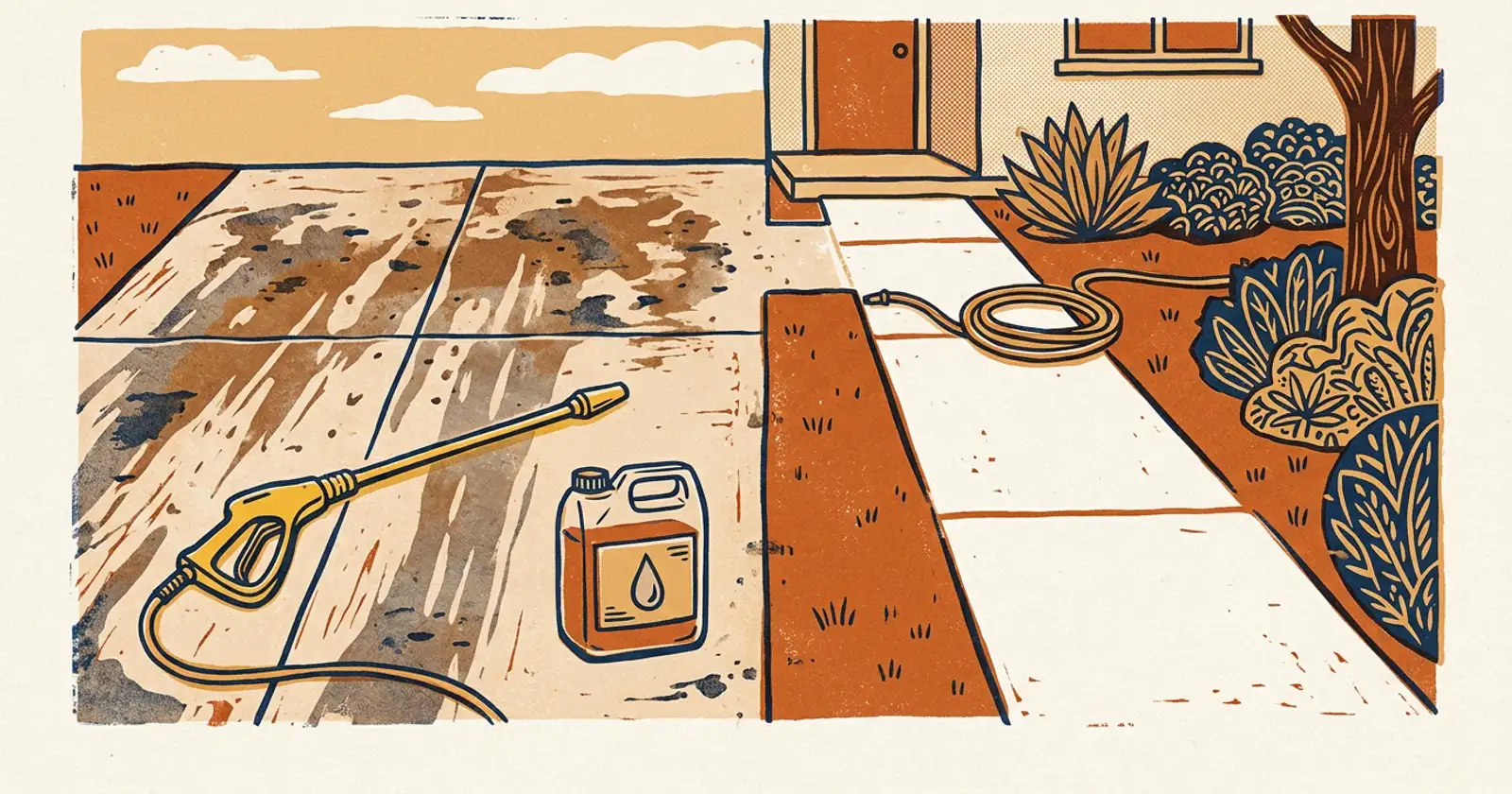
A new washer on a trade forum had this happen on his own driveway. He went over it twice with a 4-gallon-per-minute machine, a bleach mix and a surface cleaner, and could barely tell a difference. More than 30 replies later, one of the simplest was to test one spot before changing anything else.
Check 1: Is it dirt at all?
In that thread, the poster said every driveway in the neighborhood had similar dark “shadows.” One washer said driveways facing opposite directions don’t usually grow the same patterns of algae. Another suggested the marks were in the concrete itself, from the pour. A third read the parallel dark lines as tire rubber, which he said degreaser and pressure should handle.
Hit one dark area with the wand, and put a stronger cleaner on another. If neither changes anything, the marks may be in the concrete rather than on it. Our guide to damage vs wear that was already there helps you tell the difference.
Check 2: Is it growth that needs a cleaner?
Moss and lichen are growths, not dirt, so they can look unchanged after a water-only pass. Oregon State University Extension gives a homeowner recipe for moss on pavement:
- 1 cup of household bleach and 1 cup of liquid dish or laundry detergent in 1 gallon of water
- Let it sit at least 5 minutes, then rinse thoroughly with a garden hose
- Cover nearby plants first, never mix bleach with ammonia, and wear gloves and goggles
Lichen is a different problem. UW-Madison plant pathologists describe crust-type lichens as growths that “adhere tightly to the surface upon which they grow.” Our water-only wash guide explains why rinsing alone leaves concrete blotchy.
Check 3: Is it a stain with its own fix?
Some marks need a specific cleaner, not more washing:
- Brown leaf shadows: see tannin stains on concrete.
- Orange dots after a lawn treatment: see rust spots from fertilizer.
- Dark, slick patches where cars park: see oil stains on concrete.
Check 4: Did the cleaner have the strength and time to work?
In the forum thread, the replies kept coming back to two things: how strong the mix was when it reached the concrete, and how long it sat. One washer worked out that the poster’s mix was diluted a second time by his injector, to at most about 0.7%. He said that was too weak for most concrete where he worked. Whatever product you use, follow its label for mix and dwell time, and don’t let it dry on the surface.
Check 5: Is your machine the bottleneck?
A pressure washer maker’s manual explains the two numbers. Higher pressure (PSI) means more stripping power. Higher flow (GPM) means more rinsing power. One homeowner electric model is rated at 1.1 GPM. The forum washer’s machine was rated at 4 GPM, about 3.6 times the water per minute, which means a lot more rinsing power.
The thread didn’t recommend more pressure. Washers there warned that running 3,500 to 4,000 psi through a surface cleaner can etch the top of the concrete. One said he cleans concrete at about 1,800 to 2,000 psi. Uneven passes can also leave stripes on the driveway.
When a pro is the cheaper option
Two washers publish concrete rates:
| Washer | Concrete rate | Minimum | 600 sq ft driveway |
|---|---|---|---|
| Kansas City | $0.25 / sq ft | $300 per visit | $150 at the rate, $300 with the minimum |
| Nashville | $0.22 / sq ft | $149 | $132 at the rate, $149 with the minimum |
For a 600-square-foot two-car driveway, the bill comes to $149 to $300 after the minimums. If you’ve already spent one weekend on it, that can compare well with a second rental. Bigger driveways get cheaper per foot, as our big-driveway pricing guide explains.
For how we check every number here, see our methodology.
Sources
Based on 7 sources · How we price
- Oregon State University Extension, How can I get rid of the moss on my pavement?: extension.oregonstate.edu/node/198846
- UW-Madison Plant Disease Diagnostics Clinic, Lichens (UW Plant Disease Facts D0072, revised 04/13/2026): pddc.wisc.edu/2021/05/28/lichens-2
- Simpson, pressure washer operator’s manual (PSI and GPM definitions): simpsoncleaning.com/wp-content/uploads/7114140-11x17-1.pdf
- Greenworks, 1800 PSI 1.1 GPM electric pressure washer: greenworkstools.com/products/1800-psi-1-1-gpm-cold-water-electric-pressure-washer
- KC Splash, residential pricing: kc-splash.com/pricing
- Southern Pro Exteriors (Nashville), pricing: southernproexteriors.com
- Community discussion, cannot get driveway clean: pressurewashingresource.com/community/t/cannot-get-driveway-clean/39746