Here’s why it happens and what the “eco” labels really mean. We also cover how to protect your plants without skipping the cleaner.
Why water alone leaves it patchy
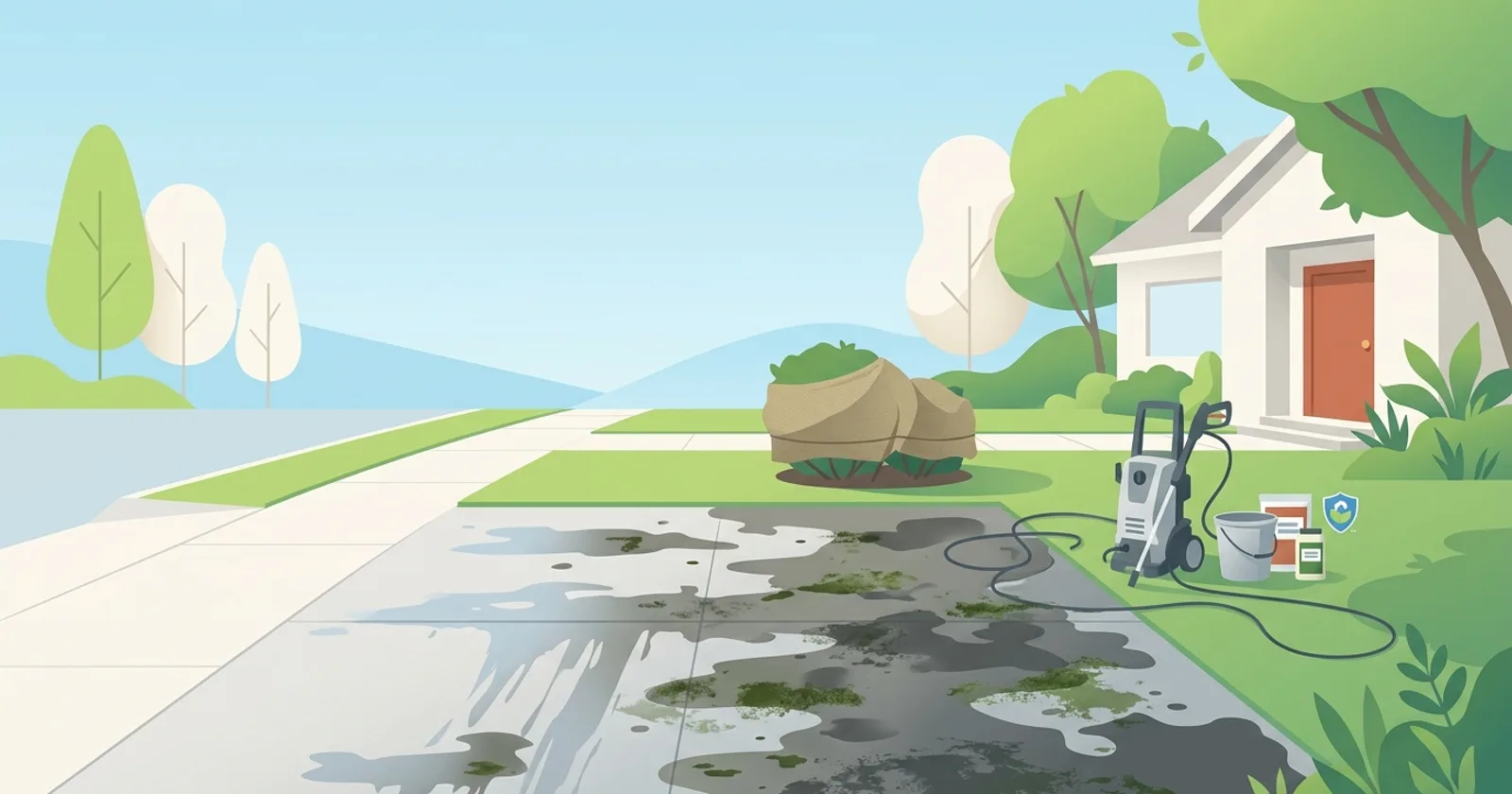
Dark patches on a driveway or walk are often not dirt. An Oregon State University Extension guide for the Pacific Northwest says algae grows on walls, sidewalks and patios in shady spots. It says moss grows throughout the region.
Pressure can knock that growth back. The same guide even lists pressure washing for algae on patios. But it adds a catch. To keep it from returning, you also have to cut back the shade and damp that feed it.
Think of it like mowing weeds instead of pulling them. The top comes off, so the slab looks cleaner for a while. Whatever survives can grow back unevenly, and the slab turns blotchy. Bleach-based house washes are sold to do the other half of the job. One label says it kills mold and mildew “down to the roots,” then gets rinsed off. Protecting water matters more beside a lake. See cleaning a dock or seawall without polluting the lake.
That matches what washers see. In an April 2025 thread on a pressure washing forum, a homeowner ran water and a surface cleaner over a dark driveway. The stains stayed. Replies blamed two things: a small machine, and no pretreatment. In a March 2026 thread, commenters warned about untreated concrete in the Pacific Northwest. It often grows back in patterns, possibly within a year. Others said the humid Southeast sees the same thing.
Stripes are a different problem
Not every bad result comes from skipping the cleaner. In an October 2024 thread, a washer did a driveway with water only at the customer’s request. Stripes showed up a week later, after the homeowners sealed it. Commenters split. Some blamed the missing chemicals. Others said the thin lines looked like etching from too much pressure on newer concrete. No cleaner would have fixed that.
So before you blame the water, look at the pattern. Straight light and dark bands are technique. Our guide to driveway stripes after pressure washing covers them. Marks that won’t wash away may be damage. See wash damage vs damage that was already there. Fall tannin marks are another cause. See leaf stains on concrete and pavers.
| What you see | Likely cause | What helps |
|---|---|---|
| Even dust, pollen or loose mud | Surface dirt | Water alone is often enough |
| Dark green or black patches in shade | Algae, mildew or moss left behind | A cleaner labeled for it, a rinse, and less shade |
| Patches back within months | Growth survived the wash | Post-treatment, plus trimming shade |
| Straight light and dark bands | Uneven wand or surface cleaner passes | An even re-clean |
| Faint lines on newer concrete | Possible etching | Less pressure; ask a pro to look |
| Dark spots where cars park | Oil | A degreaser, not more pressure |
For the last row, see our guide to oil stains on concrete.
What “eco” options really mean
If you want something gentler, EPA’s Safer Choice label is the one to know. EPA reviews every ingredient in a labeled product, whatever its percentage. It checks each against human health and environmental criteria. There’s also an outdoor use version for products likely to bypass sewage treatment and reach the environment directly. EPA’s list of example categories includes brick and masonry cleaners and degreasers.
Here’s the catch. A product that claims to kill mold, mildew or algae is likely a pesticide in EPA’s eyes. With limited exceptions, EPA must register it before it can be sold. So a cleaner can be gentle and still not be a killer. If killing growth is the goal, look for an EPA registration number on the label. EPA’s separate Design for the Environment logo marks antimicrobial products that also meet extra health and environment criteria. Whether a crew needs a license to apply these is its own question. See our piece on soft washing and pesticide licenses.
Protect plants instead of skipping the cleaner
Most “no chemicals” requests are really about the garden, which is fair. Maryland extension horticulturists say chlorine bleach can harm landscape plants. Their advice:
- Wet the plants first so any drift is diluted.
- Don’t let the solution dry on leaves. Rinse it off right away.
- Cover with care. Plastic sheeting helps. But in the sun it can magnify the rays and burn leaves.
One bleach-based house wash label says the same. Spray nearby plants with water before and after use. It also warns that the product is toxic to fish, so keep runoff out of storm drains. A good crew will tell you its plan before it starts. Add it to your questions to ask a house washing company.
When water-only is fine
Water alone is a reasonable choice for sunny concrete with no green or black growth. That means just dust, pollen or fresh mud. Lichens, the crusty gray-green spots, are usually not a problem and can be left alone, per the same OSU guide. Before winter, sealing a concrete driveway against salt is a separate job.
If your slab is shaded, damp or already patchy, ask for a quote both ways. Then you can choose knowing what water-only will and won’t do. For how we check these facts, see our methodology.
Sources
Based on 7 sources · How we price
- Oregon State University Extension, Solve Pest Problems, Moss on Roofs & Walkways: solvepestproblems.oregonstate.edu/moss
- EPA, Learn About the Safer Choice Label: epa.gov/saferchoice/learn-about-safer-choice-label
- EPA, Safer Choice Outdoor Use Label fact sheet (Sept. 2024): epa.gov/system/files/documents/2024-09/safer-choice-outdoor-use-label_factsheet.pdf
- EPA, What Is a Pesticide?: epa.gov/minimum-risk-pesticides/what-pesticide
- EPA, Learn About Design for the Environment (DfE) Certification: epa.gov/pesticide-labels/learn-about-design-environment-dfe-certification
- Ask Extension, Maryland Home & Garden Information Center, Power washing a house using bleach: ask.extension.org/kb/faq.php?id=315323
- Mold Armor E-Z House Wash label (EPA Reg. No. 4091-19): moldarmor.com/wp-content/uploads/2022/06/Product-Label-8.pdf