A window cleaner on a trade forum shared a job like this. A longtime customer asked him to clean her unstained, gray ipe deck. At one point she decided to put the money toward composite boards instead. He cleaned it in the end, but her reason for wanting out stood: the upkeep. The deck had been sanded twice, oiled and cleaned many times. That’s the real choice with ipe: how much the brown color is worth to you.
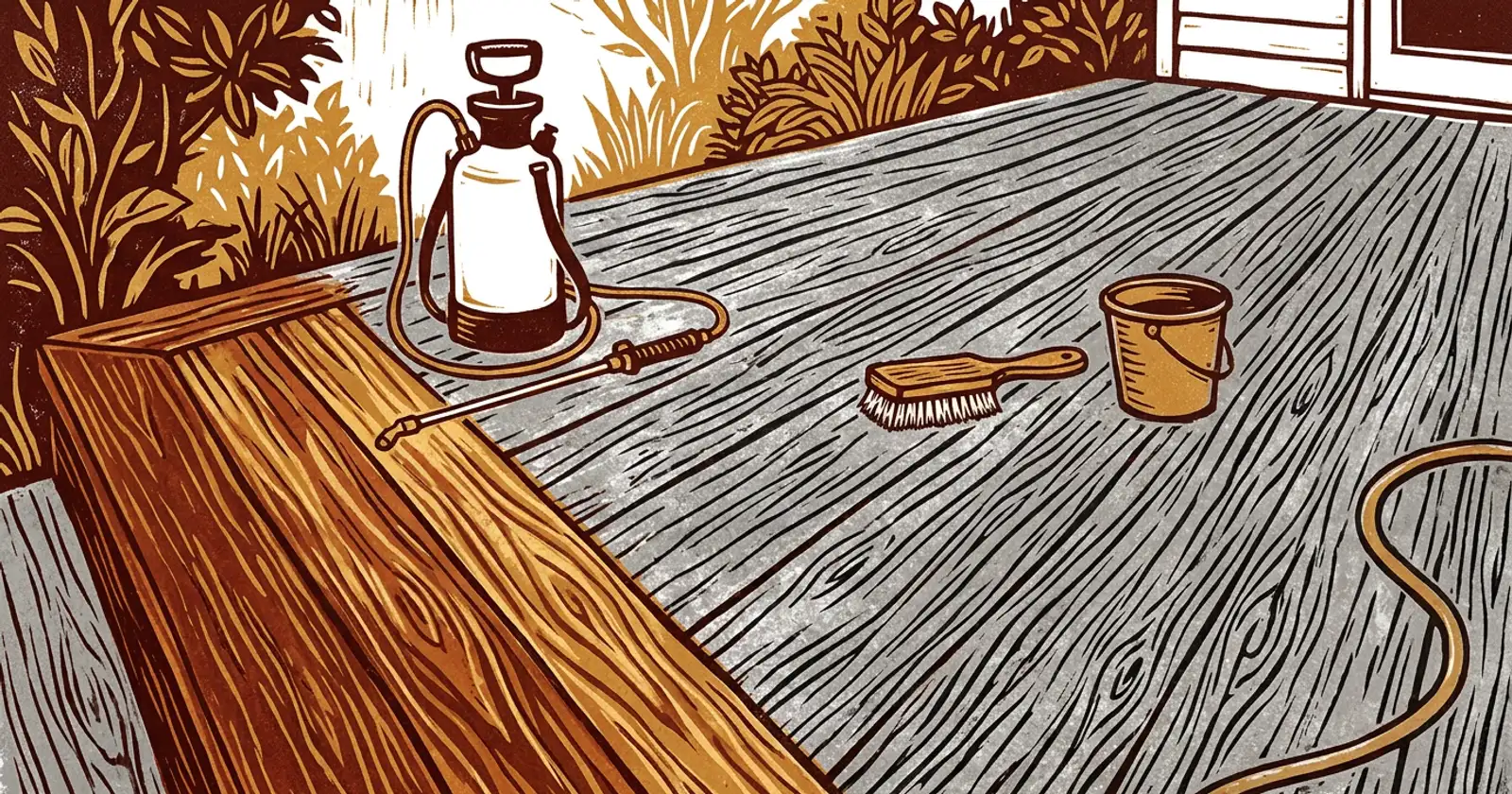
Gray is a look, not damage
One hardwood decking seller says UV light breaks down the surface fibers, and “the wood underneath remains structurally sound.” If you like the silver look, no finish is required. You just clean off dirt, mildew and pollen now and then.
That gives you two paths:
- Keep it gray. Sweep often and clean at least once a year. One finish maker says a yearly cleaning is the rule, and spring and fall is better.
- Keep it brown. Clean, brighten, let it dry, then oil. The seller says most decks need oil every one to two years.
The cleaning method hardwood sellers describe
- Clear the deck and the gaps. One seller says clearing the gaps lets water drain.
- Wet the boards and nearby plants with plain water. A second decking seller does this first to avoid streaks.
- Apply a hardwood deck cleaner and keep it wet. On that seller’s own job, the cleaner sat for 30 minutes.
- Scrub with a stiff brush, never metal bristles. Work along the grain, then rinse.
- Brighten. A brightener neutralizes the cleaner and removes tannin discoloration, one seller says.
- Let it dry. A finish maker says to wait at least 24 to 48 hours. It wants wood moisture below 15% before oiling.
This is the same clean-brighten-dry order that softwood decks follow. Our deck prep guide covers it step by step.
How much pressure, if any
Here the sources don’t agree. One finish maker recommends against pressure washers on hardwood. It says they can leave streaks and raise the grain. One decking seller’s care page says to stay at or below 1,200 psi. That seller’s blog suggests 1,500 to 2,000 psi with the widest fan tip, 8 to 10 inches away. The forum washer used a 1,500 psi fan tip and his customer was happy.
The safe middle ground: let the cleaner do the work, then rinse at the lowest pressure that does the job. Keep the tip moving with the grain. Stripes usually mean an uneven wand, and one seller suggests a rotary surface cleaner for more even results. Our guide to pressure washing damage helps you tell marks from wear.
Why finish behaves differently on ipe
Ipe is very dense, so it can’t soak up much finish. A finish maker’s oil for dense hardwoods leaves “no surface film.” It says any oil not absorbed within 10 to 20 minutes must be wiped off. A seller warns that leftover oil leaves a sticky surface, and that one thin coat beats a heavy one. So ask any crew which product they’ll use, and whether it’s made for dense hardwood.
The finish maker also warns that oily rags can catch fire on their own. Put them in a sealed metal container filled with water.
What it costs
We found no washer who publishes a separate price for ipe. These are wood-deck rates, with a finish maker’s list price for doing the oil yourself.
| Option | Published price | 300 sq ft deck |
|---|---|---|
| Pro cleaning as the prep step, LA-area painter | $0.50–$1.50 per sq ft | $150–$450 |
| Pro wood deck clean with brightener, Kansas City washer ($300 minimum) | $1.50 per sq ft | $450 |
| Pro wash, stain and seal on a sound deck, Reno painter | $1.00–$2.50 per sq ft | $300–$750 |
| DIY hardwood oil (DeckWise Ipe Oil, 250–300 sq ft a gallon) | $74.30 per gallon | 1–2 gallons, $74–$149 |
Oiling takes more time than washing. One decking seller’s crew of four spent about 4 hours on a 1,000-square-foot deck with 170 feet of railings. Cleaning took about 1.5 hours, and oiling took about 2.5. Our deck cleaning and staining cost guide covers railings and stairs.
Humid waterfront decks
Around Annapolis, summers run humid. At Baltimore, a nearby long-record NOAA station, average morning humidity is 77% across the year and 84% in August. One seller says shaded decks collect mildew faster, and humid weather slows drying. The finish maker says not to oil when rain is expected within 24 to 48 hours.
Which path is cheaper
Gray is the budget option. You pay for a yearly cleaning, and the wood still lasts. Brown costs a cleaning plus an oil coat every year or two. If upkeep is the reason you’re eyeing composite, see what composite deck care involves before you switch. Have hardwood siding too? Our cedar siding guide covers a gentle wash. For how we check every number here, see our methodology.
Sources
Based on 14 sources · How we price
- Advantage Lumber, Hardwood Deck Care & Maintenance: advantagelumber.com/how-to/hardwood-deck-maintenance
- Advantage Lumber blog, Pressure Washing & Oiling Guide for Hardwood Siding & Decking: blog.advantagelumber.com/2026/08/06/pressure-washing-oiling-guide-for-hardwood-siding-decking
- Advantage Lumber blog, How to Clean an Ipe Wood Deck: blog.advantagelumber.com/?p=8232
- Advantage Lumber blog, Is Your Ipe Decking Grey?: blog.advantagelumber.com/?p=7346
- Advantage Lumber blog, End Sealing vs Oiling: blog.advantagelumber.com/2026/05/25/does-hardwood-decking-need-sealing-understanding-the-difference-between-end-sealing-and-oiling
- ABS Wood, Ipe Wood Deck Cleaning and Finishing: abswood.com/ipe-deck-clean-refinish
- DeckWise, Deck & Wood Cleaner: ipeoil.com/products/deck-wood-cleaner
- DeckWise, Deck & Wood Brightener: ipeoil.com/products/deck-wood-brightener
- DeckWise, Ipe Oil Hardwood Finish: ipeoil.com/products/ipe-oil
- KC Splash, residential pricing: kc-splash.com/residential-pressure-washing-pricing
- AllBright Painting, deck staining cost per square foot: allbrightpainting.com/blog/2026/january/whats-the-deck-staining-cost-per-square-foot-
- True Coat Painting, cost to stain a wood deck: truecoatpaintingnv.com/blog/how-much-does-it-cost-to-stain-a-wood-deck
- NOAA NCEI, Comparative Climatic Data, relative humidity table (data through 2023): ncei.noaa.gov/sites/default/files/2024-11/relhum23.txt
- Community discussion, cleaning a gray ipe deck: pressurewashingresource.com/community/t/expensive-ipe-wood-deck/40820