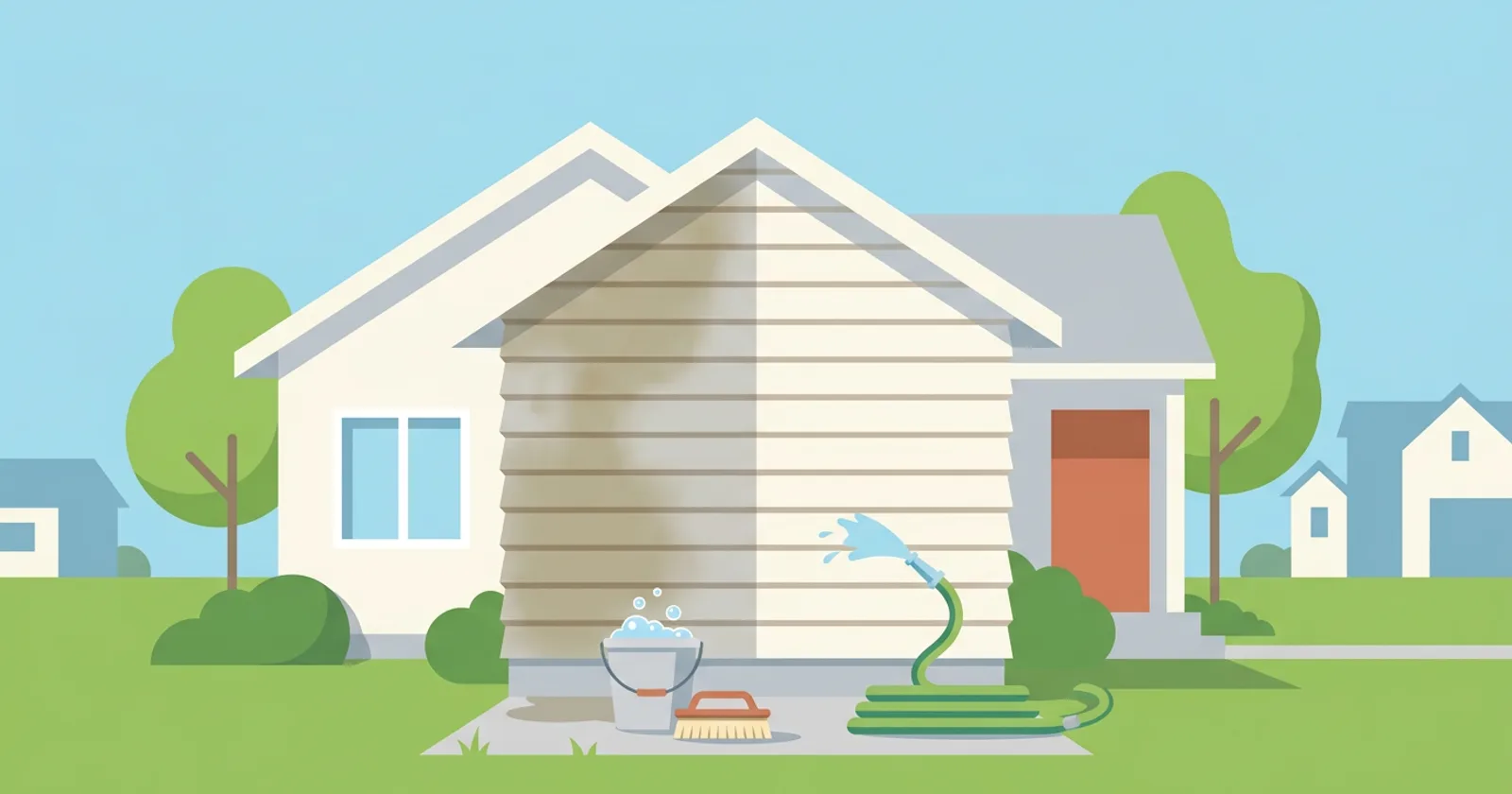
A contractor on a pressure washing trade forum described a cedar house stained about four years earlier. Instead of weathering to a soft gray, the walls had turned brown and black with mold. He asked why it happened and what to change for better results.
Good news first: the Forest Products Laboratory says mold and algae don’t break down the wood itself. Removing them is “a cosmetic issue”. The damage usually comes from cleaning too hard. Treated kindly, wood siding lasts: a lab handbook pictures the Fairbanks House in Dedham, Massachusetts, built in 1637. Most of its white pine clapboard siding was replaced in 1903 and had stood 80 years without paint.
Three ways a cleaning goes wrong
Too much pressure. The lab’s finishing handbook says high-pressure water can “erode the wood as well as strip the paint.” Soft earlywood wears away faster than the harder latewood, leaving a rough surface. The handbook lists 600 to 20,000 psi for stripping paint with water. The cedar lumber trade group warns that power washing off an old finish risks “seriously damaging the wood” and its ability to hold a new one.
Harsh chemicals. Sunlight weakens lignin, the natural glue that holds wood fibers together. Strong cleaners then pull off too many fibers, and penetrating stains don’t soak in as well afterward. The lab says chlorine bleach can pulp the wood into a fuzzy surface. Cleaners with strong alkali (sodium or potassium hydroxide) can do even more damage.
The wrong brush. Skip steel wool and wire brushes. The handbook says tiny iron bits left behind react with cedar’s natural extractives and leave blue-black stains.
Is it mildew or dirt?
Put a drop or two of fresh household bleach on the dark spot. The lab says mildew usually bleaches out in 1 or 2 minutes. If the spot stays dark, it’s probably dirt, which a mild detergent wash usually handles.
Match the cleaner to the stain
| Problem | What the source recommends | Source |
|---|---|---|
| Dirt | Mild, non-phosphate detergent solution | Western Red Cedar Lumber Association |
| Mildew, mold, algae | Oxygen bleach cleaner (sodium percarbonate) preferred over chlorine bleach | USDA Forest Products Laboratory (GTR-202); Western Red Cedar Lumber Association |
| Mildew, per one stain label | 1/3 cup heavy-duty detergent, 1 quart household bleach, 3 quarts warm water | ZAR Deck and Siding Semi-Transparent data sheet |
| Tannin discoloration (stain bleed) | 4 oz oxalic acid per gallon of warm water, 20 minutes, then rinse | Pittsburgh Paints Paramount stain data sheet |
| Blue-black iron stains | 5% oxalic acid solution | USDA Forest Products Laboratory (GTR-202) |
The lab and the cedar trade group prefer oxygen bleach, but one stain label still calls for household bleach. Follow your finish’s label, and never mix bleach with ammonia or ammonia cleaners: the lab warns the fumes can kill.
A gentle clean, the lab’s way
The lab’s shake and shingle siding guide lays out this routine:
- Start weak. Mix the cleaner weaker than the label’s strength and try a small patch. Strengthen it only if it doesn’t clean. A fuzzy surface means it’s too strong.
- Pick a cool, cloudy day, or even a gentle rain, so the cleaner doesn’t dry out.
- Apply it with a garden sprayer, sponge mop or soft-bristle brush. Keep the surface wet for 12 to 15 minutes. Don’t scrub hard.
- Rinse with a garden hose, aimed down, so you don’t force water up behind the courses.
- Protect yourself and your plants. Wear eye protection and rubber gloves, and rinse any splashes off plants or other parts of the house right away.
- Let it dry for several days before any refinishing.
For a whole-house soft wash routine, see how to soft wash your house safely. Decks follow their own steps; see deck prep before you stain.
When a wash isn’t enough
Mildew that keeps coming back is a finish problem. The cedar trade group says restaining “does not solve a mildew problem.” Clean it off, let the wood dry, then refinish with a coating that contains a mildewcide.
Semitransparent stains are easy to renew. The lab says a stiff bristle brush to clear dirt and loose fibers, then a fresh coat, is usually enough. Walls age differently: the lab says these stains usually last 4 to 5 years on a south wall and more than 10 years on a north wall.
Switching a weathered semitransparent stain to a solid-color stain or paint is a bigger job. The old finish and weathered wood have to come off, and the lab calls this one of the few cases where careful power washing by a skilled operator is necessary. If the paint may date from before about 1985, it could contain lead, so don’t sand it.
Hiring someone for cedar
Before you book, ask:
- Which cleaner will you use, at what strength, and will you test a small patch first?
- Will you rinse at garden-hose pressure? The lab says pressure washing cedar should be left to contractors with real cedar experience.
- If you’re washing the roof above my stained siding, how will you keep runoff off the walls and rinse it right away?
More good questions are in what to ask a house washing company, and roof jobs have their own trade-offs in is roof cleaning worth it. If something looks off after a wash, here’s how to tell wash damage from wear that was already there. For prices, see house washing cost. How we check facts is on our methodology page.
Sources
- USDA Forest Products Laboratory, Installation, Care, and Maintenance of Wood Shake and Shingle Siding (FPL-GTR-202): fpl.fs.usda.gov/documnts/fplgtr/fpl_gtr202.pdf
- USDA Forest Products Laboratory, Wood and Wood Products Finishing (Agriculture Handbook 647): fpl.fs.usda.gov/documnts/usda/ah647.pdf
- Western Red Cedar Lumber Association, Care and Maintenance of Western Red Cedar Siding: realcedar.com/siding/care-maintenance
- Western Red Cedar Lumber Association, How to Restore Your Western Red Cedar Siding: realcedar.com/siding/restoration
- Sika (ZAR), Deck and Siding Semi-Transparent product data sheet: usa.sika.com/dms/getdocument.get/908e652c-e294-4188-bd9b-9ff4ce7eae22/zar-deck-and-sidingsemi-transparent.pdf
- PPG Pittsburgh Paints, Paramount Semi-Transparent/Semi-Solid stain data sheet (41-8210X): buyat.ppg.com/rep_pafpainttools_files/Pittsburgh%20Paints%20and%20Stains/41-8210X.pdf
- Community discussion, Stained Cedar House (March 2025): pressurewashingresource.com/community/t/stained-cedar-house/39712