That’s the short version of what extension entomologists and siding makers say. Here’s why the eaves fill up, how to clear them on each type of siding, and why the webs keep coming back.
Why your eaves fill up
Eaves are calm and sheltered, which is what spiders and mud daubers want. University of Minnesota Extension says web-building spiders build in calm, undisturbed places, and that homes near rivers, lakes or fields are more likely to have large numbers of spiders. It also notes that funnel weavers are common across Minnesota, with webs tucked into corners of porches and windowsills as fall arrives. In lake country, more insects means more spiders.
Mud daubers follow the spiders. Utah State University Extension lists their nesting spots as the sides of structures and under window sills and eaves. Mississippi State’s extension explains that they pack each nest cell with paralyzed spiders for their young, and that the mud can stain walls and ceilings.
Which nests are still in use
University of Minnesota Extension says mud daubers are active from about June through August, and the adult females die by the end of summer. Their young stay in the nest and come out the next summer. Mississippi State notes that a grown wasp leaves by cutting a hole through the side of the nest, so a hole means a wasp has already left that cell.
One more wrinkle: blue mud daubers reuse and repair old nests, according to the Minnesota page. An old nest left up can get reused.
The good news is that you don’t need to wait. Minnesota Extension says you can ignore mud dauber nests on a home or remove them with a putty knife, since the wasps don’t defend them.
How to clear them
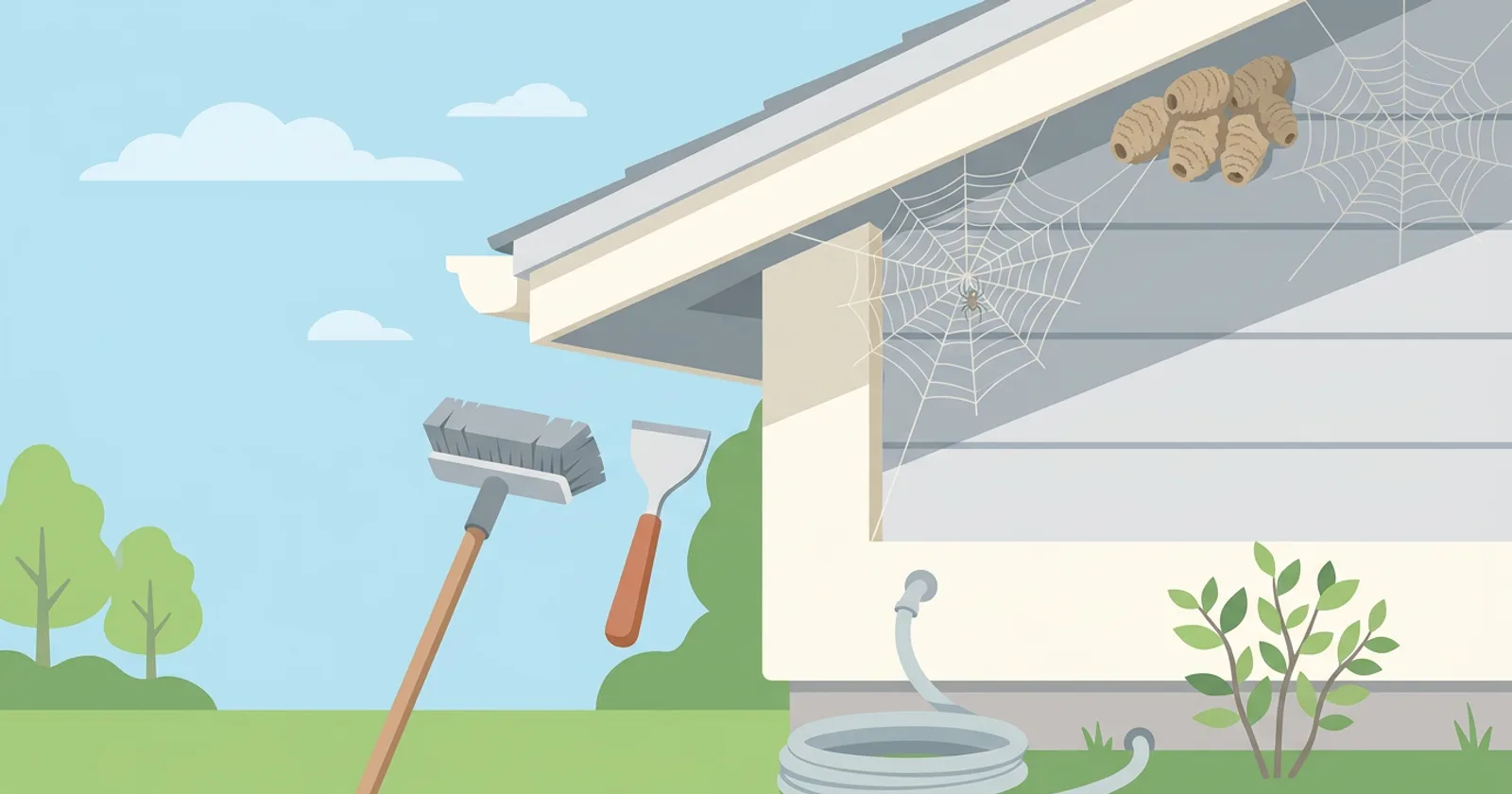
- Webs first. Minnesota Extension suggests a broom, a vacuum or a hard spray of water, and says to remove and destroy any egg sacs you find. A long-handled cobweb duster is one way to reach the eaves; one forum operator below uses exactly that.
- Scrape the nests. Mississippi State recommends scraping nests off, then using a wet cloth and a spray bottle of water on the leftover mud. Utah State suggests doing it early in the morning, wearing gloves and a bee veil, and washing the spot with soap and water afterward.
- Then wash. With the mud gone, a normal low-pressure rinse finishes the job.
Expect some staining where old nests sat. In one community thread, a washer asked to clean more than 100 nests off an EIFS wall, and replies warned that long-standing nests can leave marks, so set expectations with the owner before starting. Mississippi State also cautions that some wasp sprays contain petroleum products that can stain walls.
What your siding can take
Pressure is where a quick web clean turns into a repair. Here’s what three siding makers say.
| Siding | Maker’s guidance | For webs and nests |
|---|---|---|
| Vinyl (CertainTeed) | Doesn’t recommend power washing; avoid prolonged or high-pressure rinsing of open ventilated areas | Brush and hose; go easy near vented soffits |
| Fiber cement (James Hardie) | Wide fan tip, at least 6 feet from the wall, under 1,500 psi; no hard scrub brushes | Soft brush, then a gentle rinse |
| EIFS (Dryvit) | Rinse normally below 600 psi; 45° or wider tips up close; a ladder leaned on the wall can damage it | Scrape gently, rinse cold, keep ladders off |
EIFS, the foam-backed system, needs the most care. In another community thread, a homeowner planning to hit stucco and foam trim with a 3,000 psi washer was warned in several replies to skip high pressure on the foam. Our guide to washing your house safely yourself covers low-pressure methods.
Will they come back?
Yes, at least some. Minnesota Extension says it isn’t practical to make a home spider-free. What helps:
- Change the lights. Insects draw spiders. The extension suggests yellow bulbs, less light overall, and pole lights aimed at the door instead of fixtures on the wall.
- Trim and tidy. Cut back shrubs touching the house, keep grass short near the foundation, and clear wood and brick piles.
- Seal and screen. Caulk cracks and gaps and replace poor screens. Utah State suggests checking for new mud dauber nests from early summer into fall.
Some washers treat repeat web visits as an add-on. In a 2026 thread on a pressure washing forum, an operator weighed a webs-only route for lake communities, and another said they grab webs with a cobweb duster, then rinse with plain water.
What to ask a washer
- Will you brush webs and scrape nests by hand before washing?
- What pressure and tip will you use on my siding?
- If old nests leave stains, is that covered or extra?
- Do you offer quick web touch-ups between full washes?
For the rest of the call, use our questions to ask a house washing company, and see what a house wash costs. If you’re worried about marks after the job, our guide to wash damage versus damage already there shows how to document them. Birds are a different case; see our guide to bird droppings and nests you can’t remove. Here’s how we check every claim.
Sources
- University of Minnesota Extension, Spiders: extension.umn.edu/garden-and-home/home-maintenance/household-insects/spiders
- University of Minnesota Extension, Fall’s hidden architects: funnel weavers in Minnesota gardens (2025): extension.umn.edu/yard-and-garden-news/falls-hidden-architects-funnel-weavers-minnesota-gardens
- University of Minnesota Extension, Solitary wasps: extension.umn.edu/garden-and-home/yard-and-garden/yard-and-garden-insects/solitary-wasps
- Mississippi State University Extension, Bug’s Eye View: Organ Pipe Mud Dauber (2020): extension.msstate.edu/newsletters/bugs-eye-view/2020/organ-pipe-mud-dauber-vol-6-no-20
- Utah State University Extension, Mason, Potter and Mud Dauber Wasps: extension.usu.edu/planthealth/ipm/notes_nuisance/mason-potter-mud-dauber-wasp
- CertainTeed, How to Clean Vinyl Siding: certainteed.com/siding/how-clean-vinyl-siding
- James Hardie, Technical Bulletin #20, Cleaning Primed and ColorPlus Siding (2018): images.homedepot-static.com/catalog/pdfImages/e2/e2a8a8f2-bb30-4b6a-9cf3-f76c4a979c8a.pdf
- Dryvit, DS152 Cleaning and Recoating: dryvit.com/resource/download/ds152_Cleaning_and_Recoating.pdf