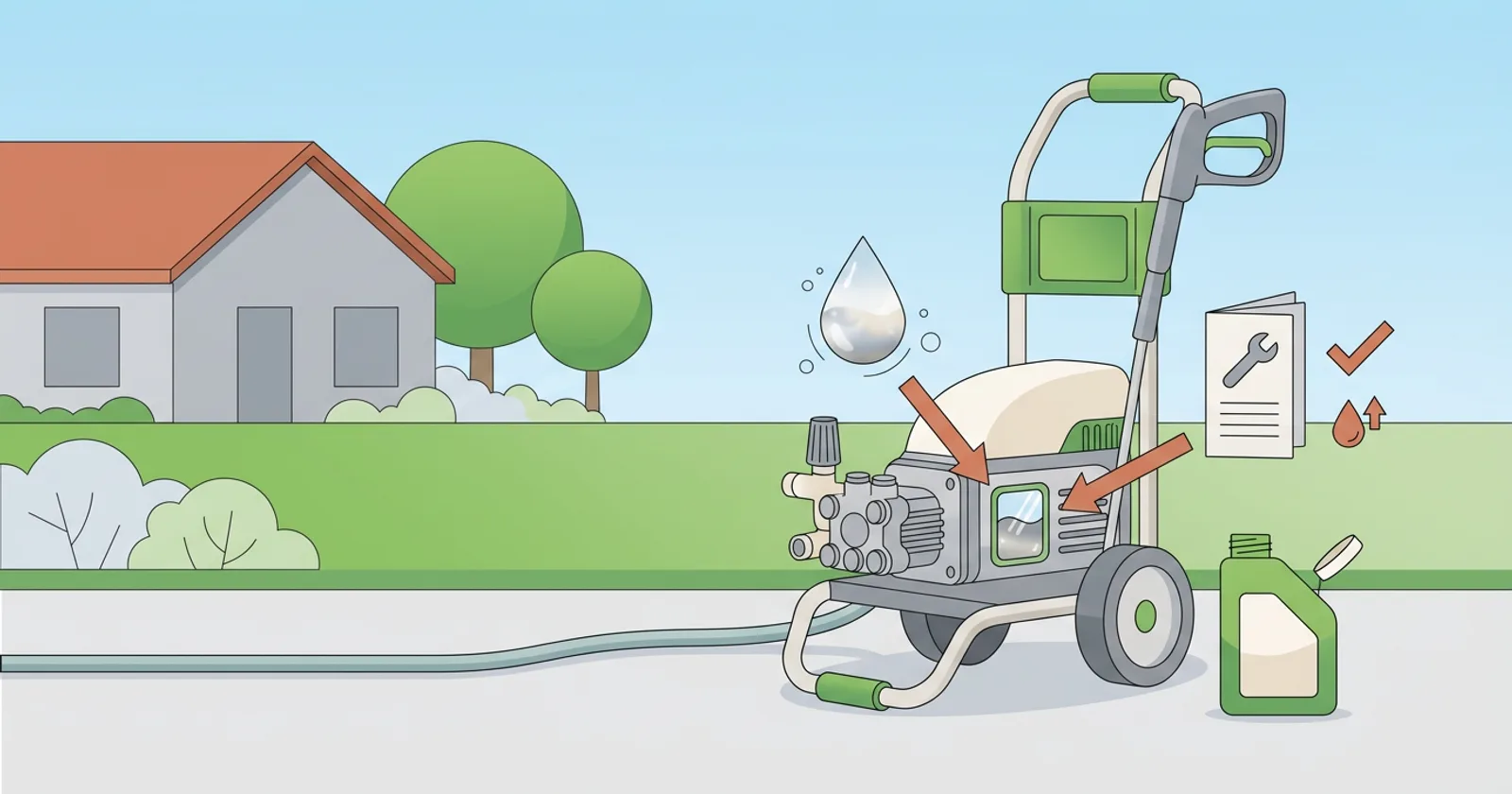
Owners in an online pressure washing community ask about this often. One had inherited a used county machine with white oil. Another found gray, cement-colored oil only 35 hours into a new pump.
What each color usually means
When the color in the sight glass shifts, here’s how to read it:
- Milky white or tan. One pump maker says that if a pump keeps running after its low-pressure and high-pressure seals wear, water can travel back along the plunger rod and past the oil seal. The water turns the oil milky first. In severe cases, the maker warns, it can damage the drive end. A service manual from the same maker also says a milky-white color can be a sign of water getting in through the oil seals.
- Gray or chalky, and it won’t separate. None of the makers’ guides we checked describes gray oil by name. Operators in the community thread read it as the same water-in-oil emulsion, and one noted that emulsified oil may take a long time to separate, if it ever does. Treat it like milky oil.
- Black. That manual says black oil can mean the oil has lost much of its lubricating ability, the pump is overheating, or the wrong oil type is in it.
- Glittery or metallic. If you see flecks or a metallic shine, stop running the machine and have a pump shop open it up. That’s our caution, not a maker’s spec.
One more cause is worth ruling out. A commenter in another community thread said detergent oil can look milky in the sight glass, which hides a real water leak. That’s another reason to use the oil your manual names.
Condensation or a seal leak? The one-change test
A second pump maker’s troubleshooting chart lists water in the crankcase with two causes. The first is worn packing (the water seals). The second is humid air condensing into water inside the crankcase. Its fix for the second one is to change the oil more often and use the non-detergent oil it specifies.
Humid air doesn’t take much cooling to give up its water. The National Weather Service defines the dew point as the temperature air must be cooled to in order to reach saturation. In Jackson, Mississippi, NOAA’s 1991–2020 hourly normals put a mid-July 6 a.m. temperature at 74.4°F and the dew point at 71.7°F. That’s only 2.7 degrees apart. A machine parked in a garage or trailer in air like that has very little margin.
So try this:
- Drain the milky oil and refill to the middle of the sight glass with the oil your manual names.
- Run a normal job and check the glass at the end of the day.
- Still clear? Condensation is the likely cause. Shorten your oil change interval and store the machine somewhere drier.
- Milky again within hours? Water is getting past the seals. Plan a seal kit, and expect the shop to check the plungers and the oil seals too.
- Water dripping under the pump or oil leaking between the crankcase and manifold? One maker says oil in that spot means worn oil seals that need replacing.
Our winterizing routine covers freezing, which is a different problem from oil, but dry storage helps both.
How often to change pump oil
Intervals vary a lot by pump. Here’s what the makers’ own pages say.
| Maker and source | Oil it names | First change | After that |
|---|---|---|---|
| Cat Pumps oil FAQ | Its own ISO 68 hydraulic oil; no alternatives | 50 hours | Every 500 hours |
| Cat Pumps 35PFR service manual | Its own pump oil | 50 hours | Every 3 months or 500 hours |
| Comet pump repair manual | Comet pump oil; check level every 8 hours | 50 hours | Every 500 hours |
| Simpson pump oil page | Its 15W-40 non-foaming pump oil | 50 hours | Every 100 hours or every 3 months |
| General Pump TSF service instructions | SAE 30 non-detergent | Not stated | Change more often if humid air condenses |
Two patterns stand out. Every source in the table that gives a first change puts it at 50 hours, so a new pump’s first oil change comes early. And two of them add a calendar limit, which matters if you only run the washer a few weekends a year, because condensation doesn’t wait for running hours.
Running a business? Logging hours per machine makes this easy, and the cost of oil and seal kits belongs in your pricing. New operators can add a spare quart of pump oil to the gear list in our guide to starting a pressure washing business. Homeowners choosing a first machine can compare pump types in our electric or gas pressure washer guide.
When to stop running the pump
Shut it down and don’t finish the job if the oil goes milky again right after a change, if water or oil is leaking between the crankcase and the manifold, or if you see metal in the oil. Running on with water in the crankcase is how a seal problem becomes a drive-end problem. When in doubt, take photos of the sight glass and call a pump shop before you start it again.
How we checked these sources is on our methodology page.
Sources
Checked 2026-10-09. Makers’ pages are quoted for what they say about their own pumps. No maker endorses or is endorsed by this site.
- Cat Pumps, Pressure Washer Resource Center, Oil Inquiries: catpumps.com/node/4110
- Cat Pumps, 35PFR plunger pump service manual: catpumps.com/sites/default/files/products/pdfs/35FR1Svc.pdf
- Cat Pumps, R-Series service manual (oil color guidance): catpumps.com/sites/default/files/products/pdfs/R-SeriesSvc.pdf
- Comet, pump repair manual (hosted by a distributor): images.kleen-ritecorp.com/Documents/Manuals/Comet%20High%20Pressure%20Pumps/CP6305090000/Comet%20Pump%20Repair%20Manual.pdf
- General Pump, TSF Series “66” servicing instructions (hosted by a distributor): images.kleen-ritecorp.com/Documents/Manuals/General%20Pump/GPTSF2021/General%20Pump%20TSF2021%20Service%20Instructions.pdf
- Simpson, Premium Pump Crankcase Oil 80138: simpsoncleaning.com/products/pump-oil
- Briggs & Stratton, Pressure washer water pump maintenance: briggsandstratton.com/en-us/support/maintenance-how-to/water-pump-maintenance
- National Weather Service glossary, Dew point: forecast.weather.gov/glossary.php?word=dew%20point
- NOAA NCEI, 1991–2020 hourly normals, Jackson International Airport, Mississippi (USW00003940): ncei.noaa.gov/data/normals-hourly/1991-2020/access/USW00003940.csv
- Community discussion: reddit.com/r/pressurewashing/comments/1k9ghhf
- Community discussion: reddit.com/r/pressurewashing/comments/1n50h6h