A washer on a trade forum described it well. After three slow months, the bleach in his trailer tank was so weak it didn’t touch mildew on the flashing. Another owner said he had 27 drums waiting out the winter in a warehouse. If either sounds like you, here is what the makers say, and what to do about it.
Why bleach goes “dead”
Bleach doesn’t spoil like food. It slowly breaks down into salts and a small amount of oxygen gas. The chlorine industry’s trade group names the main drivers in its storage guide for end users: strength, temperature, metal traces, alkalinity and UV light.
Heat is the big one. The group says the breakdown rate rises 2 to 4 times for every 18°F of extra storage temperature. The trade note above fits that: going from 77°F to 95°F cuts the half-life by almost three-quarters.
Stronger bleach also breaks down faster. The group notes that diluting 12.5% bleach by half soon after delivery slows the breakdown by a factor of four. One chlorine producer’s EPA-registered label for its 15.5% bleach goes further. If you’ll hold it more than 3 days at 70°F, 7 days at 60°F or 14 days at 50°F, the label says you must dilute it to 12.5%.
| What speeds it up | What the makers say to do | Source |
|---|---|---|
| Heat | Keep storage at or below 85°F, ideally under 75°F | Olin product sheet |
| Sunlight and UV | Opaque containers; store under cover, away from sun | Chlorine Institute; Olin SDS |
| High strength | Dilute soon after delivery if you’ll hold it | Chlorine Institute; Olin EPA label |
| Metals (nickel, cobalt, copper, iron) | Plastic piping and valves; titanium is the only suitable metal | Chlorine Institute |
| Old bleach mixed with new | Empty the tank before refilling | Chlorine Institute |
| Time | Buy smaller lots and turn stock over fast | Chlorine Institute; PHTA trade note |
The Tucson problem: summer beats your shed
One chlorine producer says storage areas shouldn’t go above 85°F, and should ideally stay under 75°F. Now look at Tucson. NOAA’s 1991–2020 normals put the average temperature there at 86.1°F in June, 88.2°F in July and 86.9°F in August. That’s the 24-hour average, nights included, and it is already over the line for three months. Tucson also averages about 68 days a year at 100°F or more.
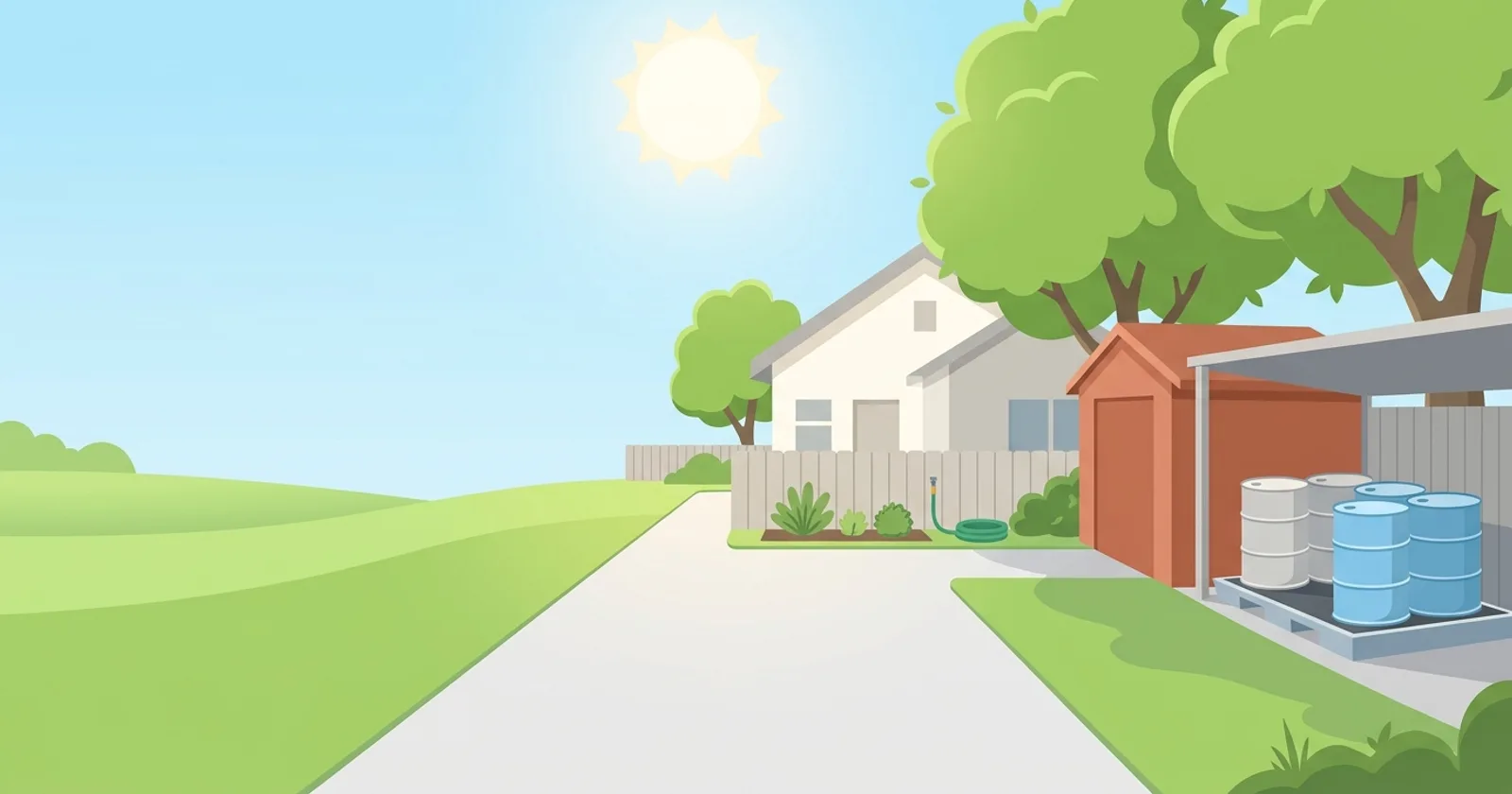
So in a desert summer, a drum in a hot trailer or shed is likely to lose strength fast. That doesn’t mean you can’t wash in Tucson. It means buying small lots often, as the makers advise, and keeping the stock in the coolest, shadiest spot you have. For setting the trailer up safely, see water tank weight, trailer brakes and DOT numbers.
Getting through a slow season
Cold is your friend here. Lower temperatures slow the breakdown, and the trade group says the best storage is the lowest strength, the coldest temperature and the shortest time. A maker’s safety data sheet (SDS) asks for a dry, clean, cool, well-ventilated place under cover, in the original vented container. Another producer’s SDS warns that when bleach is heated, its decomposition products can make containers rupture.
Before winter:
- Run the stock down in the fall instead of buying a fresh drum in September.
- Move drums under cover, out of the sun and away from heat.
- Get bleach out of the trailer tank and lines for the off-season. The trade group wants storage time short and metal contact kept to a minimum, and a warm tank with metal fittings works against both. Our winterizing routine covers the pump.
- Write the delivery date on each drum and use the oldest first.
- Test in spring before you price a job on full-strength mix.
Storing it safely
This part isn’t optional, and it comes straight from the SDS. One producer’s SDS says do not mix bleach with acids, ammonia, alcohol, ethers or hydrocarbons, and do not store it together with acids. Contact with acids releases toxic gas. That matters in a wash trailer if you carry acid-based cleaners, so keep them stored apart from the bleach.
If you have employees, OSHA’s Hazard Communication standard applies. You need the SDS for each chemical where workers can get to it during every shift, a label on each container of hazardous chemicals and training on the hazards. OSHA’s first aid rule also requires quick-drench or eye-flushing facilities in the work area wherever someone can be splashed with corrosive materials. Our article on hiring your first helper covers the employer side.
Whether you need a pesticide license to use bleach on houses is a separate question, covered in soft wash and pesticide licenses. This article is general information, not safety-compliance or legal advice. Your product’s label and SDS come first, and OSHA or your state’s OSHA plan has the final word. For how we check every number, see our methodology.
Sources
Makers’ and agencies’ documents are cited for what they say about their own products and rules. None endorses this site.
- Chlorine Institute, Bleach – Storage Guidelines for End Users: assets.noviams.com/novi-file-uploads/tci/pdfs-and-documents/Bleach_Storage_Guidelines_for_End_Users-ed6f4a1b.docx
- PHTA Recreational Water Quality Committee, Tech Notes: Sodium Hypochlorite (AQUA Magazine, May 2020): info.orendatech.com/hubfs/AQ520-TECH-Notes_Sodium-Hypochlorite-AKA-Liquid-Chlorine-1.pdf
- Olin Chlor Alkali Products, Sodium hypochlorite (bleach) product page (archived): web.archive.org/web/20250217164701/https://www.chemicalonline.com/doc/sodium-hypochlorite-bleach-0001
- US EPA, label notification for Olin High Strength Sodium Hypochlorite EP (Reg. No. 72315-16): www3.epa.gov/pesticides/chem_search/ppls/072315-00016-20120502.pdf
- Olin Corporation, Sodium Hypochlorite 5–17% safety data sheet (2021): labelsds.com/images/user_uploads/Olin%20Sod%20Hypo%2012.5%20SDS%206-14-21.pdf
- Formosa Plastics Corporation, Sodium Hypochlorite Solution safety data sheet (2026): fpcusa.com/content/uploads/2026/04/402-SDS-V5-NAE-EN.pdf
- OSHA, 29 CFR 1910.1200 Hazard Communication: osha.gov/laws-regs/regulations/standardnumber/1910/1910.1200
- OSHA, 29 CFR 1910.151 Medical services and first aid: osha.gov/laws-regs/regulations/standardnumber/1910/1910.151
- Hach, Hypochlorite Test Kit, Model CN-HR: hach.com/p-hypochlorite-test-kit-model-cn-hr/2687200
- NOAA NCEI, 1991–2020 monthly normals, Tucson International Airport (USW00023160): ncei.noaa.gov/data/normals-monthly/1991-2020/access/USW00023160.csv
- NOAA NCEI, 1991–2020 annual normals, Tucson International Airport (USW00023160): ncei.noaa.gov/data/normals-annualseasonal/1991-2020/access/USW00023160.csv