This is a weight and road-rules guide, not legal advice. Rules differ by state, so treat every threshold below as a starting point and check your state DMV and FMCSA before you build.
Start with the water math
The USGS lists one gallon of water at 8.34 pounds. Multiply your tank size by that, and you have the load that sloshes behind you on every job.
| Tank size | Water weight (8.34 lb/gal) | Share of a 3,000 lb trailer brake line |
|---|---|---|
| 50 gal | about 417 lb | 14% |
| 100 gal | about 834 lb | 28% |
| 150 gal | about 1,251 lb | 42% |
| 200 gal | about 1,668 lb | 56% |
| 275 gal (IBC tote) | about 2,294 lb | 76% |
| 525 gal | about 4,379 lb | 146% |
The last column compares water alone with Minnesota’s 3,000-pound trailer brake line, covered below. The trailer frame, tank, machine and gear all come on top.
Read the trailer’s GVWR, not the ad
Every trailer has a gross vehicle weight rating (GVWR). Federal rules define it as the maker’s value for the loaded weight of a single vehicle. It’s printed on the certification label, which on a trailer sits on the forward half of the left side.
Subtract the trailer’s empty weight from its GVWR, and what’s left is all you can carry: tank, water, machine, reels, hose, pumps and chemicals. Small utility trailers fill that gap fast.
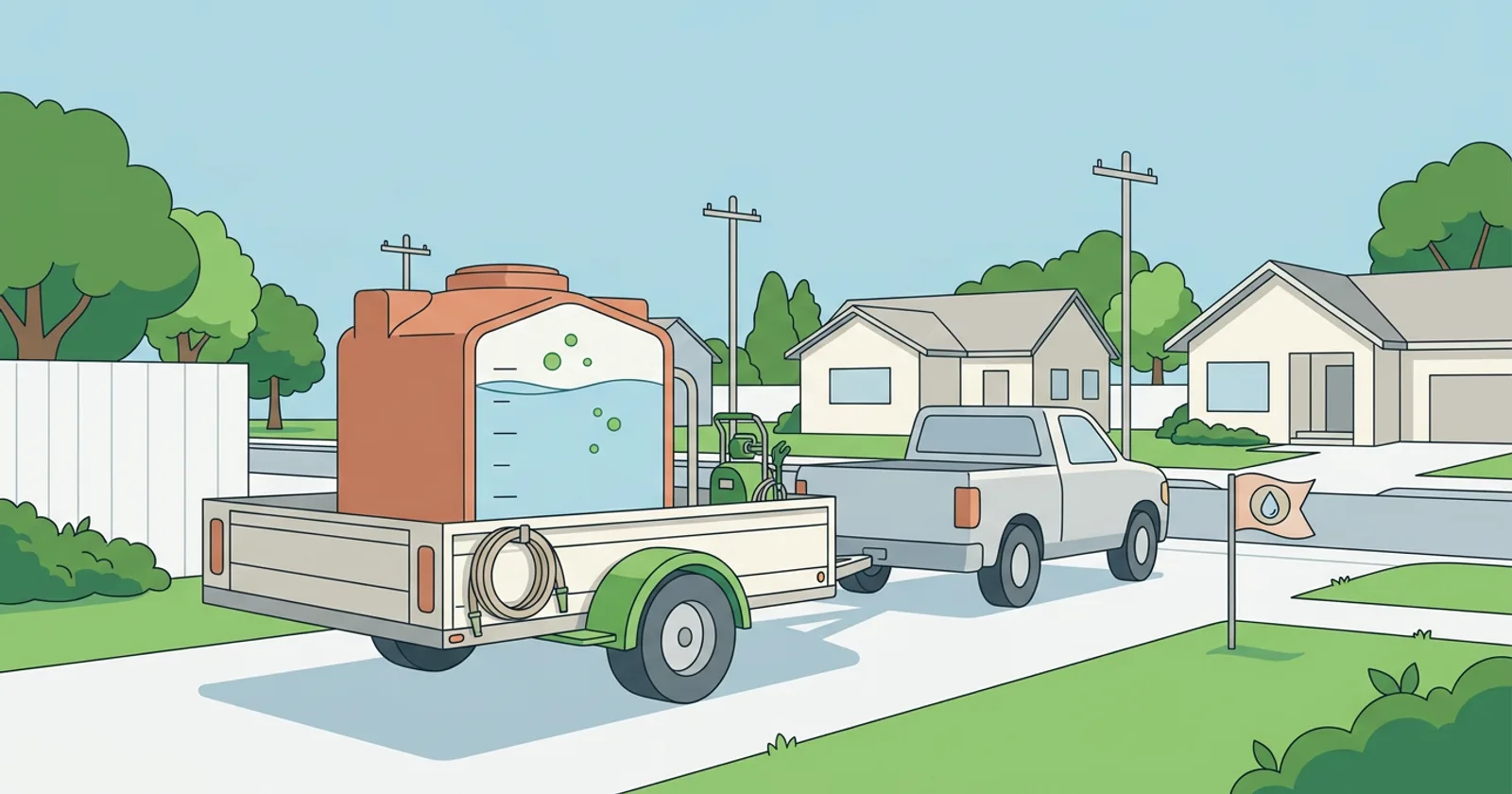
In one discussion on a pressure washing trade forum, a new operator planned a buffer tank on a small 5x8 utility trailer. A reply warned that a 275-gallon tote would put the trailer well over its limit. Others suggested a 100 to 150 gallon tank to start.
Your truck has its own towing and payload limits, too. Check the owner’s manual before you hitch a full tank to it.
Trailer brakes: a state question
Brake rules come from state law, and the weight lines differ. Minnesota is a clear example. Its statute says a trailer with a gross vehicle weight of 3,000 pounds or more needs brakes adequate to stop and hold it. A trailer over 3,000 pounds also needs brakes that will stop and hold it if it breaks away from the truck.
Run the numbers on a 200-gallon tank. The water is about 1,668 pounds. If the trailer, tank, machine and gear add another 1,400 pounds, you’re at 3,068 pounds, past the line in Minnesota. Your state may set its line higher or lower, so look up your own vehicle code or ask your DMV.
When a USDOT number comes in
FMCSA says companies that operate commercial vehicles hauling cargo in interstate commerce must have a USDOT number. The weight trigger is a gross vehicle weight rating or gross combination weight rating, or actual weight, of 10,001 pounds or more, whichever is greater.
Two details catch wash operators:
- It’s the combination. Your truck and trailer are counted together. Say your truck weighs 6,500 pounds and the loaded trailer 3,600. That’s 10,100 pounds, over the line. Ratings count too, so a truck and trailer with big GVWRs can cross it even when they’re running light.
- In-state work can count. FMCSA lists states that require a USDOT number for their own intrastate commercial vehicles. Minnesota, Texas and Wisconsin are on the list. And a Minnesota operator who drives to a job in Wisconsin is crossing a state line, which FMCSA counts as interstate commerce.
FMCSA tells intrastate operators to check with their state agency. Do that before your first paid job, and keep the answer on file. A USDOT number can also bring other duties, so read the FMCSA pages that apply to your setup.
Do you even need the tank?
Many house washes run off the customer’s spigot. Our guide to how much water a house wash uses shows a 4 GPM machine spraying for an hour uses 240 gallons. If the spigot keeps up with your machine, you may not need to haul water at all. In the forum thread above, one reply noted that small direct-drive pumps rely on spigot pressure to feed them, and another said they wouldn’t run a buffer tank with a 4 GPM unit.
A bigger tank earns its weight when a property has no usable spigot or local water rules get in the way. Our article on pressure washing during water restrictions covers that.
Before you buy a trailer, price the whole build against the jobs it will pay for. Our guide to starting a pressure washing business lists real gear prices, and our pricing guide helps you see how many jobs a bigger rig needs to pay back.
For how we checked every number here, see our methodology.
Sources
- USGS, Circular 1268, Conversion factors: pubs.usgs.gov/circ/2004/circ1268/htdocs/text-conversion.html
- eCFR, 49 CFR 571.3 Definitions (GVWR): ecfr.gov/current/title-49/subtitle-B/chapter-V/part-571/subpart-A/section-571.3
- eCFR, 49 CFR 567.4 Requirements for manufacturers of motor vehicles (certification label): ecfr.gov/current/title-49/subtitle-B/chapter-V/part-567/section-567.4
- eCFR, 49 CFR 390.5 Definitions (commercial motor vehicle): ecfr.gov/current/title-49/subtitle-B/chapter-III/subchapter-B/part-390/subpart-A/section-390.5
- FMCSA, Do I Need a USDOT Number?: fmcsa.dot.gov/registration/do-i-need-usdot-number
- Minnesota Statutes 169.67, Brakes: revisor.mn.gov/statutes/cite/169.67
- Community discussion, Pressure Washing Resource forum, First Trailer Build Help: pressurewashingresource.com/community/t/first-trailer-build-help/40628