That’s a real line item for a church budget. Here’s how to size it, what drives the price, and what the committee should get in writing before anyone climbs.
What a church wash costs
Few washers publish church prices, but many publish commercial building rates. A church is priced like any other building: by wall area, height, surface and how hard it is to reach.
| Item | Published price | Who publishes it (area) |
|---|---|---|
| Building walls, soft washed | $0.15 to $0.40 per sq ft | First Choice Power Washing (Lexington, KY) |
| Commercial building washing, by size, height and access | $0.15 to $0.90 per sq ft | Pressure Washing New Jersey (central NJ) |
| Sidewalks and walkways | $0.08 to $0.40 per sq ft | First Choice Power Washing (Lexington, KY) |
| 34-ft articulating boom lift rental | $260 a day | BigRentz (national rental marketplace) |
| 60-ft telescopic boom lift rental | $355 a day | BigRentz (national rental marketplace) |
A quick way to measure. Multiply the building’s outside perimeter by the wall height. A 60-by-100-foot sanctuary has a 320-foot perimeter. With 30-foot walls, that’s about 9,600 sq ft of wall. Gables and a tower add more.
At $0.15 to $0.40 a foot, 10,000 sq ft of wall runs about $1,500 to $4,000. At the New Jersey washer’s top rate of $0.90, the same walls would cost $9,000. That washer says taller or heavily soiled buildings usually cost more. Add walkways and steps at their own per-foot rate.
For a deeper look at per-building budgets, see what property managers pay for building washing.
Tall walls and steeples
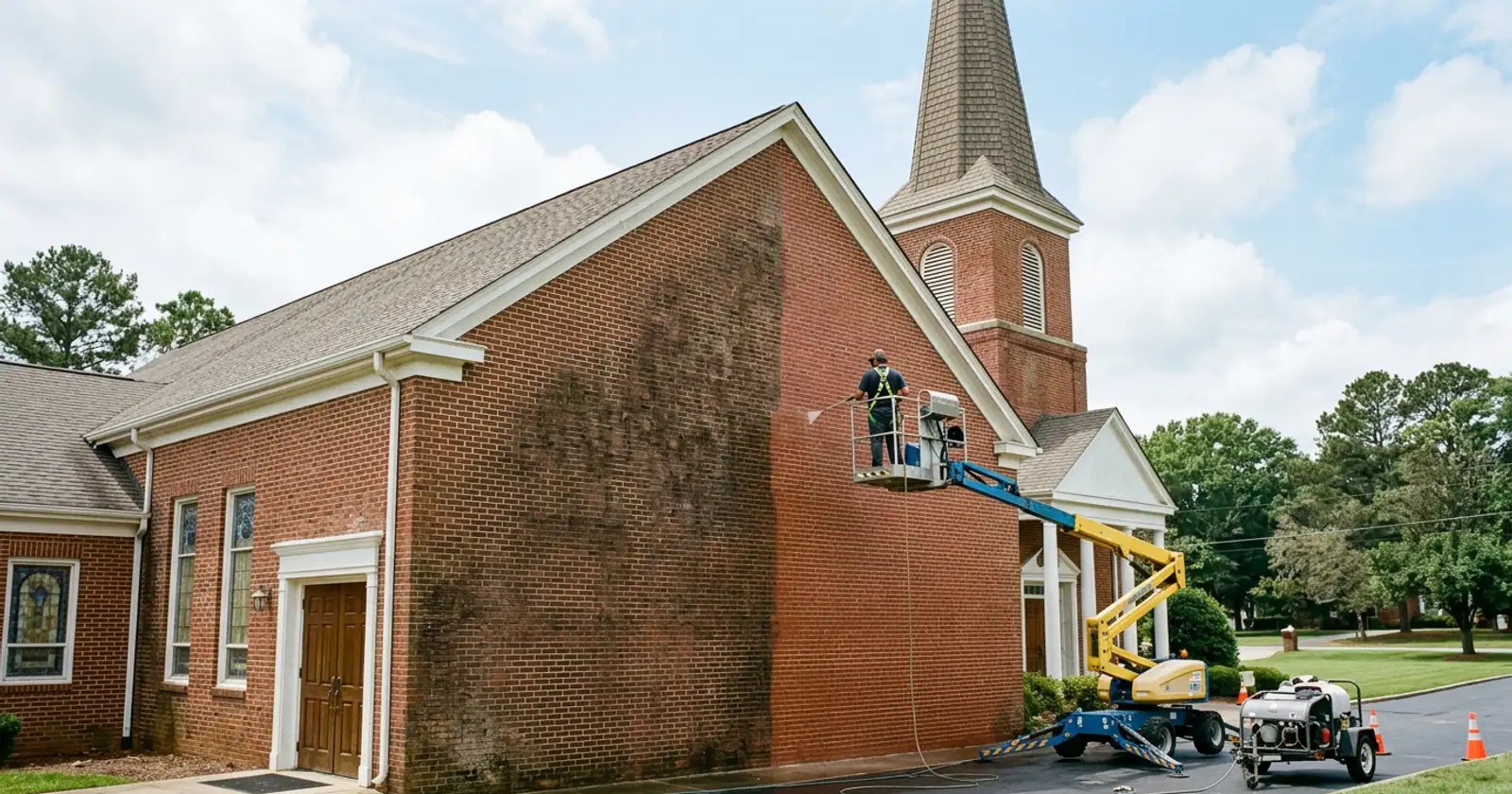
Most church walls can be soft washed from the ground. The crew sprays a cleaner at low pressure and lets it work, so nobody blasts the brick. One South Carolina company describes its steeple application as pressure equal to a garden hose.
Steeples and tall peaks are different. One steeple specialist lists aerial lifts and rope access as its ways up. If the bid needs a lift, ask whether the rental is included. One rental marketplace lists a 60-foot boom at $355 a day. Our drone washing vs lift guide compares a drone crew with a lift crew for very tall work.
Old brick, stone and stained glass
Historic masonry needs a gentle start. The National Park Service’s masonry cleaning brief says to begin at very low pressure, 100 psi or below, even with a garden hose. It says to go no higher than about 300 to 400 psi. It also recommends a small test area first, judged only after the masonry dries. For a listed or historic building, ask the washer to do a test patch before the full job.
Stained glass needs cover. The Park Service’s stained glass brief says leaded glass should always be well protected when chemical cleaners are used outside. It warns against acidic, caustic, abrasive and ammonia cleaners on the glass itself. Restoring large church windows is expensive, so this is the cheapest insurance on the job. Ask the crew how they’ll protect each window.
If you’re seeing dark streaks below the window sills, our guide to black streaks under windows on brick explains what usually causes them.
Volunteers or a contractor?
A volunteer workday can save money on the easy parts: sweeping, rinsing steps, moving planters and picking up debris. The high work is another story. OSHA’s aerial lift fact sheet says only trained and authorized people are allowed to operate a lift. A rented lift with an untrained volunteer is a risk the church carries.
When you hire, a church insurer warns that if a contractor lacks proper insurance, you could end up paying for injuries or damage the contractor causes. A church management company says the certificate should name the church as an “additional insured” on the vendor’s policy.
Who signs, and what goes in writing
Before you sign, check your bylaws or denomination’s rules for who can approve a contract. In many churches that’s the trustees or a property committee, not the person who found the washer. Then put these in the contract:
- Scope: which walls, the steeple, walkways and gutters, and whether the lift is included.
- Method: soft wash on siding and brick, a pressure limit, and a test patch on old masonry.
- Protection: how windows, doors, plants and the parking lot will be covered and rinsed.
- Schedule: working days that avoid services, funerals and weddings. One North Carolina company says it plans around all three.
- Insurance: a current certificate naming the church as additional insured, received before work starts.
Our interview script for washing companies has more questions to ask on the phone. Washers bidding the job can see our guide to bidding commercial jobs. Our methodology page explains how we check these numbers.
Sources
Based on 12 sources · How we price
- First Choice Power Washing, How Much Does Apartment Complex Pressure Washing Cost in Lexington, KY: firstchoicepowerwashing.com/how-much-does-apartment-complex-pressure-washing-cost-in-lexington-ky
- Pressure Washing New Jersey, Building Washing and Curb Appeal: pressurewashingnewjersey.com/building-washing-curb-appeal
- BigRentz, Boom Lift Rental: bigrentz.com/equipment-rentals/boom-lifts
- Elite Softwash & Pressure Cleaning, Church & Steeple Cleaning: elitesoftwashllc.com/commercial/church-and-steeple-cleaning
- Church Steeple Washing: churchsteeplewashing.com
- Carolinas Premier Softwash, Church Exterior Cleaning: carolinaspremiersoftwash.com/commercial-pressure-washing/church-exterior-cleaning
- Fresh Look Power Clean, Church Exterior Cleaning: freshlookpowerclean.com/church-exterior-cleaning
- National Park Service, Preservation Brief 1, Assessing Cleaning and Water-Repellent Treatments for Historic Masonry Buildings: nps.gov/orgs/1739/upload/preservation-brief-01-cleaning-masonry.pdf
- National Park Service, Preservation Brief 33, The Preservation and Repair of Historic Stained and Leaded Glass: nps.gov/orgs/1739/upload/preservation-brief-33-stained-leaded-glass.pdf
- OSHA, Aerial Lifts fact sheet: osha.gov/sites/default/files/publications/aerial-lifts-factsheet.pdf
- Brotherhood Mutual, Hiring a Contractor for Ministry Construction Projects: brotherhoodmutual.com/safety-library/general-contractor-hiring
- Smart Church Solutions, Why Every Church Must Require a Certificate of Insurance: smartchurchsolutions.com/resources/blog/why-every-church-must-require-a-certificate-of-insurance