Maybe it starts at the pump: you spot a mildew-streaked canopy, start measuring in your head, and the manager asks for a price.
This guide walks through what each kind of client asks for, how to split the bid into pieces, and a checklist to run before you send it. For per-square-foot benchmarks, see how much to charge for pressure washing.
What commercial clients ask for before you bid
A certificate of insurance. Ask for the client’s exact requirements in writing, including whether they want to be named as an additional insured, then have your agent send the certificate the same day. The U.S. Small Business Administration lists general liability insurance as coverage for “any business.” It also notes that businesses with employees must carry workers’ compensation, and that rules vary by state.
A schedule that protects their sales. Restaurants don’t want you near the patio at brunch, and gas stations can’t close a pump island at rush hour. Ask early which windows are off-limits.
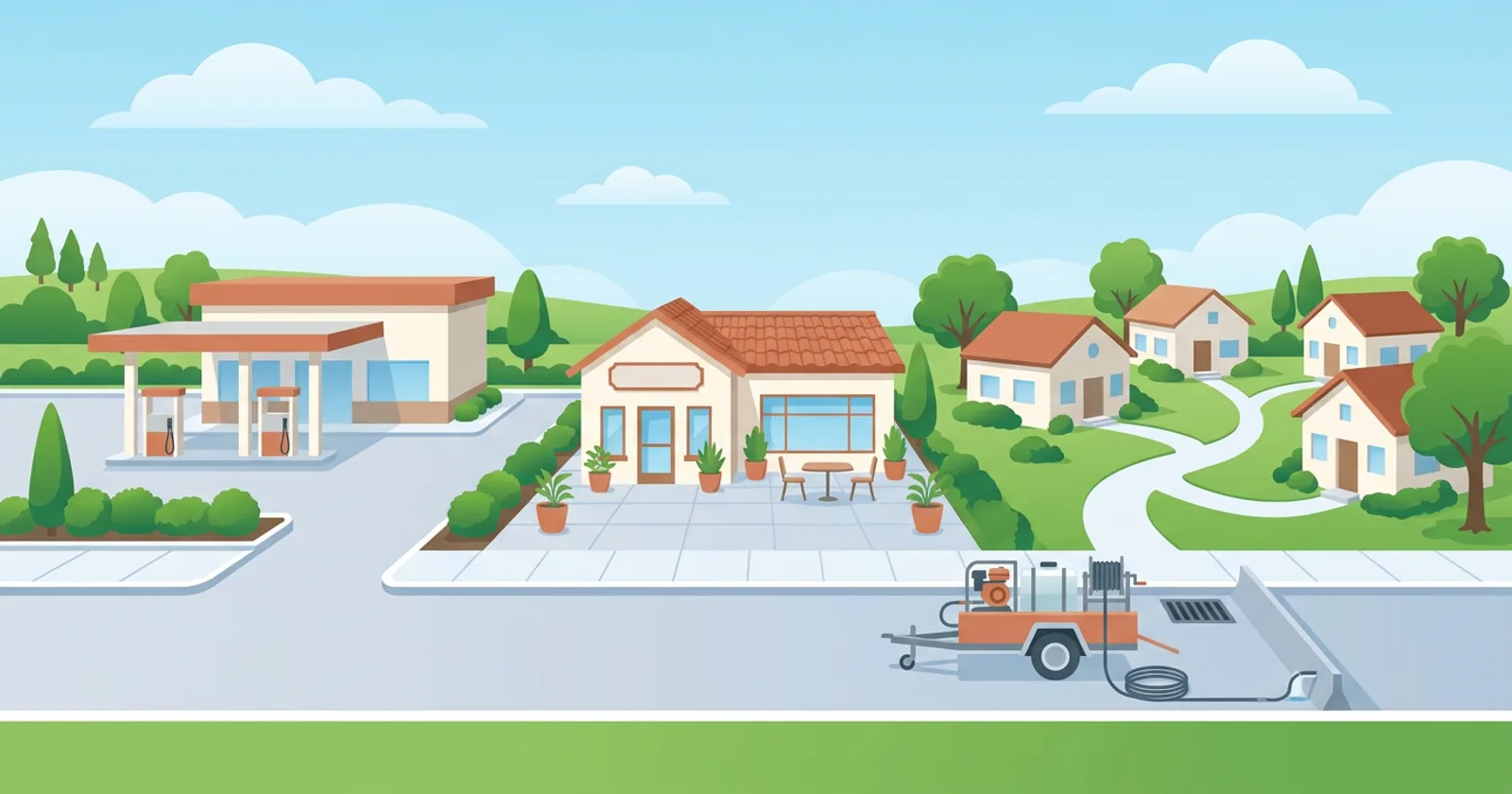
A wash water plan. This is the one that surprises new operators. Storm drains usually don’t go to a treatment plant. The EPA says polluted runoff in city storm systems is “often discharged, untreated, into local water bodies.” Your city’s own rules decide what you can do, so read them before you bid.
One city’s rules, as an example
Monroe, North Carolina, publishes a wash water pamphlet for pressure washers. Under its rules:
- Fuel islands and gas stations, parking lots, restaurant back areas, grease bins, dumpsters and kitchen exhaust or hood vents are all on its list of wash water that can’t go to a storm drain or a landscaped area.
- Where storm-drain discharge is allowed at all, no soaps or chemicals may be used and the water must be below 110°F.
- A permit is needed for most commercial operations, and violators could face local or state fines.
- Collected water can go to the city sanitary sewer only after contacting the city, often with pretreatment, or to a liquid-waste company, which the city notes usually charges by the gallon.
Your city’s rules will differ, so treat Monroe as a model of the questions to ask, not the answer. For how much water a job can produce, see how much water a house wash uses. This isn’t legal advice; call your local stormwater or public works office.
Bidding gas stations
A gas station isn’t one surface. Split it up or you’ll underbid. In one recent forum thread about a large station, replies said to list the pieces before you name a number and to price the drive as its own cost.
- Canopy and fascia: height and access drive the time. Note whether you need a lift.
- Pump islands and pads: gum, oil drips and spilled soda. See our guide to oil stains on concrete for what lifts and what won’t.
- Dumpster pad: a separate line, because it often needs degreaser, hot water and full water capture.
- New concrete: ask when it was poured. In one forum thread about a station quote, a washer warned that running a surface cleaner on new concrete can etch it.
Offer a one-time deep clean plus an optional recurring visit, so the manager has a smaller first number. Once most of your bids close, your close rate and booked-out weeks can tell you when to raise your prices.
Bidding restaurants
- Hoods: hood cleaning is its own specialty. If you’re not trained in it, don’t touch the hood itself.
- Dumpster pads and back doors: price these as their own lines, with a written plan for capturing and disposing of the water.
- Sidewalks and patios: usually before opening or after close, with an after-hours charge.
A West Virginia operator new to the trade asked on a trade forum how to price a fast-food restaurant’s sidewalks, picnic area, tables and grease storage. One reply offered a simple fix for not knowing your speed: clean a sample area first. You learn your real time, and the client sees the result.
Bidding HOAs
You’re selling to a volunteer board that must justify every dollar to its neighbors.
- Walk the property with the manager or a board member, so you don’t miss a hidden court or a pool deck.
- Line items: flatwork, curbs, fencing and entrance signs, each priced separately.
- Paperwork: ask whether they need a certificate of insurance and a W-9. The IRS says Form W-9 provides your taxpayer ID to whoever must report payments to you.
- Format: a one-page scope with photos of similar work, and a seasonal schedule billed in equal monthly amounts.
| Client | What they ask first | Split into its own line |
|---|---|---|
| Gas station | Insurance certificate; no full shutdown | Canopy, pump islands, dumpster pad, travel |
| Restaurant | Off-hours work; wash water plan | Dumpster pad, back door, patio, after-hours |
| HOA | Insurance, W-9, a board-ready scope | Flatwork, curbs, fencing, signs |
Your commercial bid checklist
- Water source: test the spigot’s flow; a weak one may mean a buffer tank.
- Wash water plan: find every storm drain near the work, and write down how you’ll block, capture and dispose of the water.
- Surfaces: new or old concrete, stamped, painted. List each separately.
- Time windows: write down exactly what the client says.
- Insurance: confirm their limits and wording before you send the bid.
- Scope lines: be specific about where each area starts and ends.
- Recurring option: add it as a separate, optional line.
If you’re still setting up the business, start with starting a pressure washing business. Our methodology page explains how we source our numbers.
Sources
- City of Monroe, NC, Best Management Practices for Vehicle Washing, Pressure Washing, Equipment Washing and other Outdoor Surface Cleaning Operations: monroenc.org/DocumentCenter/View/2038/Pressure-Washing-and-Mobile-Car-Washing-PDF
- U.S. EPA, Stormwater Discharges from Municipal Sources: epa.gov/npdes/stormwater-discharges-municipal-sources
- U.S. Small Business Administration, Get business insurance: sba.gov/business-guide/launch-your-business/get-business-insurance
- IRS, About Form W-9: irs.gov/forms-pubs/about-form-w-9
- Community discussion: PressureWashingResource.com, “First timer Pressure washing” (February 2025): pressurewashingresource.com/community/t/first-timer-pressure-washing/39579