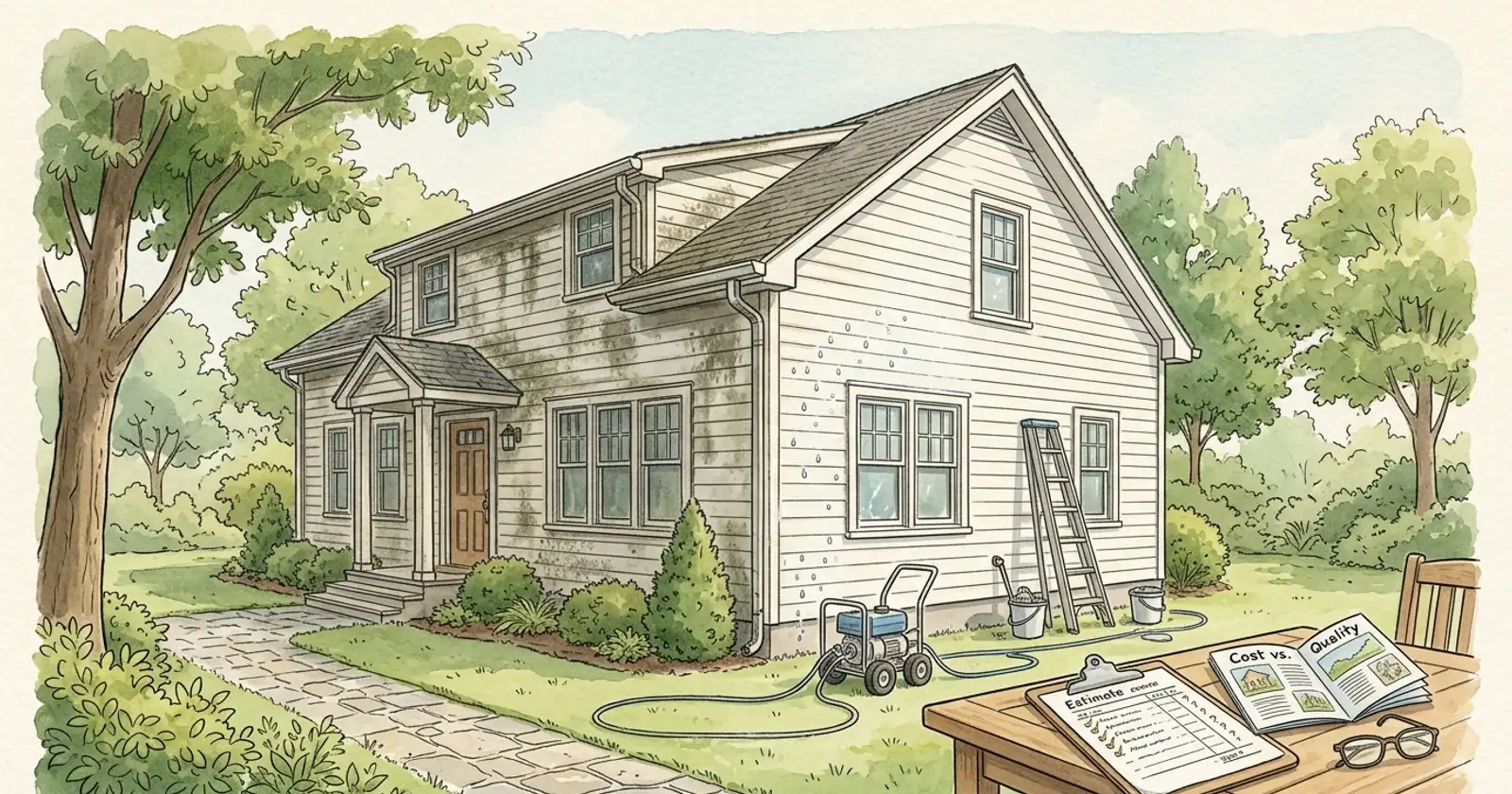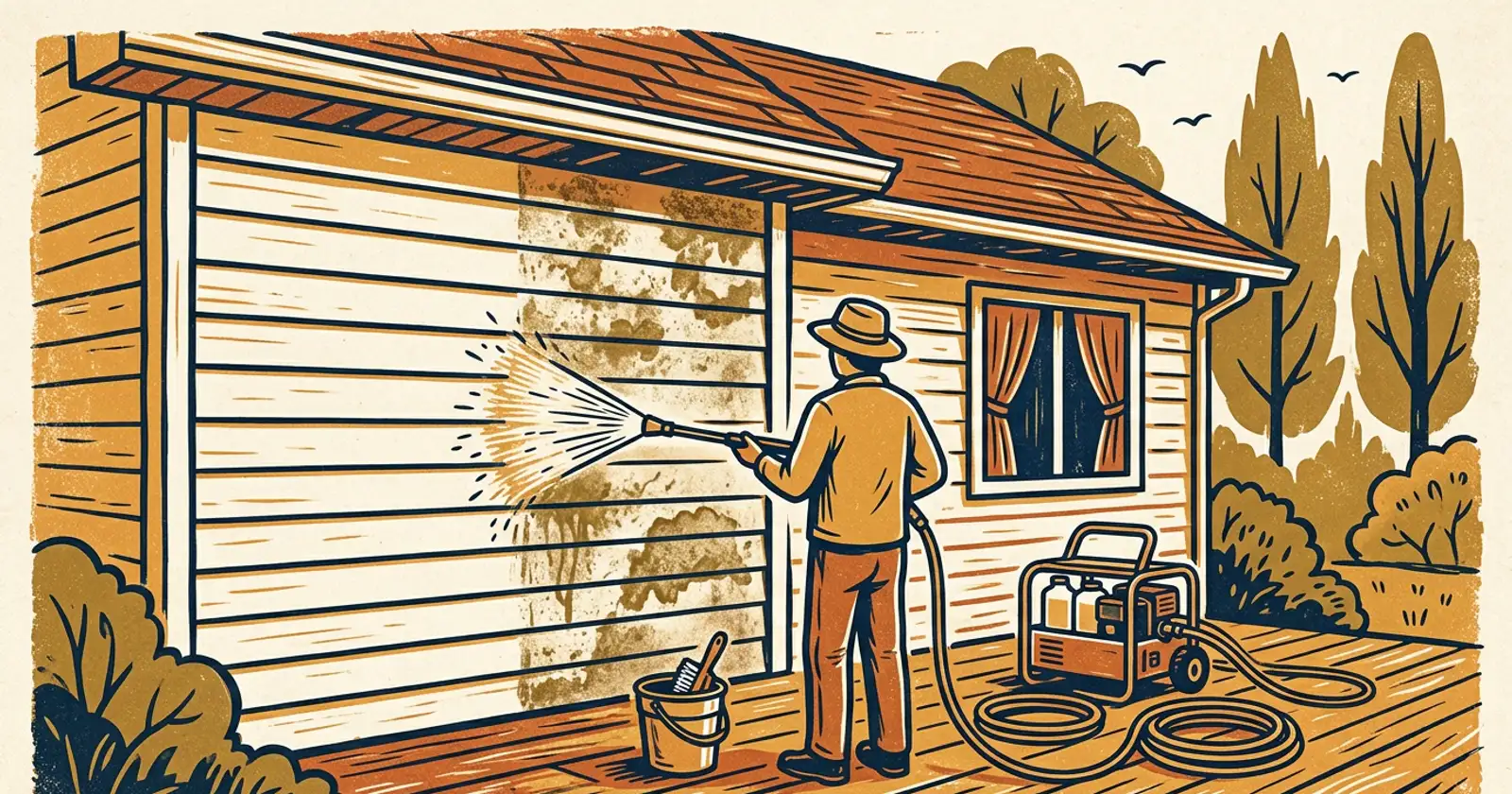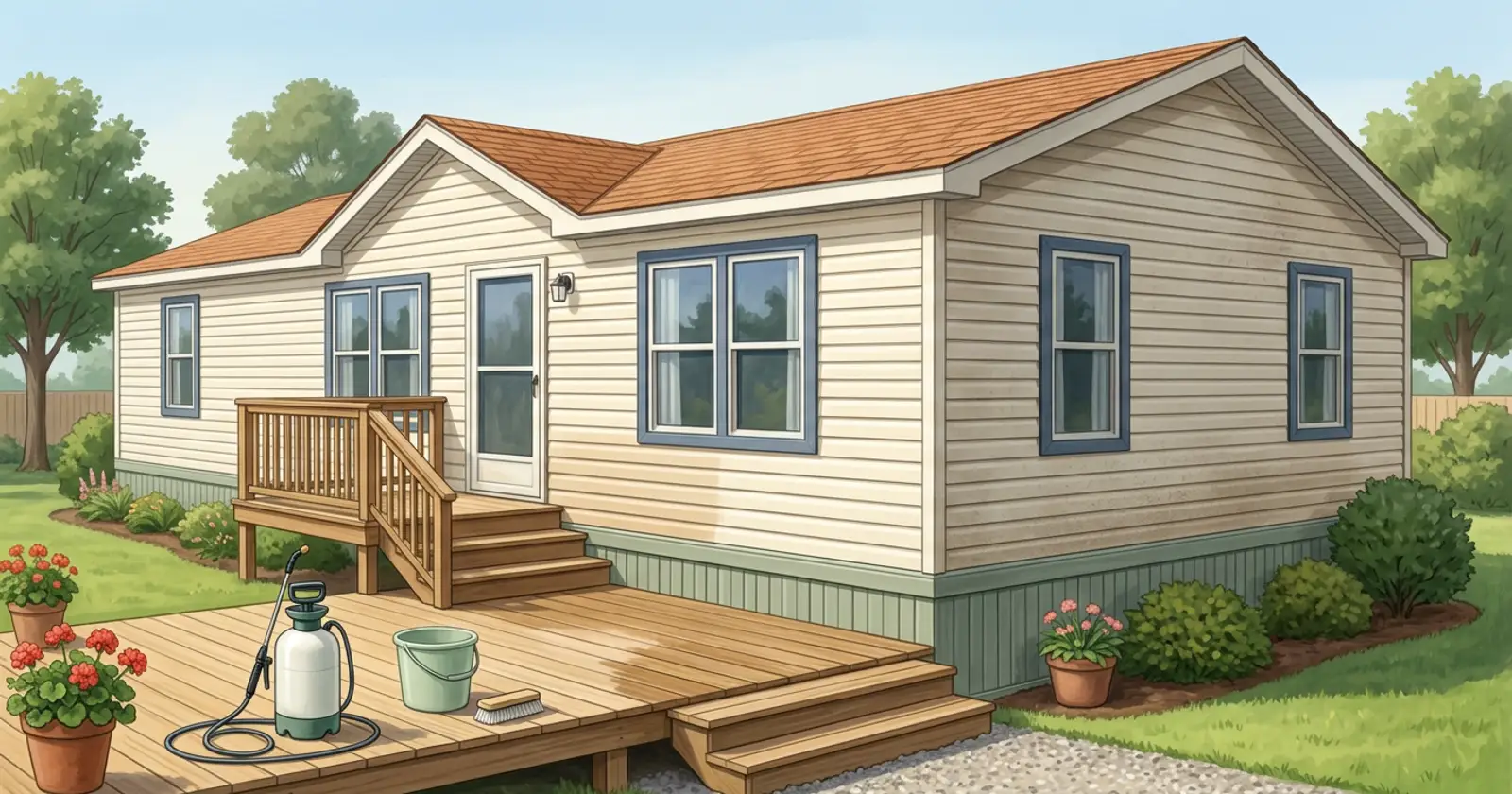
The bigger question is how. Vinyl, old aluminum and skirting all need low pressure and the right cleaner, not a blast from a high-pressure wand.
On pressure-washing forums, the same questions keep coming up. Owners ask if mobile-home vinyl will come clean with water alone. Others ask how strong to mix bleach in a pump sprayer. Homeowners ask if chalky aluminum siding can be washed at all, or has to be painted. Here’s what the makers and HUD’s own rules say.
What it costs
Only one of these washers posts a mobile-home price. For the others, we applied their published square-foot or size-band prices to the average new home. The Census Bureau’s Manufactured Housing Survey, sponsored by HUD, gives the 2025 averages. It put a single-section home at 1,073 square feet and a double-section at 1,766.
| Washer (area) | How it prices | Single-wide (about 1,073 sq ft) | Double-wide (about 1,766 sq ft) |
|---|---|---|---|
| Quest Cleaning (Dodge and Jefferson counties, WI) | Mobile-home soft wash price list | $175–$250 | $275–$450 (double- and triple-wide) |
| KC Splash (Kansas City metro) | $0.20 per sq ft of footprint, $300 minimum | $300 (minimum applies) | About $353 |
| JT’s Power Washing (Kansas City metro) | Soft wash by home size | $225–$275 (up to 1,500 sq ft) | $275–$350 (1,500–2,500 sq ft) |
| Wow Soft Wash (Portland, OR area) | Single-story by sq ft band | $335 (1,000–1,500 sq ft) | $385 (1,500–2,000 sq ft) |
A few things push the price up. The Wisconsin washer names older aluminum siding, heavy multi-year growth, skirting and porch add-ons, and oxidation removal. For how full-size homes are priced, see our house washing cost guide.
Vinyl siding needs soap, not force
A Florida manufactured-home builder’s care guide says to clean vinyl siding at least once a year. Rinse with a hose first. Then use a non-abrasive household detergent with a soft cloth or soft-bristle brush. Its rules are short:
- no harsh or abrasive cleaners
- no cleaning in direct sunlight; let the wall cool first
- don’t paint or wax the siding
That’s why a soft wash suits these homes. A cleaner does the work and a low-pressure rinse carries it off. If you’d rather do it yourself, our DIY soft wash guide walks through the label-first approach.
If the vinyl leaves powder on your finger, it’s oxidized. Our guide to chalky vinyl siding explains why a wash can make that look blotchy.
Old aluminum siding is meant to chalk
Aluminum siding chalks on purpose. One aluminum siding maker’s care sheet says its finish is made to chalk “in a controlled manner,” releasing fine pigment powder. Rain carries that powder and surface dirt away. Spots rain can’t reach get a garden-hose rinse.
For heavier dirt, the same sheet suggests:
- about 1/3 cup of laundry detergent per gallon of water
- a soft rag, sponge or soft-bristle brush, used gently
- washing from the bottom up to limit streaks, then a full freshwater rinse
It warns against rubbing hard enough to make glossy spots on the satin finish. It also rules out abrasive or solvent cleaners and paint remover. They “may soften or actually remove” the finish.
Rain doesn’t solve everything. That sheet says mildew usually shows up first where rain doesn’t fall, such as under the eaves and in porch enclosures. That holds even in a wet place like Pensacola. NOAA’s 1991–2020 normals put yearly rainfall there at about 68 inches. The sheet’s mildew mix is 1 quart of 5% bleach, 2 quarts of water, 1/3 cup of detergent and 2/3 cup of trisodium phosphate. Stronger mixes may damage the finish, so test a hidden spot first.
If the chalk is already heavy and the color has faded, a wash won’t bring the color back. Take dated photos before anyone starts. Our guide to damage that was already there explains why.
Keep water out of the skirting
Skirting covers the crawlspace under the home, and HUD’s installation rules treat that space with care. Skirting must not trap water between the siding and trim. It also must not force water up into the wall cavities. The crawlspace needs vents. Normally that’s at least 1 square foot for every 150 square feet of floor area. Vents go as high as practical and need screens that keep rodents out.
That shapes how a washer should work:
- Don’t spray up into the seam where the skirting meets the siding, or straight into the vents.
- Don’t flood the crawlspace. The builder’s guide warns against letting water gather under or around the home.
- Leave the vent covers on. They keep rodents out, and the builder says pests can tear the bottom board and ducts.
The same guide says to check the bottom board for tears. No insulation should show. If a wash turns up a torn vent screen or a gap, fix it before the next storm.
The roof
The builder’s guide says not to go on the roof yourself. Do your checks from the ground and call a pro. If your home has a metal roof, our metal roof cleaning guide covers what panel makers allow.
Before you book
- Ask if the price includes skirting, porches, steps and carports.
- Ask how the washer handles vents and the skirting seam.
- Ask for a test spot on chalky aluminum or faded vinyl.
Our list of questions to ask a house washing company covers the rest. For how we check our numbers, see our methodology.
Sources
Based on 14 sources · How we price
- Jacobsen Homes, Exterior Maintenance Guide for Your Manufactured Home: jachomes.com/resources/guide/exterior-maintenance
- Alside, Aluminum Soffit, Siding and Accessories Lifetime Limited Warranty (care and maintenance instructions): alside.com/wp-content/uploads/sites/3/2021/02/Alside-Aluminum-Warranty.pdf
- HUD Model Manufactured Home Installation Standards, 24 CFR 3285.504 (Skirting): ecfr.gov/current/title-24/subtitle-B/chapter-XX/part-3285/subpart-F/section-3285.504
- HUD Model Manufactured Home Installation Standards, 24 CFR 3285.505 (Crawlspace ventilation): ecfr.gov/current/title-24/subtitle-B/chapter-XX/part-3285/subpart-F/section-3285.505
- U.S. Census Bureau, Manufactured Housing Survey, average square feet of floor area (2014–2025): www2.census.gov/programs-surveys/mhs/tables/time-series/Annual_AvgSqft.xlsx
- NOAA NCEI, U.S. Climate Normals 1991–2020, Pensacola Regional Airport: ncei.noaa.gov/data/normals-annualseasonal/1991-2020/access/USW00013899.csv
- Quest Cleaning, Mobile Home Cleaning: questcleaningwi.com/mobile-home-cleaning
- KC Splash, Residential Pressure Washing Pricing: kc-splash.com/residential-pressure-washing-pricing
- JT’s Power Washing Pros: jtspowerwashingpros.com
- Wow Soft Wash, Pricing: wow-softwash.com/pricing
- Community discussion, soft washing an aluminum-sided mobile home: reddit.com/r/pressurewashing/comments/1tdiqtn
- Community discussion, mobile home vinyl with no chemicals: reddit.com/r/pressurewashing/comments/1jc717a
- Community discussion, mixing a pump-sprayer solution for mobile home vinyl: reddit.com/r/pressurewashing/comments/1ms17qp
- Community discussion, washing chalky aluminum siding: reddit.com/r/HomeImprovement/comments/1ugf0gz