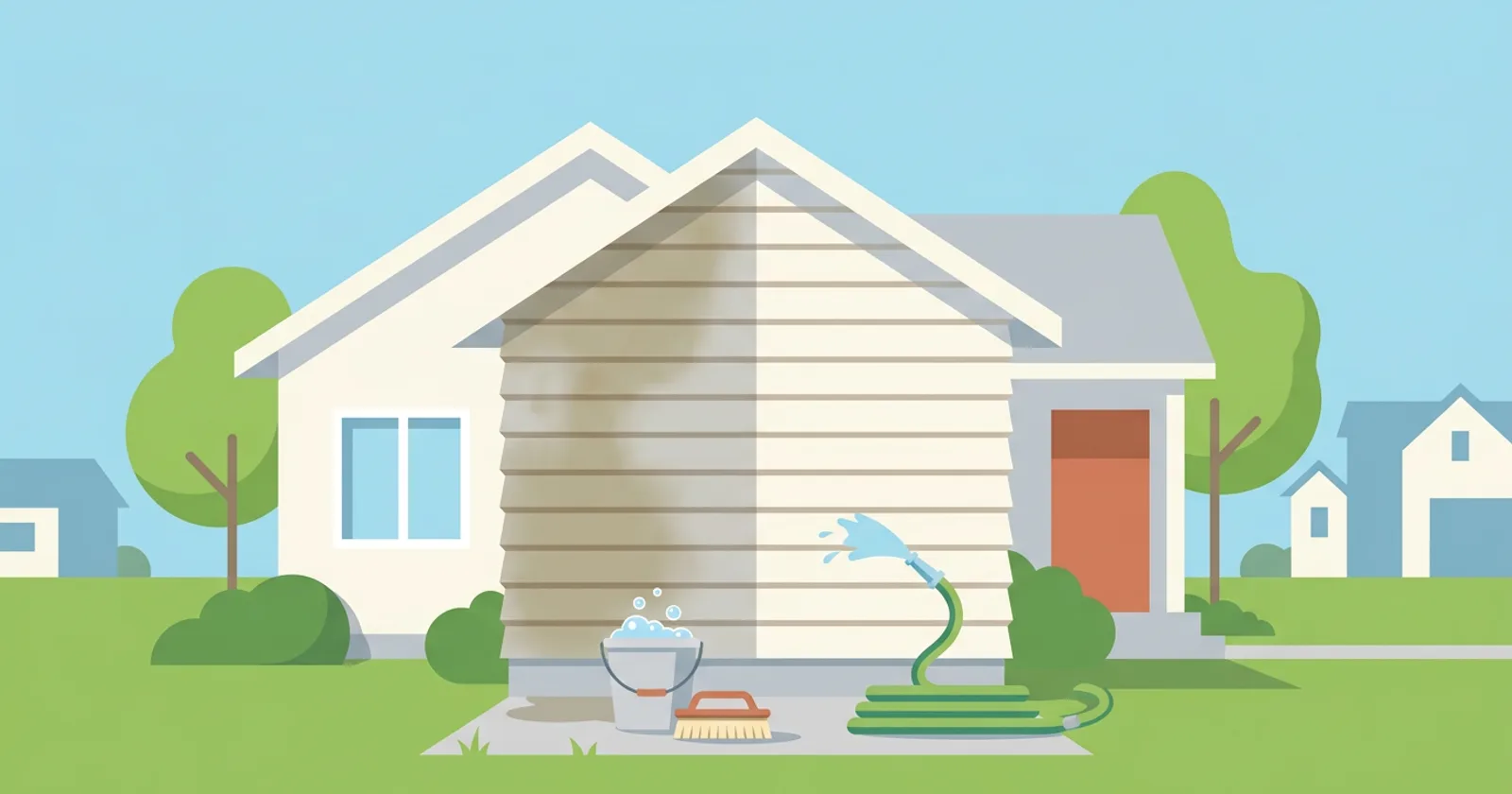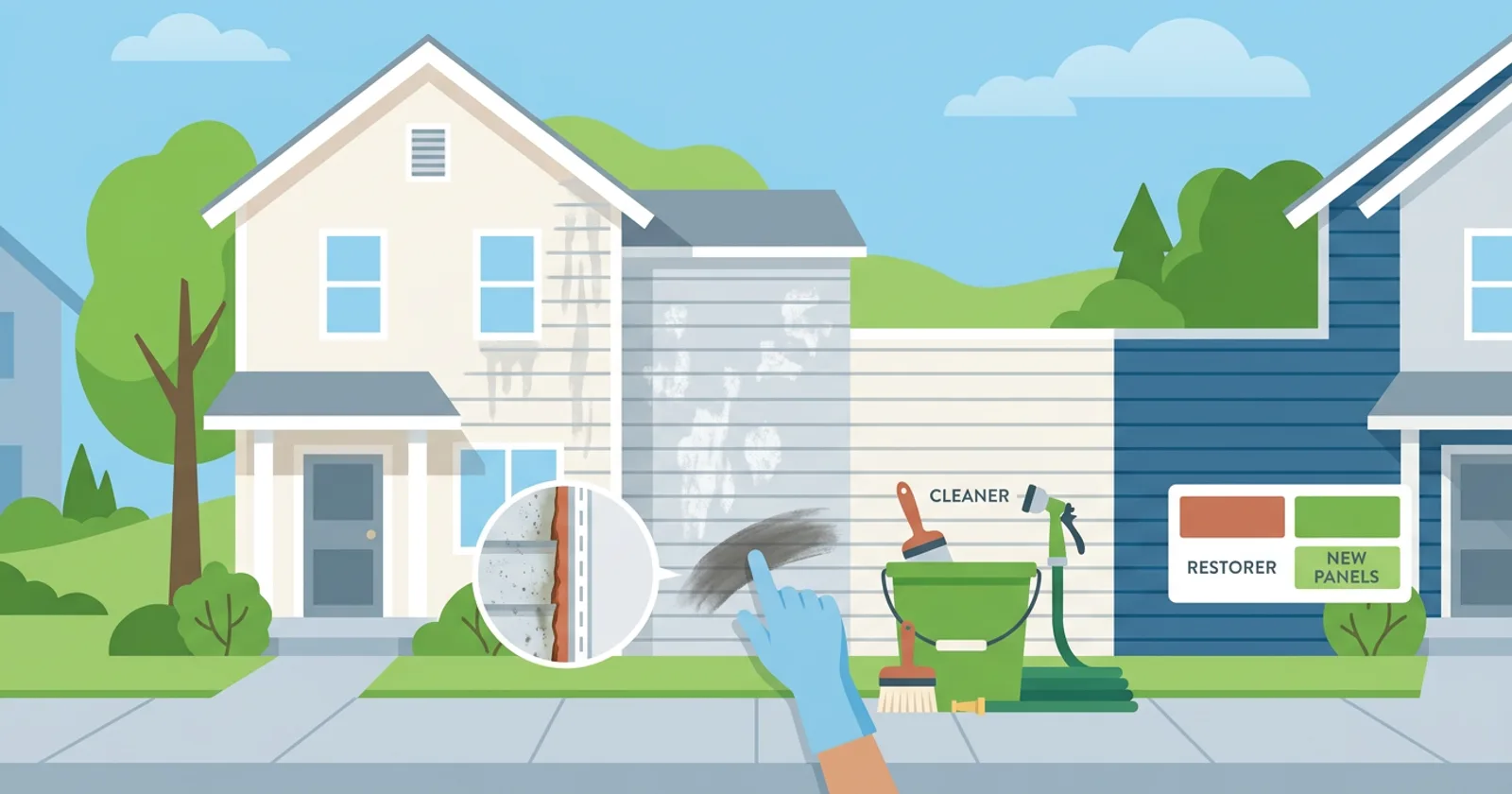
If your siding looked fine yesterday and blotchy today, that’s frustrating. Here’s how to tell what you’re looking at, and what a wash can and can’t fix. (Chalky paint is a different problem with a different fix; our Louisiana heat and humidity guide covers that one.)
What oxidation on vinyl is
One vinyl siding maker’s care page calls chalk a dull film that is common on all pigmented materials left out in sun and weather. A weathering-test lab’s paper on vinyl siding describes how it builds: the plastic yellows and fades, and if that goes on long enough, the surface itself starts to break down.
Another maker’s warranty says normal weathering can make any surface oxidize, chalk or collect dirt “due to varying exposures to sunlight.” That word varying explains most blotchy walls. Your house doesn’t age evenly, so it doesn’t clean evenly either.
Why some walls streak and others don’t
The siding industry’s color test leaves sample panels outdoors for two years, tilted at 45 degrees and facing south, into the sun. Your house has walls that face the sun and walls that hide from it. Even in Las Vegas, where NOAA’s long-run records put sunshine at 84% of the possible daylight hours, a shaded wall sees less sun than a sunny one.
Sun isn’t the only cause. In that same lab paper, a northern industrial test site produced more color change in colored samples than the sunny southern sites did. The authors pointed to freeze-thaw and industrial pollutants. So a cloudy climate doesn’t protect siding from fading either.
How the wash is done matters as well. The trade group’s manual says to wash a whole house from the bottom up to prevent streaking.
Try the finger-rub test
Before anyone sprays anything, rub a dry fingertip across a sunny wall, then a shaded one. Powder on your finger means chalk. One pro on a trade forum suggests the same check after a wash: if the odd-looking spot has little or no chalk, the wash likely took the oxidation off there and left it elsewhere.
Take dated photos of each wall too. Our guide to wash damage vs damage that was already there explains why those photos matter.
What you might be looking at
| What you see | Finger test | What a normal wash does | What helps | Who says so |
|---|---|---|---|---|
| Gray dirt or pollen film | Dirty, not powdery | Removes it | Soapy water, a soft brush and a garden hose | CertainTeed care page |
| Black mildew spots | Not chalky | Clears with the right mix | The manual’s detergent mix plus bleach | Vinyl siding installation manual (PEPA) |
| Chalk (oxidation) | Powder on your finger | Removes it unevenly, so streaks appear | A separate oxidation-remover step; brushing won’t restore color | Alside warranty; 3R Ox Killer label; EaCo Chem Cleansol BC page |
| Drip streaks under windows, roof lines or siding laps | Little powder | Hard spray can push water behind panels | A gentler rinse | CertainTeed care page; community discussion |
What a wash can and can’t fix
A wash removes loose chalk, dirt and growth. It can’t put back color the sun has already broken down.
Scrubbing harder isn’t the answer. The trade group’s manual says stiff bristle brushes and abrasive cleaners can change the gloss of the cleaned area and “cause the siding to look splotchy.” One maker goes further and doesn’t recommend power washing vinyl at all, citing moisture intrusion, damage and discoloration. It suggests a hose-end house wash instead. The same logic applies to gutters, as in tiger stripes versus oxidation.
Oxidation removal is its own step, with its own chemicals. One oxidation-remover label says the concentrate must be diluted, the area below (including plants) wetted first, the product applied at low pressure, and everything rinsed from the top down before it dries. Another product’s seller says the right dilution depends on the stain and the surface, and a test area decides it. Neither page promises the original color comes back.
Before you hire anyone for chalky siding
- Ask what you’re paying for. A regular wash and oxidation removal are different jobs. Ask for oxidation removal as its own line item. Our house washing cost guide shows what a normal wash runs.
- Ask for a test patch on a wall nobody sees much.
- Expect it to come back. One maker’s warranty treats chalking as normal weathering, so the sun keeps working after any cleaning.
- Think twice before replacing a few panels. The same warranty warns that replacement panels may differ in gloss and color from weathered ones.
- Check the warranty before painting. That warranty doesn’t cover siding coated over the original finish without the maker’s approval. Its fade coverage starts above 4 Hunter units of measured color change.
Our list of questions to ask a house washing company helps you settle chemicals and rinse methods before the job. For how we check our facts, see our methodology.
Sources
- CertainTeed, How to Clean Vinyl Siding: certainteed.com/siding/how-clean-vinyl-siding
- Q-Lab, Accelerated Weathering of Vinyl Siding Specimens (technical article): q-lab.com/sites/default/files/Technical_Articles/Accelerated-Weathering-of-Vinyl-Siding-Specimens.pdf
- Alside, Vinyl Siding Limited Warranty: alside.com/wp-content/uploads/sites/3/2021/02/Alside-Siding-Warranty.pdf
- Polymeric Exterior Products Association (formerly the Vinyl Siding Institute), Vinyl Siding Installation Manual (2022): polymericexteriors.org/wp-content/uploads/2022/10/2022-Vinyl-Siding-Installation-Manual-ENGLISH_100322_LR.pdf
- 3R, Ox Killer: Oxidation Remover & Siding Cleaner (product directions): 3rpressurewashers.com/products/ox-killer-oxidation-remover-siding-cleaner
- EaCo Chem Cleansol BC, retailer product page and manufacturer Q&A: windowcleaner.com/products/eaco-chem-cleansol-bc
- NOAA NCEI, Comparative Climatic Data, average percent of possible sunshine: ncei.noaa.gov/sites/default/files/2024-11/pctpos23.txt
- Community discussion, siding stains after a wash: pressurewashingresource.com/community/t/siding-stain-from-weep-holes/40535