Start with the finger-rub test
Rub a dry fingertip, or a dark cloth, across a clean-looking part of the door. Then rub it across a streak. A paint maker’s problem-solver page says a dusty, powder-like film that comes off is chalking. It says sunlight breaks down the binder that holds pigment in place.
A second paint maker’s field test adds a useful twist. Rub one spot back and forth 10 times with a black cloth. White on the cloth means chalk. No residue means the color has faded instead.
If chalk comes off, read our guide to chalky vinyl siding after a house wash. Painted steel can chalk too, so a wash can leave it looking uneven.
Then look at the pattern
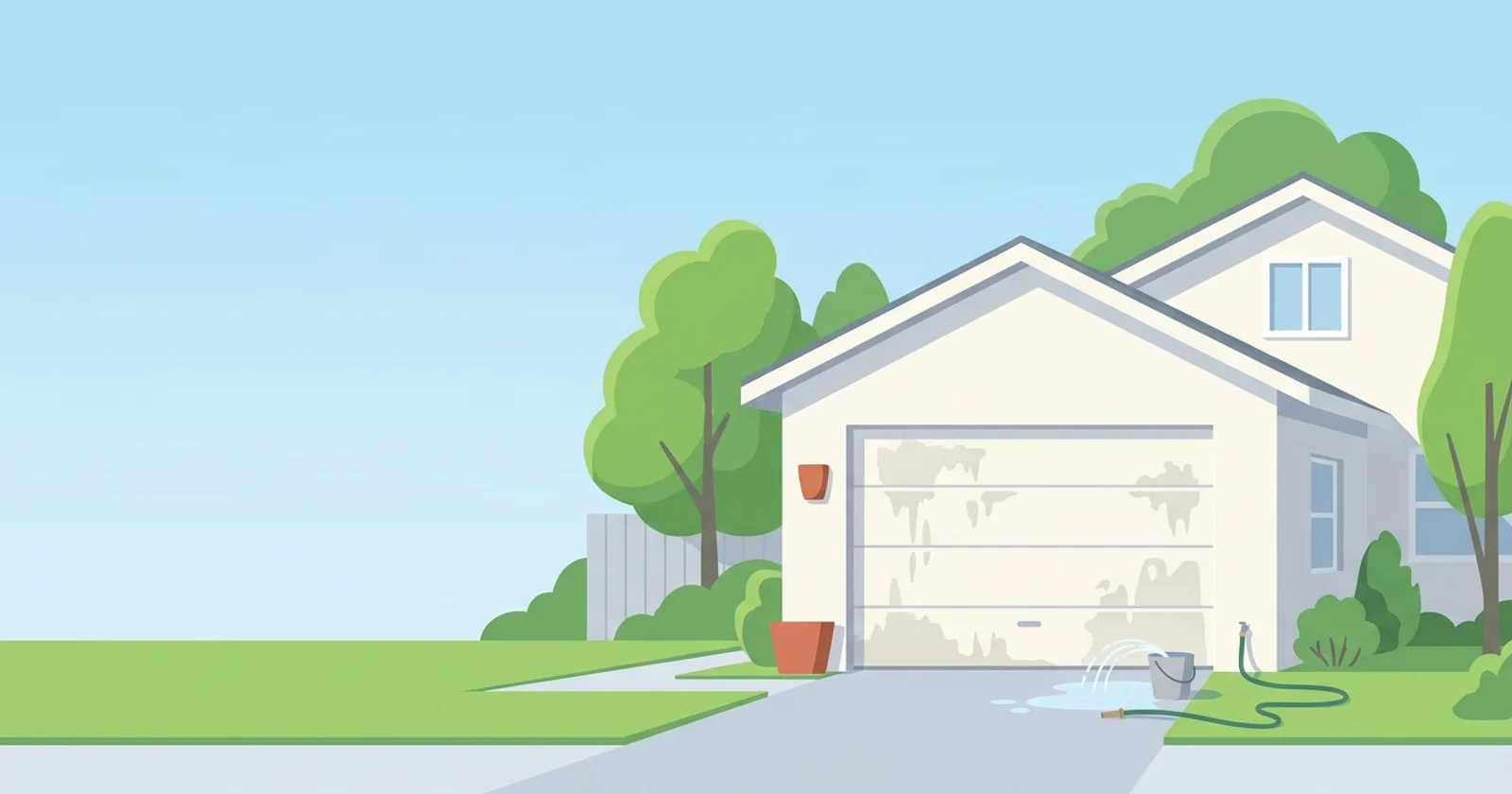
Streaks only on the sunny side. On a trade forum, a Florida washer described cleaning four identical fire stations the same way, with the same soap mix. Only the doors on the west side, facing the sun, streaked. A finger test showed no chalk, and treating the doors again didn’t change anything. The poster said it was windy, not hot. Other pros still pointed to soap drying on a sunny panel before the rinse. One gave three tips:
- Soap the shady side first.
- Rinse the sunny side first.
- Wet a sunny surface beforehand to cool it.
A garage door maker’s manual gives similar advice: avoid cleaning in the hot sun.
Drip-like blotches that didn’t move at all. Another washer found blotches on a door that looked like splashed water. There was no chalk on a wipe, and a standard house wash didn’t lighten them. One reply said this shows up now and then after pest-control spraying around a garage. It also happens after homeowners use wasp spray. The labels back that up. One wasp and hornet spray’s label says it may discolor painted surfaces. Another says it may stain or affect vinyl, painted and plastic surfaces. It tells users to test a hidden spot and recheck in a few hours. Those marks were probably there before the wash, not caused by it. Our guide to wash damage vs damage that was already there explains how before-photos settle that question. In another thread, one pro said they take before and after photos. They tell the owner up front when a worn door needs paint.
Faded, uneven color that’s worst where the sun hits. A clean finger with washed-out color points to fading rather than chalk. Sun-facing doors get the most sun. In El Paso, NOAA’s long-run records put sunshine at 83% of possible daylight hours over a year. In June it’s 90%. A west-facing door there takes a lot of afternoon sun.
What you’re probably looking at
| What you see | Finger test | Likely cause | What helps | Who says so |
|---|---|---|---|---|
| Even streaks, sunny side only | Clean finger | Soap dried before the rinse | Re-wash in shade or cooler hours; keep the panel wet; rinse well | Avante care manual (Clopay); community discussion |
| Patchy dull areas | Powder on finger | Chalking paint, cleaned unevenly | Mild detergent and gentle scrubbing; paint if chalk keeps coming back | Dunn-Edwards chalking guide; Clopay commercial door blog |
| Drip or splash-shaped blotches that don’t change | Clean finger | Pest or wasp spray on the finish | Test a small spot; repaint if it won’t clean | Bee Gone spec sheet (Noble); Onguard label; community discussion |
| Washed-out color, no powder | Clean finger | Faded paint | Repaint with the paint the door maker allows | Resene paint testing guide; Canyon Ridge care manual (Clopay) |
What door makers allow
Door makers keep it gentle. One maker’s care page suggests 1 cup of household detergent in 5 gallons of warm water. Use a dense sponge or cloth, and rinse well. It says plainly not to pressure wash a garage door. Another maker’s manual also says not to use a pressure washer on the door. It says to skip scouring powders and solvents.
For chalk, one maker’s guide for steel and aluminum doors suggests gently scrubbing panel by panel with mild detergent. Spray as you go, so soap doesn’t sit and leave spots. Gutters can show a similar pattern. See tiger stripes vs oxidation on gutters.
A washer on a trade forum described a step-up approach for streaks:
- Re-wash first.
- Then soap and brush lightly.
- Then try a degreaser.
- Only then use an oxidation remover.
That washer warned that acid can take off paint, especially thin paint where the base coat shows through. Our list of questions to ask a house washing company helps you ask what a washer plans to use before they start.
When only paint will fix it
Cleaning removes chalk and dirt, not lost color. One pro said some pest sprays cause problems with the finish, so marks that survive a wash may need paint. A paint maker’s guide adds that a fresh coat alone won’t solve chalking unless the surface is fixed first.
Before you paint, read your door’s manual. One maker allows high-quality 100% acrylic latex exterior paint. It says oil-based or alkyd paint will void the warranty. It strongly recommends solar-reflective paint for darker colors in direct sun. Check your warranty, too. One maker’s warranty excludes chemical action and normal fading or discoloration.
Comparing a repaint with a wash? Our house washing cost guide shows what the wash part usually runs. For how we check facts, see our methodology.
Sources
Based on 12 sources · How we price
- Amarr, Garage Door Care and Maintenance: amarr.com/residential/service_and_support/care_and_maintenance
- Clopay, How to Clean Your Garage Door and Preserve Its Finish: clopaydoor.com/residential/support/service-support/how-to-clean-your-garage-door-and-preserve-its-finish
- Clopay, Canyon Ridge Garage Doors Care and Maintenance (PDF): literature.clopay.com/pdf_files/RSDR-CRCAREMAINTBR-17.pdf
- Clopay, Avante Garage Doors Care and Maintenance (PDF): literature.clopay.com/pdf_files/RSDR-AVANTECAREMAINTBR-17.pdf
- Clopay, How to Clean Your Aluminum Commercial Door in 5 Easy Steps: clopaydoor.com/blog/post/blog/2024/05/14/how-to-clean-your-aluminum-commercial-door-in-5-easy-steps
- Dunn-Edwards, Chalking Paint Explained: dunnedwards.com/explore/how-to/paint-problem-solver/chalking
- Resene, Basic on-site paint testing: m.resene.co.nz/paint-testing.htm
- Noble Chemical, Bee Gone Wasp & Hornet Spray technical data report (PDF): cdnimg.webstaurantstore.com/documents/specsheets/noble_4420_bee-gone_spec.pdf
- Onguard, Hornet & Wasp Foam label (Canada, PDF): labelsds.com/images/user_uploads/Canada%20-%20Onguard%20HornetWasp%20Foam%20Label%202-22-24.pdf
- NOAA NCEI, Comparative Climatic Data, average percent of possible sunshine: ncei.noaa.gov/sites/default/files/2024-11/pctpos23.txt
- Community discussion, blotchy garage door stain after a house wash: pressurewashingresource.com/community/t/help-identifying-stain-on-garage/40648
- Community discussion, washing an old garage door: pressurewashingresource.com/community/t/garage-door/38979