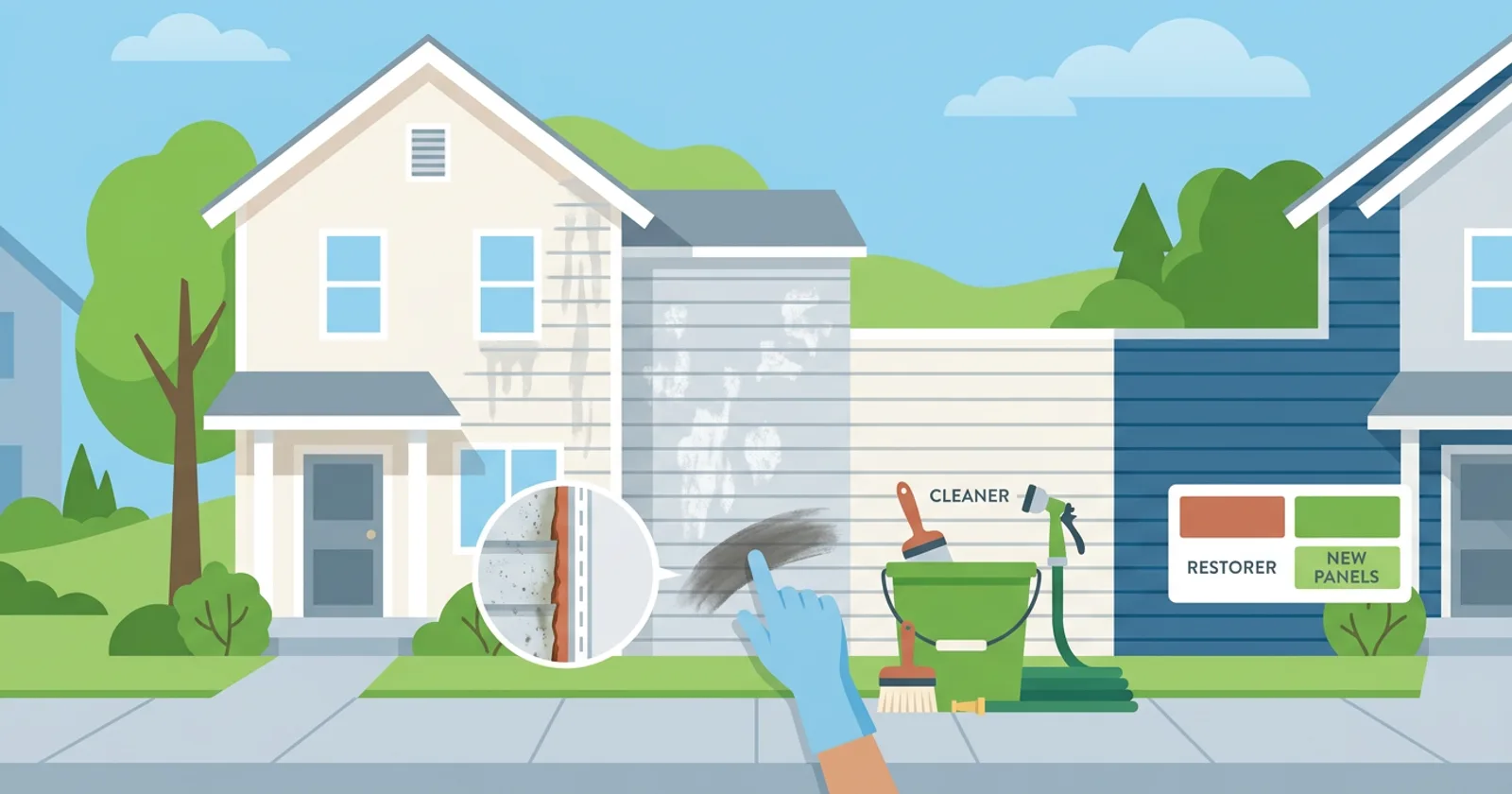
Picture a spring morning. You step onto the porch with your coffee and notice little black specks freckled along the lower siding by the flower bed. You try your thumb. A fingernail. Still there. Then you see the same dark pinpricks on the car. Nobody flicked tar at your house. A tiny fungus did, and it has surprisingly good aim.
What is artillery fungus?
Artillery fungus, Sphaerobolus stellatus, is a wood-decay fungus that lives in mulch and rotting wood. It grows tiny cups that each hold one dark spore mass. When the cup is ready, it flips inside out and fires that mass off like a cannon. A Connecticut Agricultural Experiment Station fact sheet says the masses can fly more than 6 feet up and over 20 feet out, and that they aim toward light and light-colored objects. That’s why white siding, windows and pale cars get hit.
Each spot is roughly 1 to 2 millimeters across, and the masses are sticky, so they glue themselves to whatever they hit. The good news: the same fact sheet says the fungus is not a pathogen of plants, animals or humans. It’s a looks problem, not a structural one.
Where and when it shows up
Penn State researchers called it a major problem in New Jersey, Ohio and Pennsylvania. In a 1997 release they said it caused more than $1 million in homeowner damage claims in Pennsylvania in a single year. A University of Delaware extension sheet says growth is favored by hardwood in the mulch, heavy rain and watering of foundation beds, and that it’s worst on north sides of buildings, where shade keeps things damp.
Timing matters too. The Connecticut sheet says it’s mostly a problem in the cool, wet weather of spring and fall, and Penn State put spore production between 50 and 68 degrees Fahrenheit. If new dots keep appearing, the fungus in your beds is still firing.
Why it’s so hard to get off
A Rutgers extension blog says the spores are hard to remove “even with high pressure sprayers.” A Penn State turfgrass professor who studied the problem as a student put it plainly: “We just couldn’t get the spores off.”
Two more catches. The Connecticut sheet says the spore masses can stay alive for more than 10 years. Penn State Extension adds that homeowners who scrape spots off and let them fall into the mulch can re-infest the bed. And even after the dots come off, a stain can stay behind, though it usually fades with time.
Removal options, gentlest first
Here’s what the extension sources say about each approach. If you’re not sure whether a stain or mark was there before a wash, see how to tell wash damage from damage that was already there.
| Method | What the sources say | The catch |
|---|---|---|
| Soap, water and a scrub brush | Can work before the spots dry (Univ. of Delaware) | Rarely practical; most people notice them once dry |
| Razor blade (glass only) | Spots scrape off glass easily (CT Ag. Experiment Station) | Use only on glass; other surfaces can be damaged |
| Careful scraping and scrubbing | Needed once spots have dried (CT Ag. Experiment Station) | Lay a tarp below so spores don’t fall into the mulch |
| Power washing | Mixed results; better on new vinyl, limited on old vinyl, aluminum and older painted wood (CT Ag. Experiment Station) | Stains may remain afterward |
Cars deserve extra care. The Connecticut sheet notes that pitting has occasionally been seen, especially on cars, so talk to a detailer before you scrub a painted panel.
Hiring a pro for artillery fungus
A house washing pro can help, but go in with honest expectations. When you call, ask:
- Will you test a small area first and show me the result?
- How do you protect the beds so scraped spores don’t land in the mulch?
- What will you do if some spots or stains don’t come off?
A good company won’t promise every dot will vanish. Our questions to ask a house washing company cover the rest of that call, and our house washing cost guide shows typical prices.
Mulch choices that reduce artillery fungus
The fungus lives in the mulch, so the mulch is where you stop it. Penn State Extension says they tested 27 mulches in the field, and every one eventually supported the fungus after a few years outside. Some did better than others, though:
- Large pine bark nuggets were the most resistant in one study, because they stay hard and dry.
- Cypress also performed well, though Penn State notes possible sustainability concerns.
- Mostly bark, not wood: the Connecticut sheet suggests mulch with at least 85% bark.
- Stone, pea gravel or black plastic right next to the house, where the Connecticut sheet says the risk is greatest.
Habits help as well. Rake the beds to break up the fungus and help them dry out. A fresh layer each year seems to reduce problems, Penn State says, if you don’t skip a year, though they haven’t confirmed it. Just don’t pile it too deep. Delaware’s extension sheet also notes Penn State research finding that fresh mushroom compost blended into mulch at 40% or more can suppress the fungus.
Those peppery dots don’t mean you did something wrong. Change what’s in the bed, keep wood mulch away from the siding, and you cut off the source. For other easy-to-miss issues, see the mistakes homeowners make around a wash. For how we source and check every claim, see our methodology.
Sources
- Connecticut Agricultural Experiment Station, S. M. Douglas, Sphaerobolus spp.: The Artillery Fungus (May 2010 revision): portal.ct.gov/-/media/caes/documents/publications/fact_sheets/plant_pathology_and_ecology/sphaerobolusspptheartilleryfungus050310rpdf.pdf
- Penn State Extension, Artillery Fungus in Mulch: extension.psu.edu/artillery-fungus-in-mulch
- Penn State News, Artillery Fungus Threatens Homeowners, Mulch Industry (1997): psu.edu/news/agricultural-sciences/story/artillery-fungus-threatens-homeowners-mulch-industry
- Penn State News, Deja vu all over again: research shows mulch fungus causes turfgrass disease (2015): psu.edu/news/research/story/deja-vu-all-over-again-research-shows-mulch-fungus-causes-turfgrass-disease
- University of Delaware Cooperative Extension, Artillery Fungus and Other Things That Grow in Mulch: udel.edu/academics/colleges/canr/cooperative-extension/fact-sheets/artillery-fungus-mulch
- Rutgers Plant and Pest Advisory, Control of Nuisance Fungi in Landscape Mulch: plant-pest-advisory.rutgers.edu/control-of-nuisance-fungi-in-landscape-mulch