Maybe you’re at the kitchen window with your coffee, watching the first frost on the lawn. Then you see the pressure washer still parked by the garage. You’re not alone. This month, an owner in Quebec asked an online pressure washing community the same question, with nights already below freezing.
Why ice is your pump’s worst enemy
Think of the pump like a glass bottle left in the freezer. The USGS says ice is about 9 percent less dense than liquid water, so freezing water needs more room. Inside a pump there is no extra room. Something has to give.
Damage may not show until you next run the pump. And the makers are clear about who pays. One maker’s quick setup guide says freeze damage is not covered under warranty. Two other makers list freeze damage as a warranty exclusion, and a fourth puts it in capital letters.
How soon do you need to act? In Milwaukee, NOAA’s 1991–2020 normals put the median first 32°F night on October 29. There’s a 1-in-10 chance it comes by October 15, and a 9-in-10 chance by November 10. The airport averages about 123 nights a year at or below freezing, and the median last spring freeze isn’t until April 19. If you live somewhere similar, think October, not December.
The winterizing routine
You don’t need a workshop, just a bottle of pump saver and a little daylight. Your owner’s manual comes first. Here is what the makers’ guides agree on.
| Maker guide | What it says |
|---|---|
| Mi-T-M winterizing tip | Protect the unit if storage may fall below 32°F; frozen pumps may burst or be permanently damaged |
| Echo storage page | Don’t store in freezing temperatures without pump saver; RV antifreeze without alcohol as a backup |
| Briggs & Stratton how-to | No water should remain in the pump; fill it with pump saver oil |
| Briggs & Stratton setup guide, Craftsman and Simpson warranties | Freeze damage is excluded or not covered |
1. Disconnect and drain everything
Turn the machine off and unhook the garden hose, high-pressure hose, gun, wand and any attachments. Hold the gun and wand upright, tip them back and forth, and squeeze the trigger until only air comes out. One maker says no water should remain in the pump for storage.
2. Add pump saver (not car antifreeze)
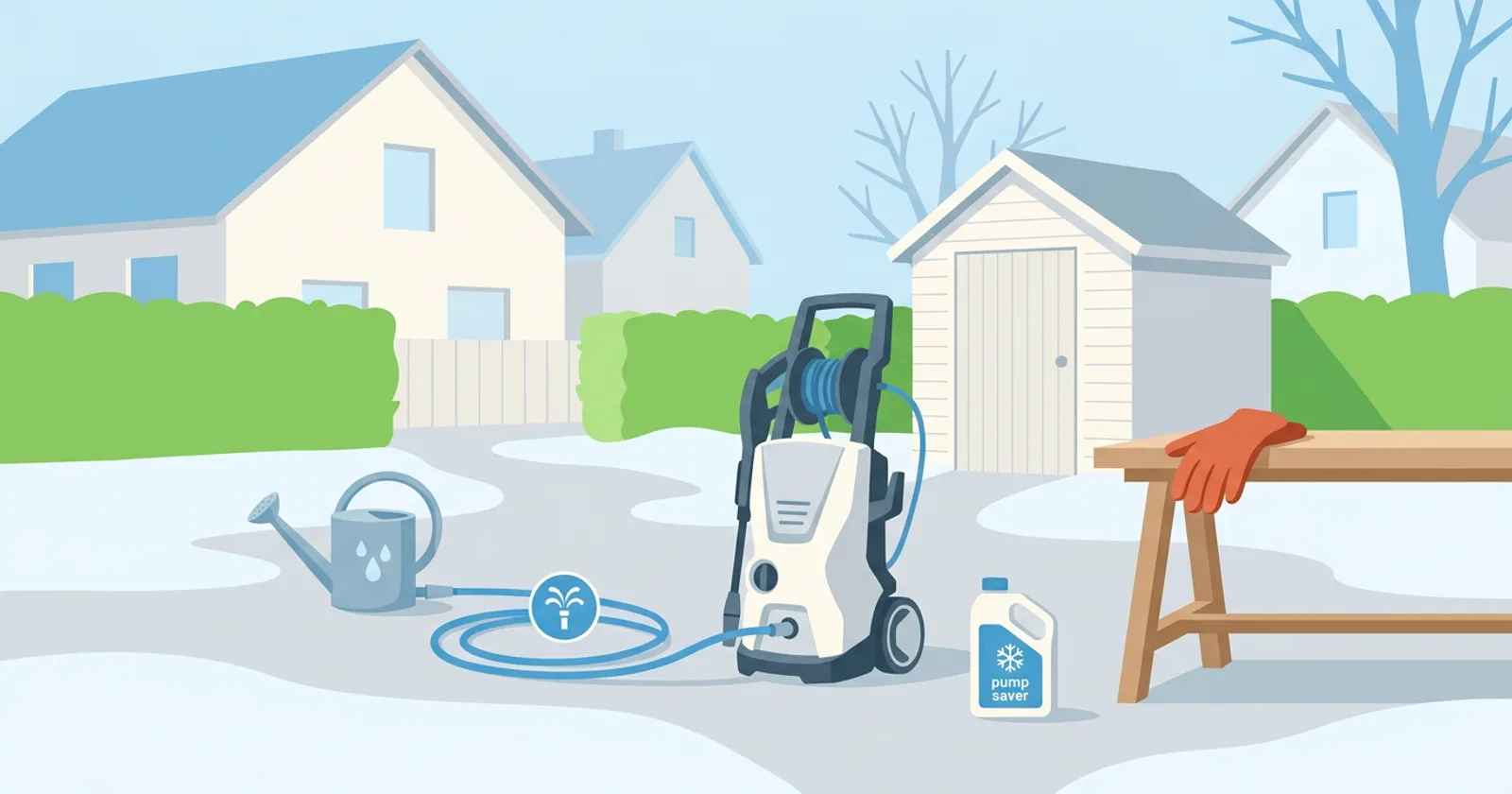
Pump saver is an antifreeze and lubricant made for pressure washer pumps. One brand lists a non-toxic propylene glycol base. It also coats the seals so they don’t dry out over the winter.
- Thread the bottle onto the pump’s garden hose inlet.
- Some bottles are simply squeezed until fluid comes out of the high-pressure side. One maker’s gas-model routine has you pull the recoil handle twice instead.
- Stop when fluid shows at the outlet, then cap the bottle and store it frost-free.
No pump saver on the shelf? One maker allows RV antifreeze without alcohol as a fallback, poured through a short length of hose.
3. Drain the attachments
Surface cleaners, rotary nozzles and extension wands can hold water. Turn them upside down, rotate them slowly and let them dry indoors so nothing is left to freeze.
4. Treat the fuel (gas models)
One maker warns that fuel goes stale after about 30 days of storage. Either add fuel stabilizer and run the engine briefly to spread it, or drain the tank and run the engine until it stops. Another says to run it for 2 minutes after adding treatment.
5. Coil, cover and store
Coil the hoses loosely and hang them off the floor. Wipe the machine down and use a cover that doesn’t hold moisture. A dry, heated corner is best. Operators with a trailer rig should do the same for every hose reel and gun on board. Our guide to starting a pressure washing business covers the rest of the gear list.
Where to keep your soaps
Freezing can ruin cleaning concentrates. One house and siding concentrate’s safety data sheet says not to store it in freezing temperatures or above 95°F. Check your own labels, keep the jugs in a heated basement or laundry room, and set them in a lidded tote in case one leaks. Keep them away from kids and pets, as always.
Your spring wake-up check
- Look for cracks in the pump housing, fittings and gun.
- Flush out the pump saver with clean water before you wash anything.
- Check the oil on gas models as your engine manual directs.
- Purge the air. One maker’s setup guide has you turn the water on and squeeze the trigger to purge air from the pump and gun.
- Watch for drips around seals during the first minute.
If pressure is low after storage, don’t panic. One operator on a trade forum stored a rig with RV antifreeze and came back to weak pressure. Other operators suggested checking the belt, the unloader’s easy-start bypass and the gauge itself. For washing your house without damaging it, see our list of pressure washing mistakes homeowners make. Freeze-thaw is hard on siding too, as our Montana house washing guide explains. Our methodology page shows how we check sources.
Sources
Checked 2026-10-08. Maker guides are quoted for what they say about their own equipment. No maker endorses or is endorsed by this site.
- NOAA NCEI, 1991–2020 annual/seasonal normals, Milwaukee Mitchell Airport (USW00014839): ncei.noaa.gov/data/normals-annualseasonal/1991-2020/access/USW00014839.csv
- NOAA NCEI, normals documentation (variable definitions): ncei.noaa.gov/data/normals-annualseasonal/1991-2020/doc/Normals_ANN_Documentation_1991-2020.pdf
- USGS Water Science School, Water density: usgs.gov/special-topics/water-science-school/science/water-density
- Mi-T-M, Winterizing a pressure washer: mitm.com/support/product-tips/winterize-and-store/winterizing-pressure-washer
- Echo, Pressure washer storage: support.echo-usa.com/en/Pressure_Washers/Storage-114 and support.echo-usa.com/Pressure_Washers/Storage-935b
- Briggs & Stratton, Winterize and store your pressure washer: briggsandstratton.com/en-us/support/maintenance-how-to/winterize-and-store-your-pressure-washer
- Briggs & Stratton electric pressure washer quick setup guide: images.homedepot-static.com/catalog/pdfImages/45/45205886-242d-4165-a06d-71f3ee43a570.pdf
- Craftsman pressure washer limited warranty: pdf.lowes.com/productdocuments/d6c33cca-d759-40c3-8ce3-b1e74dabc67d/44101792.pdf
- Simpson pressure washer limited warranty: images.thdstatic.com/catalog/pdfImages/05/05b0e97f-5d26-48f4-98f0-ace1429104fb.pdf
- BE Power Equipment, Pressure Washer Pump Saver: bepowerequipment.com/products/85-490-046
- Simple Green House and Siding Cleaner safety data sheet: cdn.simplegreen.com/downloads/SDS_EN-US_SimpleGreenPWC-HouseSidingCleaner.pdf
- ASPCA, Dangers of antifreeze and your pets: aspca.org/news/digging-deeper-getting-facts-dangers-antifreeze-and-your-pets
- Community discussion: reddit.com/r/pressurewashing/comments/1wyc1k7
- Community discussion: pressurewashingresource.com/community/t/low-pressure-after-storage-check-valve-help/40602