This guide is for owners who already run a wash business. If you’re still setting up, start with how to start a pressure washing business.
Why washers ask about lights
Winter is the gap. In a November 2025 thread on a pressure washing forum, an owner asked what businesses do in winter besides Christmas lights. Lights were already the assumed answer. In an August 2025 thread, an owner far up near the Canadian border said washing there ends around mid-October, and named lights as a fallback if money got tight.
Window cleaning is the other common fall add-on, and we compare its hourly math in adding window cleaning to a pressure washing business. Lights are a different trade-off: more selling up front, then two trips per house.
The season, month by month
- July to August: decide and price. One owner in the August thread said the light season starts in July. That’s when you pick a light model, a price sheet and a supplier.
- September to October: sell and book. One Omaha installer says most homeowners book in September or October. Installs then run in October or November, with lights turned on around Thanksgiving. Booking early, it says, lets crews finish rooftop work before freezing temperatures, snow and ice arrive.
- November to December: service calls. A Spokane installer promises to replace a flickering or dead bulb within 48 hours. Expect callbacks during your slowest wash weeks.
- January: takedown. The Omaha company says most homeowners take lights down in early to mid-January. It warns that frost and ice can make rungs and roof edges slippery then.
- February on: store, count, wash. Check and pack every strand, then winterize your pressure washer for the last cold stretch.
What installers publish
| Company | Market | Published price | Who owns the lights |
|---|---|---|---|
| Get Lit PNW | Spokane and Lincoln County, WA | $5/linear ft single-story; $6 two-story; $7+ complex or extra-tall | Not stated; takedown and labeled storage included |
| Paradise Lawns | Omaha area, NE | Small ranch $995–$1,195; average two-story $1,495–$2,195; $995 minimum per season | The installer; “not a sale of lights” |
| Alexander Group | Gwinnett, Barrow and Walton counties, GA | $6–$7/linear ft | The customer; installer stores them |
The table shows the two models you’ll choose between. In one, the customer buys the lights and you install and store them. In the other, you own the lights and rent the display out each season. The Omaha company’s price covers lights, installation, in-season repairs, takedown, storage and tax. It also gives a 20% discount to customers who pay in full at booking, compared with three payments.
On the Spokane rate sheet, a single-story home with 150 feet of roofline comes to $750. If the customer owns the lights, they pay for them and you mostly sell labor and storage space. If you own them, you buy, store and repair every strand, and the customer rents the display.
Go/no-go checklist
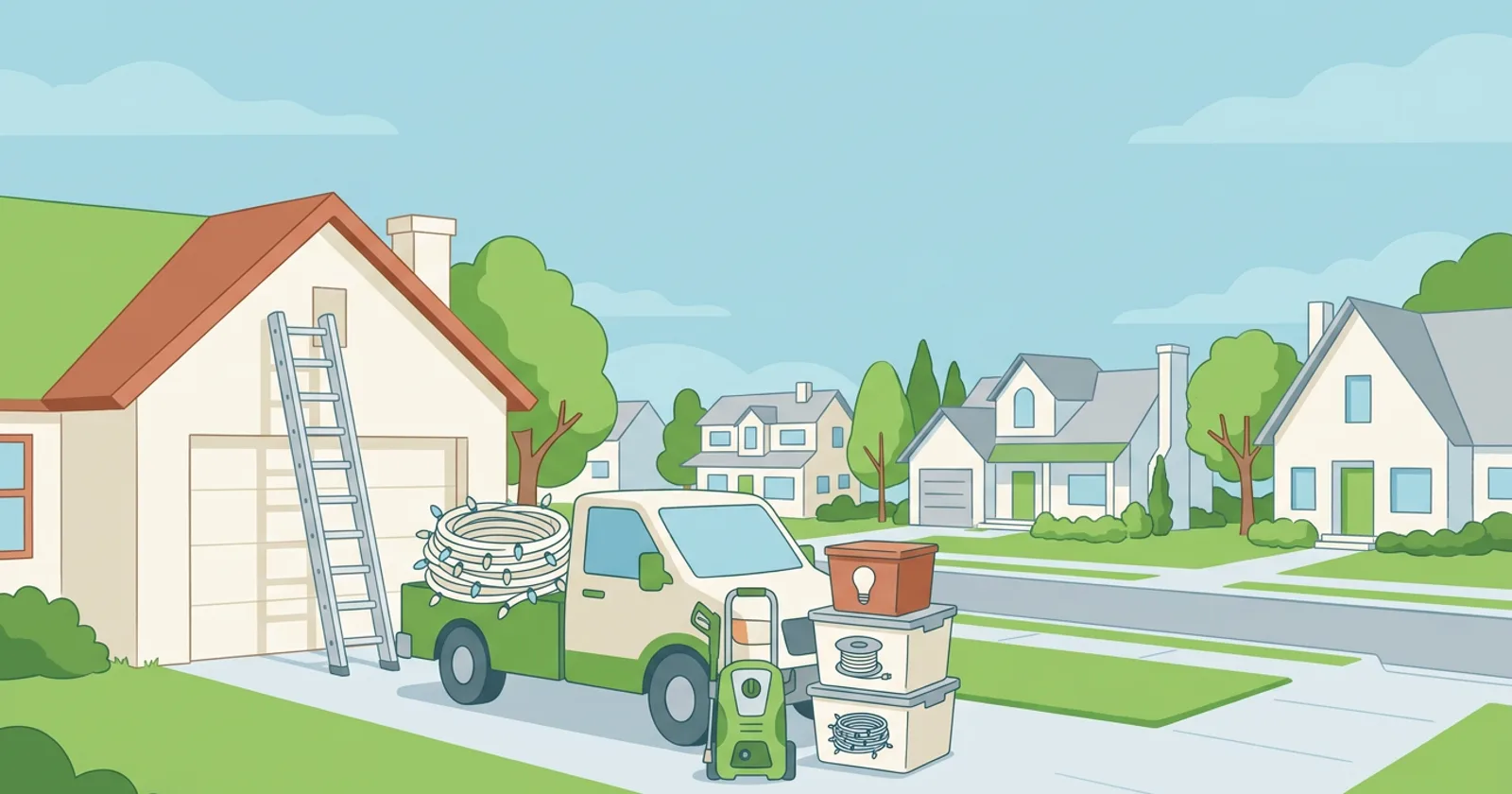
Ladders and roofs. OSHA’s ladder card says falls from portable ladders are among the leading causes of workplace deaths and injuries. It also says an extension ladder used to reach an elevated surface must extend at least 3 feet above the point of support. ESFI says to use wooden or fiberglass ladders for outdoor decorating, because metal conducts electricity. Keep yourself and your gear at least 10 feet from power lines. OSHA’s fall protection page lists trigger heights of four feet in general industry and six in construction, so if you hire help, find out which rules cover your crew. Our guide to hiring your first helper covers the payroll side.
Cords and power. ESFI says every cord and decoration used outdoors should be marked for outdoor use. Outdoor lights should plug into GFCI-protected circuits, and you can buy portable outdoor GFCIs if a circuit doesn’t have one. In a December 2025 thread, a washer doing a one-off install for a customer bought all-new cords. The customer’s were indoor cords, and the washer didn’t want to own the fire risk.
Insurance. Ask your agent in writing whether your policy covers light installation and roof work. The Omaha installer notes that it carries liability coverage for the work. The SBA’s insurance guide explains the main policy types.
Storage. In the same thread, another owner said storage was one reason to skip lights. The Omaha company keeps every light and clip in an insured, secured facility. Find your shelf space before you buy inventory.
Pricing. The one-off installer said materials alone came to about $500 on a job of roughly 139 feet. Replies said to price by the foot, add time for extras, and sell takedown up front as part of a package. For setting rates, see how much to charge for pressure washing.
A note on income claims
Forum threads include big revenue claims, but those are one person’s report, not data. Nothing here is a promise of income. Time your first few installs and takedowns. Then compare what you earn per hour with a house wash before you buy inventory. For how we gather and check prices, see our methodology.
Sources
- Get Lit PNW, seasonal light installation pricing (Spokane and Lincoln County, WA): spokaneoutdoorlighting.com
- Paradise Lawns, Christmas light installation in Omaha (prices, minimum, what’s included): paradise-lawn.com/outdoor-holiday-christmas-lights-decorations-omaha
- Paradise Lawns, when to schedule Christmas light installation: paradise-lawn.com/when-to-schedule-christmas-light-installation
- Paradise Lawns, removing outdoor holiday lights: paradise-lawn.com/removing-outdoor-holiday-lights-post-holiday-cleanup
- Alexander Group, Christmas light installation pricing: alexanderlandscapegroup.com
- OSHA, Portable Ladder Safety QuickCard: osha.gov/sites/default/files/publications/portable_ladder_qc.pdf
- OSHA, Fall Protection: osha.gov/fall-protection
- Electrical Safety Foundation (ESFI), outdoor decoration safety tips: esfi.org/outdoor-decoration-safety-tips
- SBA, get business insurance: sba.gov/business-guide/launch-your-business/get-business-insurance
- Community discussion, r/pressurewashing, November 2025: reddit.com/r/pressurewashing/comments/1ozzsyh
- Community discussion, r/pressurewashing, December 2025: reddit.com/r/pressurewashing/comments/1pftuoy