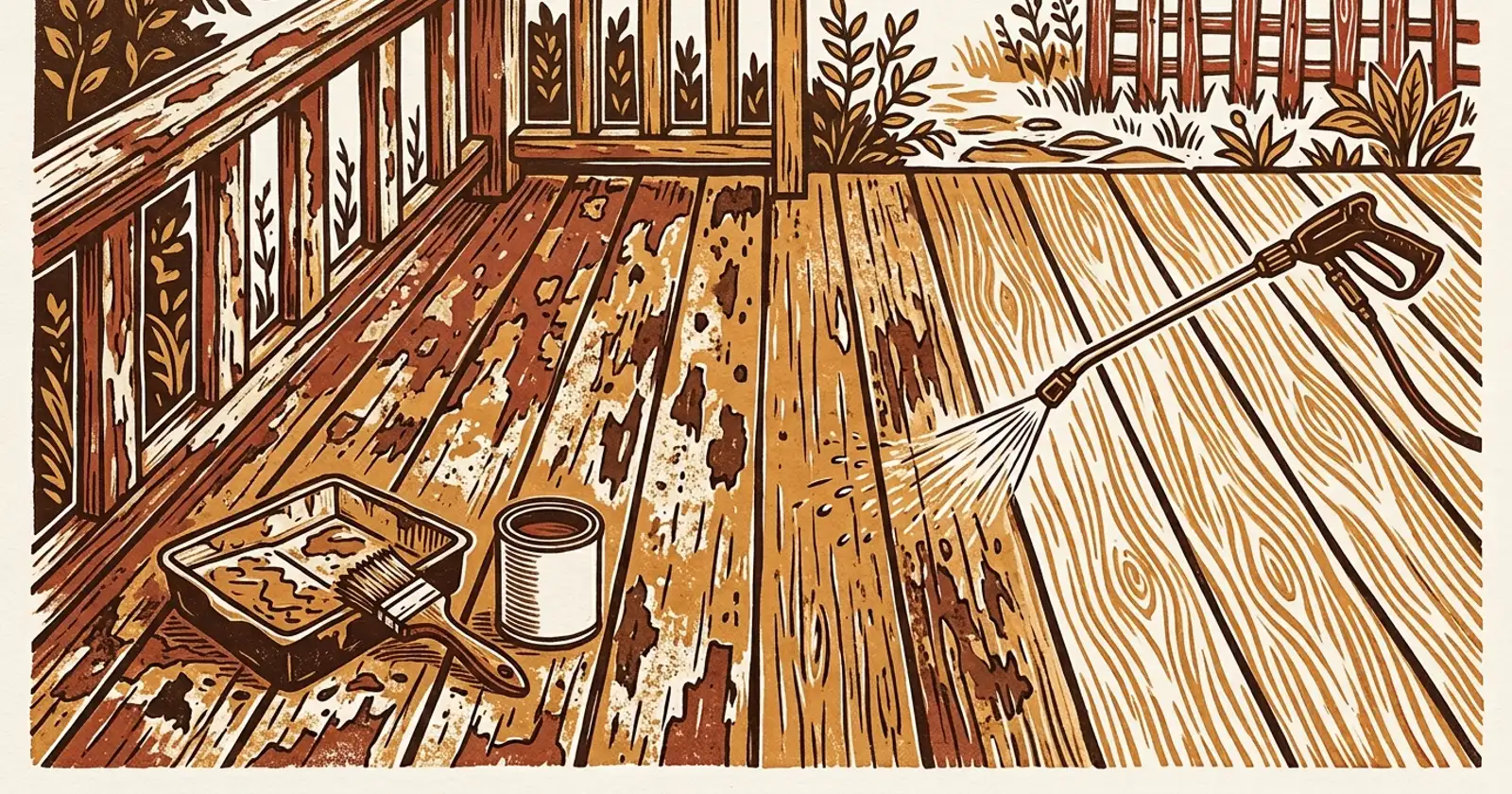
Two forum threads show what this looks like. One homeowner on a home-improvement forum said a deck restained last fall by a hired painting company still left oily footprints in the house months later (community discussion). One commenter replied that the stain probably never set properly, that excess stain doesn’t wear off, and that the only choice now was to strip and restain; the same commenter said the homeowner should have called the company back. On a washers’ trade forum, a washer said a customer asked about algae on a deck stained the year before and wanted to protect the finish (community discussion).
Match the symptom to the cause
| Symptom | Likely cause | Usual fix |
|---|---|---|
| Sticky or oily, leaves footprints | Excess stain never wiped off or never cured | Call the installer; strip and restain if it won’t set |
| Peeling or flaking | A film-forming (solid-color) stain | Strip or sand to bare wood, then restain |
| Worn through or blotchy | Stain put on damp wood, in direct sun or in humid weather | Clean, then recoat once the wood is dry |
| Green film or algae | Shade, as in the trade-forum thread; not necessarily stain failure | Gentle cleaning; the stain may be fine |
The “likely cause” column is our inference from a federal preservation guide’s staining specification and the two threads. It says not to stain when relative humidity is over 85% or when the wood’s moisture content is above 12%, not to stain damp surfaces, and not to stain in direct sun. It also says to wipe off any excess about an hour after the second coat. A crew that skipped those steps could leave a finish that fails early. How we research: methodology.
Film versus penetrating stain
The same guide draws the key line. Semi-transparent penetrating stains soak into the wood instead of forming a film, so they won’t peel, flake or blister. Solid-color stains form a thin film on the surface and can peel and flake just as paint does. If your deck is peeling, the product type is the first question to ask the installer.
Algae on a stain that’s still sound
Green growth on a year-old finish isn’t always a failure. In the trade-forum thread, the poster said a test spot at 1,400 psi with a fan tip showed the stain was fine, that he used no bleach or chemicals, and that the customer then had the whole deck done. He described the deck as backing up to woods and fairly shaded; another commenter advised test spots first. The federal guide says a mildewed surface should be washed with bleach and detergent, rinsed and allowed to dry completely before any new coat of stain.
What a redo costs
| Contractor (area) | Published price per sq ft | 300 sq ft deck |
|---|---|---|
| TexFix (San Antonio, TX) | $2 to $5, professional staining | $600 to $1,500 |
| Shelby Macomb Painters (Michigan) | $3 to $8, deck refinishing | $900 to $2,400 |
Totals are our arithmetic; prices from each contractor’s own page, checked October 2026. Stripping a peeling finish costs more than recoating a sound one; our deck cleaning and staining cost guide breaks prices out by scope, from a wash-and-recoat to a full strip.
Before you pay for a redo, ask the original installer. In the forum thread, a commenter said the homeowner should have called the company back to fix it.
Doing it right the second time
- Remove what failed. Peeling film has to come off; our deck prep guide covers stripping, brightening and dry times.
- Check the wood is dry. The federal guide’s limit is 12% moisture content.
- Pick the finish for the deck. A penetrating stain avoids peeling; a solid stain hides more but can peel.
- Work in shade. In Lubbock, Texas, the high reaches 90°F or more on about 92 days a year, per NOAA’s 1991–2020 normals, so timing the work out of direct sun matters there.
Staining a fence too? Our fence staining cost guide covers per-foot prices.
Sources
Based on 6 sources · How we price
- Community discussion, r/HomeImprovement, a restained deck tracking oil months later (May 2026): reddit.com/r/HomeImprovement/comments/1t2839t
- Community discussion, PressureWashingResource, algae on a year-old deck stain (Aug 2025): pressurewashingresource.com/community/t/algae-on-fresh-deck-stain/40336
- U.S. General Services Administration, Applying a semi-transparent or opaque stain to wood: gsa.gov/real-estate/historic-preservation/historic-preservation-policy-tools/preservation-tools-resources/technical-procedures/applying-a-semitransparent-or-opaque-stain-to-wood
- TexFix Handyman & Painting, How much does it cost to stain a deck (San Antonio): texfix.com/blog/how-much-does-it-cost-to-stain-a-deck
- Shelby Macomb Painters, deck refinishing cost (Michigan): shelbymacombpainters.com/deck-refinishing-cost-2025
- NOAA NCEI, 1991–2020 annual normals, Lubbock, TX: ncei.noaa.gov/access/services/data/v1?dataset=normals-annualseasonal-1991-2020&stations=USW00023042&format=csv&dataTypes=ANN-TMAX-AVGNDS-GRTH090,ANN-PRCP-NORMAL&includeStationName=true