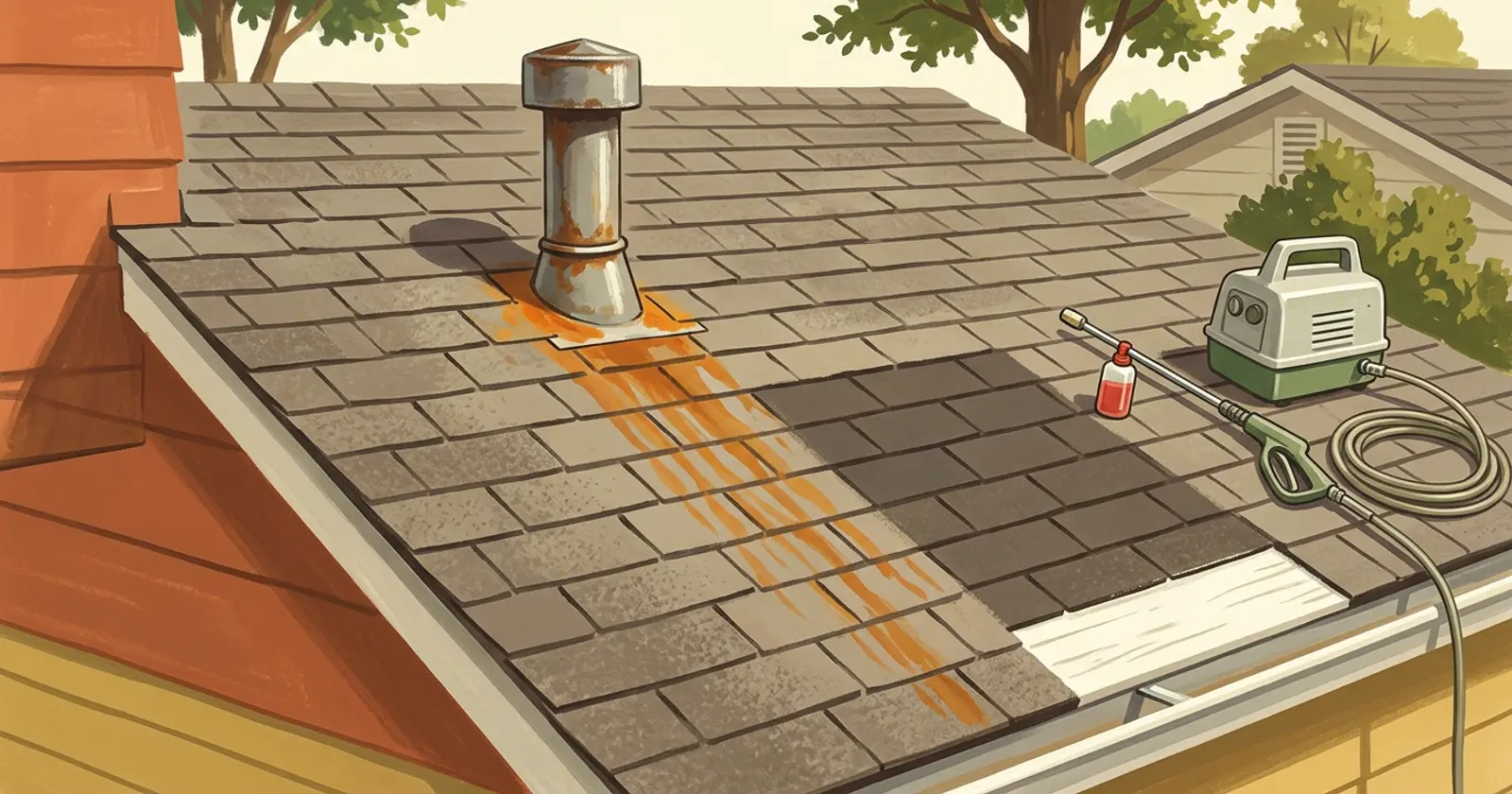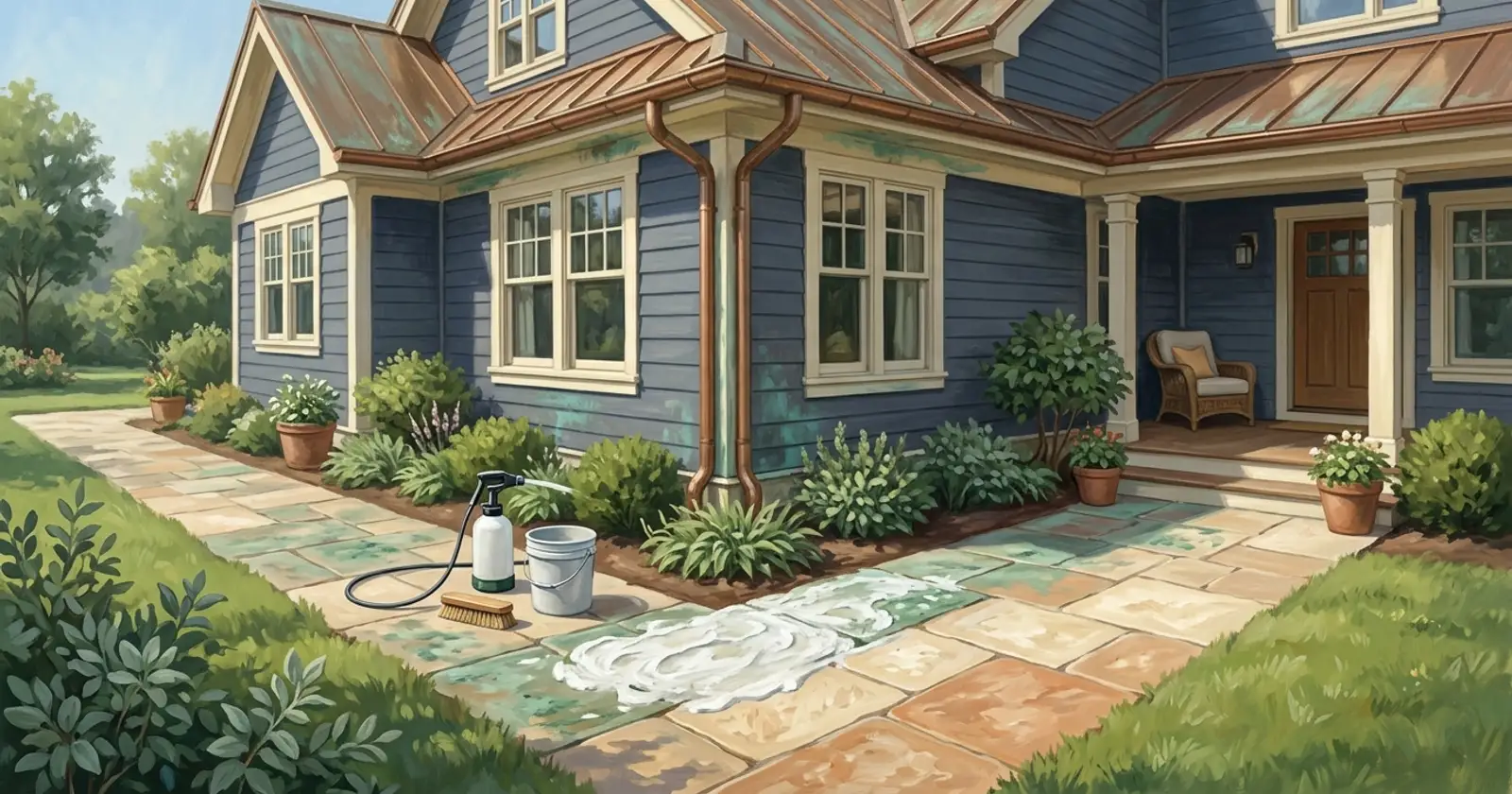
Washers see these jobs in trade forums. In one thread, a washer was asked to clean a travertine patio stained under copper gutters. The client said the last company had used vinegar. In another, a washer asked how to approach a copper roof that had stained the sidewalk below. One reply said he’d treat the concrete and leave the roof alone, because the patina protects the copper.
What the stains are
The copper industry’s trade association says copper’s natural weathering forms copper salts on the surface. Rain mixes with them, and where that water runs onto other materials it leaves the characteristic green stains. The General Services Administration (GSA), which maintains federal buildings, describes copper stains as green or muddy-brown discolorations caused by moisture acting on nearby copper, bronze or brass.
Leave the roof itself alone. The same association calls the patina a self-protective coating that is very durable and extremely stable. Cleaning it off isn’t the goal; cleaning what’s under it is.
How it comes out, by surface
| Surface | What removes it | Cost |
|---|---|---|
| Concrete walk or driveway | A copper-stain poultice: pre-wet, apply thick, cover with plastic, let dry 8 to 24 hours, scrape, rinse, repeat if needed (GSA procedure) | $125 to $450+ for metal-stain removal (Klein Pressure Washing, Texas; rust stains) |
| Whole driveway, for an even look | Treat the entire surface, not just the spots | About $700 to $1,000 for a four-car driveway (The Pressure Kru, Florida; rust stains) |
| Brick | The same GSA copper-stain spec covers brick, with surfaces below masked from runoff | Ask for a quote with a test area |
| Travertine, limestone or marble | GSA’s separate stone procedure; avoid acids on this stone | Ask for a quote with a test area |
We found no washer publishing a copper-specific price, so the prices are for rust, the other common metal stain. Middle column per the GSA procedures; the reading is ours. How we research: methodology.
The GSA’s spec for brick, concrete and limestone calls for a poultice designed to remove green copper stains. After it’s scraped off, the surface is rinsed at no more than 300 psi. One maker’s two-part copper stain remover is a strongly alkaline poultice that its data sheet says does not etch masonry. The sheet says to test a small area first and let it dry 3 to 7 days before judging. It also says to protect surrounding aluminum, metal, painted surfaces and plants from the solution and its fumes, so expect masking time in the quote.
On travertine, go slower. One stone supplier says travertine is a type of limestone, is very porous, and stains easily from acidic substances. A previous company’s vinegar treatment, as in the forum thread, is the kind of thing to ask about before quoting. Our guide to washing limestone, bluestone and flagstone covers gentle methods for stone.
Stop it coming back
A Florida washer’s rust page says it doesn’t recommend paying for removal until the cause is fixed, and that’s the same logic for copper. The copper trade association recommends overhangs, sloping copper away from other materials, gutters and drip edges. It also says a clear, silicone-based coating on cementitious surfaces helps protect them while new copper weathers fastest.
For other metal stains, see rust spots after a lawn treatment and sprinkler rust on house walls. If the roof itself is steel, see what metal roof makers allow.
Sources
Based on 10 sources · How we price
- PressureWashingResource community, Clean travertine and copper stains? (June 2025): pressurewashingresource.com/community/t/clean-travertine-and-copper-stains/40164
- A washers’ forum thread on copper roof runoff staining a sidewalk (July 2025; not linked)
- Copper Development Association, Architectural copper FAQs (archived copy, May 2026): web.archive.org/web/20260501055042/https://www.copper.org/applications/architecture/faqs.php
- Copper Development Association, Copper roofs and water runoff: an overview (archived copy): web.archive.org/web/20251029044946/https://www.copper.org/applications/architecture/water_runoff_overview.php
- U.S. General Services Administration, Removing copper-based stains from brick, concrete and limestone (archived copy): web.archive.org/web/20251118104017/https://www.gsa.gov/real-estate/historic-preservation/historic-preservation-policy-tools/preservation-tools-resources/technical-procedures/removing-copperbased-stains-from-brick-concrete-and-limestone
- U.S. General Services Administration, Removing copper/bronze stains from limestone and marble (archived copy): web.archive.org/web/20250918052645/https://www.gsa.gov/real-estate/historic-preservation/historic-preservation-policy-tools/preservation-tools-resources/technical-procedures/removing-copperbronze-stains-from-limestone-and-marble
- PROSOCO, Sure Klean Copper Stain Remover product data sheet (PDF): prosoco.com/Content/Documents/Product/SK_CSR_PDS_102419_C.pdf
- MSI, Natural travertine tile: all its perks and quirks: msistone.com/blogs/post/2012/03/01/caring-for-travertine-tile.aspx
- Klein Pressure Washing (Texas), Rust stains on concrete: best.kleinpressurewashing.com/pressure-washing-can-it-remove-rust-stains-from-concrete
- The Pressure Kru (St. Johns, FL), Rust removal service: thepressurekru.com/rust-removal-service-st-johns-fl