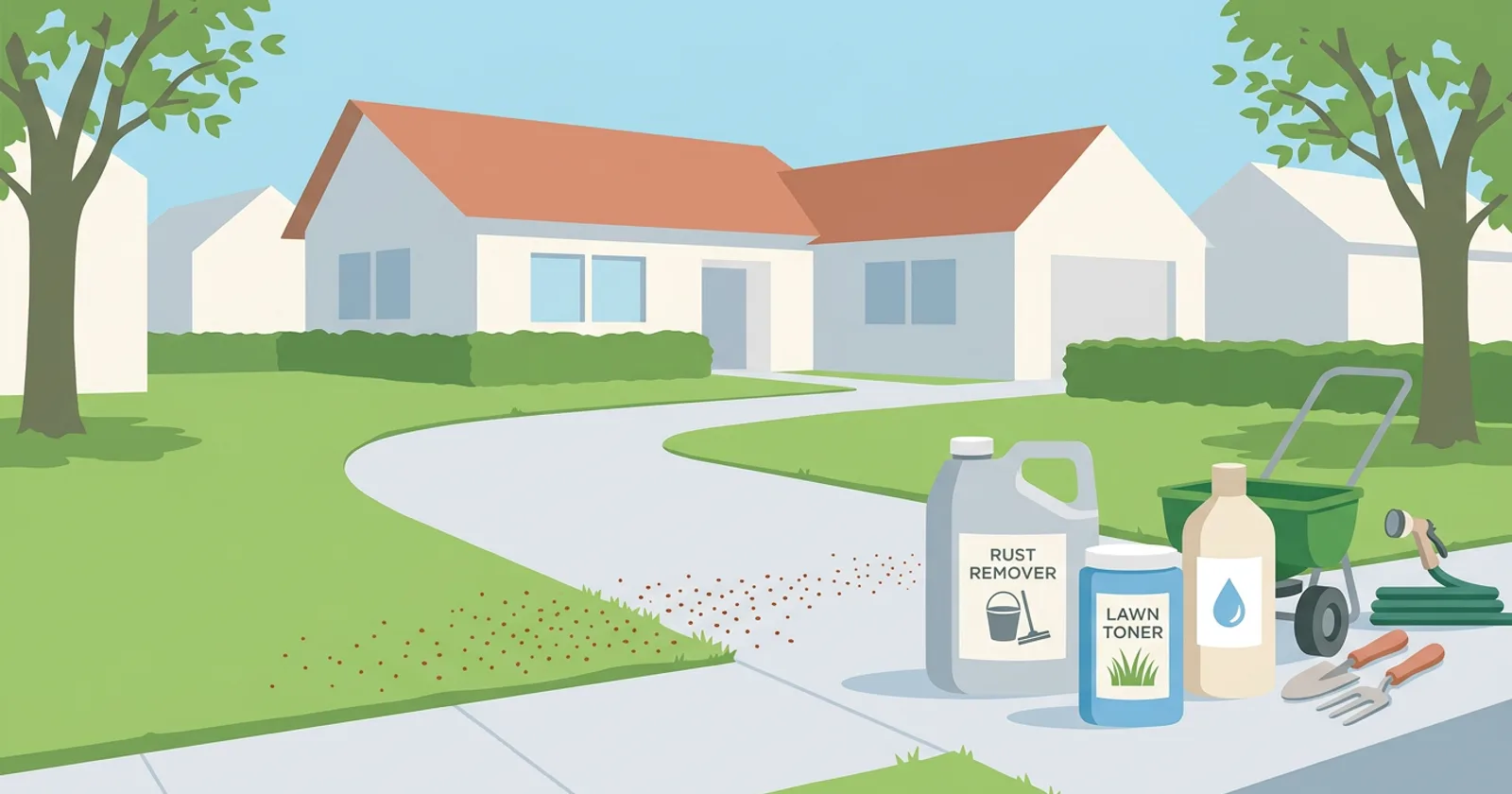
You can usually remove them with a rust remover made for concrete. Bleach won’t help, and black dots may be a different stain. Here is what’s going on, what to try in what order, and when to call someone else.
Why the spots appear
Many lawn fertilizers carry iron because it helps make a deep, dark-green lawn. One professional turf fertilizer label lists 2.0% iron and 1.0% manganese, and it warns that the iron “may stain concrete and painted surfaces.” A fertilizer maker explains that when iron oxidizes, red or orange staining can go along with it. A rust remover maker puts it simply: fertilizers with iron often leave rust spots once they get wet from rain or lawn watering.
That is why the dots look like a scatter pattern. Each one is a single granule that sat on the concrete until the sprinklers came on. Well-water sprinklers cause a similar orange stain on walls, covered in sprinkler rust on house walls.
Orange vs black spots
Orange or rust-colored dots point to iron. Black or very dark brown dots may not be iron alone. Some turf fertilizers also contain manganese, like the label above, and a federal preservation guide describes manganese stains as tan, brown, nearly black or gray. Rust removers are made for iron, so they may do less on a dark stain. Test a small spot first, and if nothing changes, have a pro look at it before you try anything stronger. Black dots on siding near mulch are a different problem: artillery fungus.
Don’t start with bleach
Bleach is the first thing many people grab, and it’s the wrong tool. A rust remover maker says customers who tried bleach on driveway rust stains had no success, and that it can make the stain a brighter orange.
Vinegar and baking-soda pastes are hit or miss. A homeowner in Arapahoe County, Colorado, told the county’s extension service that peroxide with baking soda and white vinegar did nothing at first. A later round of baking soda, peroxide and a steel brush worked, but took a lot of elbow grease. Grease needs a different approach, covered in what works on oil stains.
The stain ladder: gentlest first
Work up the ladder one step at a time, and test each product on a hidden corner of the concrete first. The table names products only so you can find the instructions we quote; it is not an endorsement.
| Step | What to use | How the maker or source says to use it | Watch out for |
|---|---|---|---|
| 1. Wait | Nothing | Stains fade “in time,” maybe by late summer (CSU Extension, Arapahoe County) | Slow; won’t help before a sale or event |
| 2. Concrete rust remover | The Rust Store Concrete Rust Remover | Mix as directed, brush on, let sit 15 to 30 minutes, then hose off | Scrub stubborn spots; work in small sections |
| 3. Oxalic acid | Oxalic acid powder (sold as wood bleach) | 1 lb per gallon of water, leave 2 to 3 hours, scrub and rinse (Portland Cement Association method) | Poisonous and corrosive; burns plants |
Oxalic acid is the strongest step and needs real care. An extension answer passed along a warning from another state’s extension office that it is poisonous and corrosive, and that children and pets should be kept away. The same answer warned it will burn plants, so don’t let it splash onto your lawn or beds. Follow the package directions carefully.
None of these sources tell you to blast the stain with high pressure. The remover and oxalic methods both end with a thorough rinse. If you are worried a wash already marked your concrete, see how to tell wash damage from damage that was already there. Streaks can appear if the rinse is uneven, as in this piece on driveway stripes.
When to call a pro, or the lawn company
Call the lawn company first if a service just treated your yard. Fertilizer labels tell the applicator to clean up hard surfaces. One label says to sweep or blow product off surfaces right after application because some ingredients can cause permanent stains. Take dated photos, ask whether they will treat the spots, and get any promise in writing.
Call a pressure washing pro when the stains cover a big area, the dots are black, or you’d rather not handle acids. Ask which rust remover they use, how they protect the grass and plants, and whether stain treatment is a separate line on the quote. Our questions to ask a house washing company cover the rest of that call. For typical driveway prices, see what pressure washing costs.
How to stop it next time
- Sweep or blow, don’t hose. Both labels we read say to sweep granules off (one adds blow) and not to wash them off with water.
- Clear the edges too. The Colorado homeowner swept the driveway, but the sprinklers washed granules from the lawn edge back onto it.
- Ask your lawn service to blow off the driveway and walks before they leave.
Skipping these steps is one of the easy mistakes homeowners make around a wash. For how we source and check every claim, see our methodology. If the lawn is also being reseeded, see washing around fall overseeding.
Sources
- Professional Turf Fertilizer 28-6-6 label: labelsds.com/images/user_uploads/Ferti%2028-6-6%20Label%2012-21-23.pdf
- EPA-accepted label, No Moss 10-4-6 (Reg. No. 2935-547), April 2009: www3.epa.gov/pesticides/chem_search/ppls/002935-00547-20090423.pdf
- Simple Lawn Solutions, How to Remove Fertilizer Iron Stains: simplelawnsolutions.com/blogs/lawncare/how-to-remove-iron-stains-due-to-fertilizer-applications
- The Rust Store, Concrete Rust Remover Step-by-Step: theruststore.com/blogs/articles/concrete-rust-remover-step-by-step
- The Rust Store, Does Bleach Work on Concrete Rust Stains?: theruststore.com/blogs/articles/does-bleach-work-on-concrete-rust-stains
- Ask Extension (Arapahoe County Extension, Colorado), Iron stains from fertilizer in concrete: ask.extension.org/kb/faq.php?id=457146
- Ask Extension (Arapahoe County Extension, Colorado), Rust stains in concrete: ask.extension.org/kb/faq.php?id=591530
- U.S. General Services Administration, Removing Manganese Stains from Brick Masonry (archived copy): web.archive.org/web/20260115211941/https://www.gsa.gov/real-estate/historic-preservation/historic-preservation-policy-tools/preservation-tools-resources/technical-procedures/removing-manganese-stains-from-brick-masonry