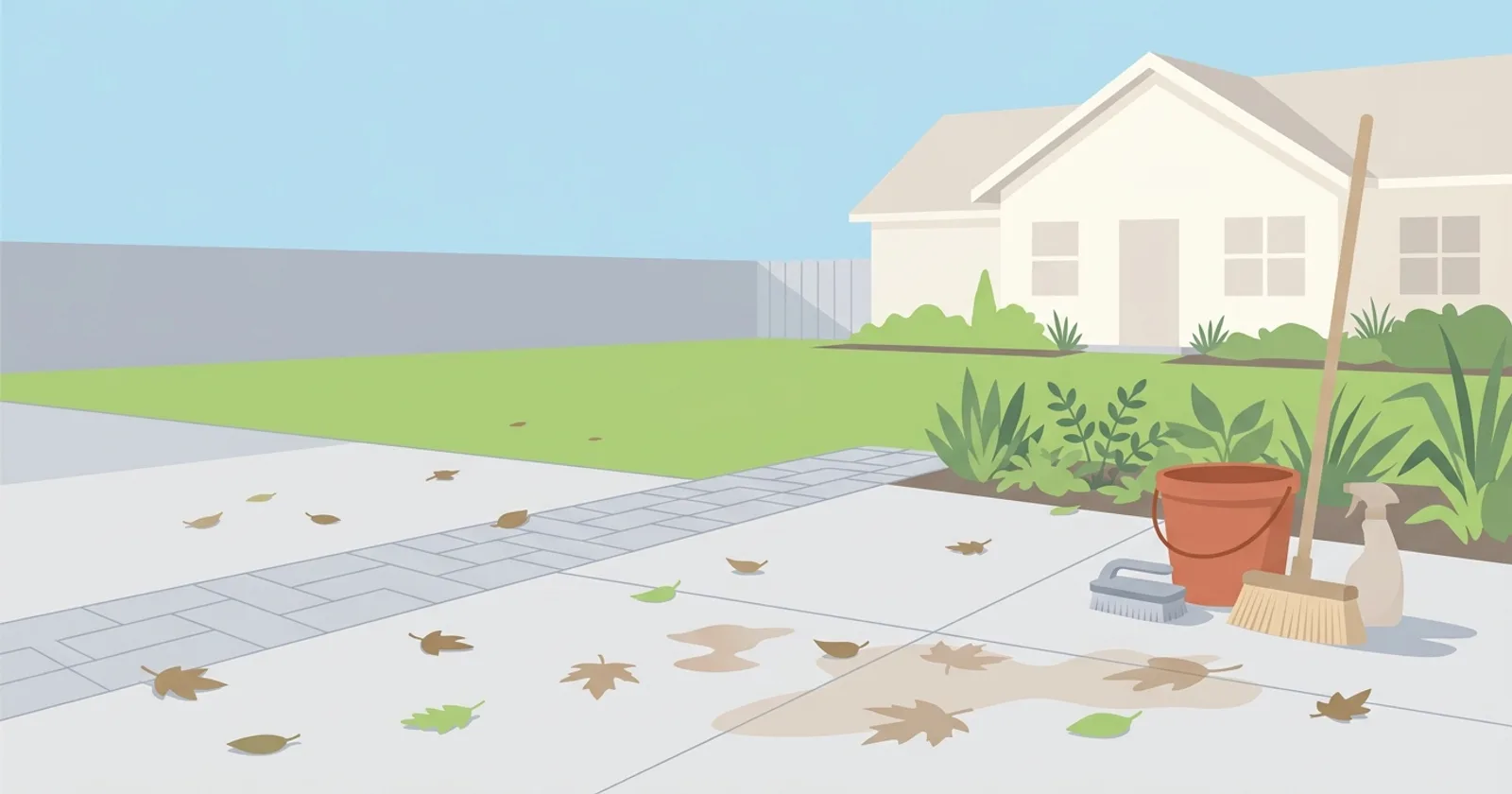
You know the look. It’s a perfect leaf print, or a brown blotch where a pile sat after a rain. Here’s why it happens, what to try in order, and when to call it done.
Why wet leaves leave a print
A paver maker explains that leaf stains come from the tannins in the leaves. Tannins bond with concrete pavers and are hard to remove. A university extension master gardener notes that oak leaves have high tannin levels and break down slowly.
Fall is when it happens. A Toronto homeowner on a pressure washing forum covered pavers with fabric while away. Where parts of the cover came off, leaves from a backyard tree left brown marks on the interlock.
Timing helps you plan. A University of Tennessee Extension forestry note covers the Knoxville area. It says fall color usually peaks the last week of October and can run into November. A paver maker calls sweeping or blowing the leaves off regularly your best defense.
Step 1. Clear the leaves and wait
Sweep the leaves off first. Then decide whether you need to do anything right now. Waiting works if you can.
One paver maker says winter snow and rain fade 80 to 100% of leaf staining on its own. Its proof is city sidewalks under big trees, which look clean by spring. For a back patio you won’t use until April, waiting costs nothing. A second paving maker agrees that stains fade with weather and regular upkeep, says sunlight often helps, and adds that a protective surface layer keeps stains shallower and quicker to clean. A university horticulture library notes that rain rinses tannins out of fallen leaves and that the prints show most on lighter surfaces.
Step 2. Use an oxygen cleaner
If you want it gone sooner, start with an oxygen-based cleaner. One concrete and driveway cleaner uses peroxide instead of bleach. Its label says:
- Mix 1 part cleaner to 20 parts water for hand cleaning (1.5 cups in 2 gallons).
- Scrub with a soft-bristle brush and rinse before it dries.
- With a pressure washer, let it sit 3 to 5 minutes. Then rinse with the nozzle at least 2 feet away.
- Test a hidden spot first, rinse any plants it touched, and never mix it with bleach.
A paver maker’s leaf-stain page suggests the same idea. Use dish soap or an oxygen cleaner, warm water and a stiff-bristle brush.
Step 3. Try a mild bleach mix
If an oxygen cleaner leaves a shadow, chlorine bleach is one more option. A bleach maker’s patio guide says its mix works on sealed concrete and sealed pavers. It lists “stains from leaves” among what it cleans. Its directions:
- 1/3 cup of regular bleach in 1 gallon of water.
- Water nearby plants first, pre-wet the patio, then scrub with a deck brush.
- Leave it on 6 minutes for general cleaning. Rinse well, and water the plants again.
Another paver maker suggests a much stronger mix, 1 part bleach to 4 parts water. Start with the milder mix and test a corner before going stronger. Wear gloves and eye protection.
What pressure alone does
A paver maker says tannins bond with concrete pavers, so water alone may not lift them. One trade-forum thread covered a retail parking deck. A washer described leaves and filth soaking into concrete under a constant drip. Another washer advised telling customers to expect the stains to “lessen but not remove.”
Pressure can also hurt. A paver maker warns not to knock out the joint sand. Never spray at point-blank range. For another water-only problem, see dark, blotchy concrete after a water-only wash.
Quick guide by stain
Brand names appear only to point to the pages quoted, not as picks.
| Situation | Try | What the source says | Watch for |
|---|---|---|---|
| Fresh prints, area not in use | Sweep, then wait | Unilock: winter weather fades 80 to 100% of staining | Keep sweeping leaves off |
| Light stains | Simple Green Oxy Solve (peroxide) | 1:20 by hand; 3 to 5 minutes before pressure rinse | Don’t let it dry; rinse plants |
| Shadow remains | Clorox Disinfecting Bleach | 1/3 cup per gallon; 6 minutes; rinse | Water plants before and after |
| Still there after bleach | Stronger bleach mix or hot water | Western Interlock: 1 part bleach to 4 parts water, or hot water | Test first |
When old stains only lighten
Some stains don’t fully leave. In an older trade-forum thread, a washer tried four things on oak and magnolia stains: straight bleach, a stronger pool-grade chlorine, TSP and a degreaser. Nothing worked, and one reply called them “there to stay.” Other washers suspected the chlorine had dried too fast on sunny concrete. They suggested a cool morning and keeping the spot wet.
Results vary, so aim for lighter rather than gone. For stubborn marks, a paver maker mentions a hot-water pressure washer. That’s gear a pro brings. See what pressure washing costs before you call. An orange or white mark is a different stain. See rust spots after a lawn treatment or white haze on brick and pavers. For grease, see oil stains on concrete. Faded color is also a separate problem. See faded pavers.
Every number here was checked against its source. Our methodology explains how.
Sources
Based on 11 sources · How we price
- Unilock, “How to remove leaf stains from pavers” (archived copy, November 2024): web.archive.org/web/20241111102637/https://unilock.com/maintenance/how-to-remove-leaf-stains-from-pavers
- Western Interlock, “Effective Cleaning Solutions for Stubborn Stains on Pavers”: westerninterlock.com/effective-cleaning-solutions-for-stubborn-stains-on-pavers
- Simple Green, Oxy Solve Concrete and Driveway Cleaner (product directions): simplegreen.com/products/oxy-solve-concrete-driveway-cleaner
- Clorox, “How to Clean a Concrete or Cement Patio”: clorox.com/learn/how-to-clean-a-concrete-or-cement-patio-with-bleach
- MBI (paving maker), How to clean leaf stains: mbi.nl/en/knowledge-base/how-to-clean-leaf-stains
- University of Washington Botanic Gardens, Elisabeth C. Miller Library, What causes autumn leaves to stain concrete?: depts.washington.edu/hortlib/pal/what-causes-autumn-leaves-to-stain-concrete
- University of Illinois Extension Master Gardener answer on oak leaves (Ask Extension): ask.extension.org/kb/faq.php?id=435557
- University of Tennessee and Tennessee State University Extension, Bedford County Ag Note on fall color (October 2021): bedford.tennessee.edu/wp-content/uploads/sites/162/2021/10/AG-NOTEOctober-26-2021.pdf
- Community discussion: r/pressurewashing, “Tannin stains on interlock” (December 2025): reddit.com/r/pressurewashing/comments/1prpb3j
- Community discussion: PressureWashingResource.com, “Are my expectations too high? Re: Stain Cleaning” (March 2025): pressurewashingresource.com/community/t/are-my-expectations-too-high-re-stain-cleaning/39637
- Community discussion: PressureWashingResource.com, “Help! Can’t get these stains out” (March 2020): pressurewashingresource.com/community/t/help-can-t-get-these-stains-out/24422