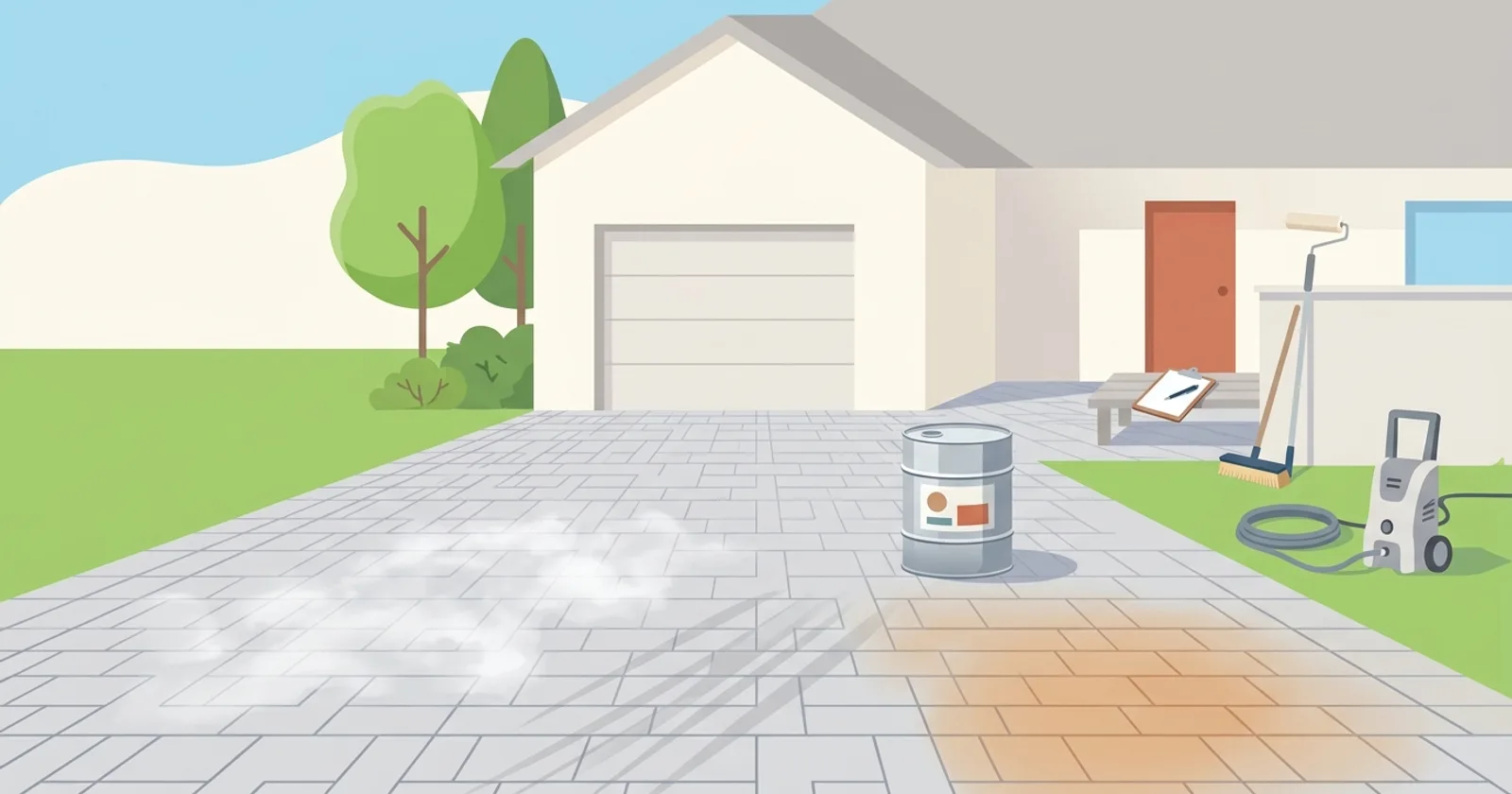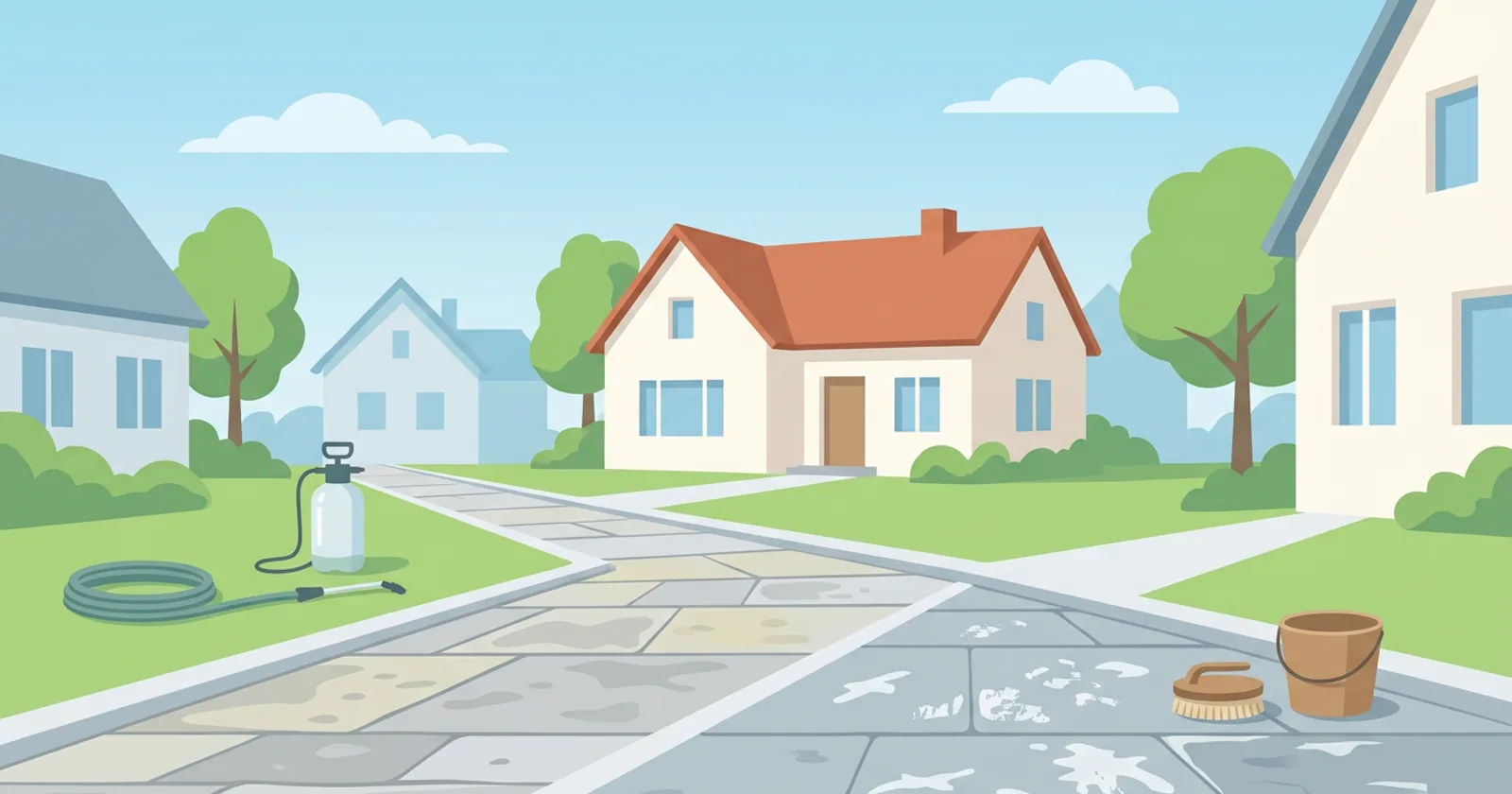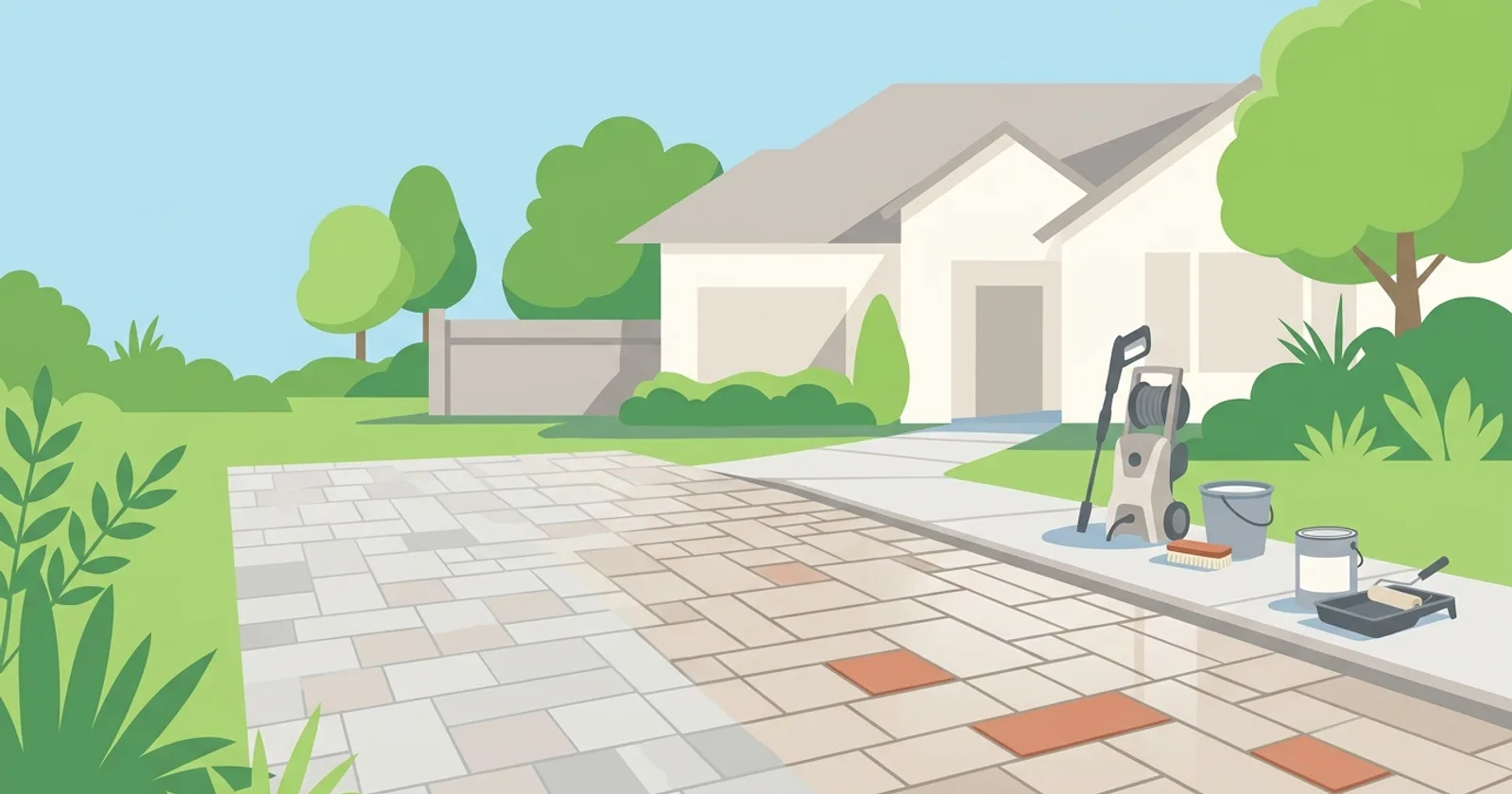
So before you pay for a restoration, figure out which kind of faded you have. A washer on a pressure washing forum described the problem well in August 2026. A client’s large paver driveway was only three years old. Yet a lot of the pavers already showed bare aggregate. The pavers tucked under the eaves, out of the sun and rain, looked close to new once cleaned. That contrast is the best clue you have.
Three kinds of “faded”
Dirt and growth. A gray film of dirt, algae or mildew makes any paver look dull. This is the easy one. A proper cleaning brings the color right back.
A white haze. Powdery white salts or old sealer can make pavers look chalky and pale. That isn’t fading at all. Our guide to white haze on brick, pavers or stone shows how to tell the causes apart.
Real wear. Sun, weather and traffic slowly wear the top of the paver away. How much that changes the look depends on how the paver was made.
| What you see | Likely cause | Will cleaning or sealing help? |
|---|---|---|
| Even gray or green dullness; color shows when wet | Dirt, algae or mildew | Yes. Cleaning alone often does it |
| White powder or chalky film | Efflorescence or old sealer | Yes, with the right cleaner, not a sealer |
| Lighter color, same smooth face | Sun and weather on the pigment | Partly. An enhancing sealer can deepen it |
| Coarse stones showing across the face | Top surface worn away | Only a little. The lost layer won’t come back |
| Worst in sun, fine under eaves or furniture | Sun and rain exposure | Partly; shaded pavers show the original color |
How the two paver types wear
Paver makers build concrete pavers two main ways.
A through-body (or thru-mix) paver uses the same blend of large and small stones from top to bottom. One paver maker says concrete will wear at the surface and expose the large aggregates. That makes the paver look less colorful and older.
A face-mix paver has a thin top layer of finer stones and concentrated color over a coarser base. One maker puts that layer at about 10% to 12% of the paver’s depth. A landscape supply retailer describes face-mix pavers as about 90% coarse base. The fine top resists wear, but it is thin. If it wears through early, as on the three-year-old driveway, the coarse base shows.
You may not know which type you have. Ask the installer for the paver maker and product name. It matters for every step that follows.
Cleaning can help or hurt
Cleaning is always the first move, since you can’t judge the color through dirt. But how it’s done matters. The paver industry’s trade association says to use a low setting and a wide spray. It warns that too much focused pressure can strip the surface off the pavers. On worn pavers, an aggressive wash can make exposed stone look worse. Old or fragile natural stone, like a grave marker, is covered in the headstone guide.
The same group adds that sand left on the pavement year after year can wear the surface. It may speed up color change. Sweeping it off is a simple habit that helps. Fall leaves can mark pavers too. See leaf stains on concrete and pavers.
What a color-enhancing sealer can do
A sealer with a color enhancer works a bit like water. It darkens and deepens the surface. One paver maker says a wet-look sealer deepens paver color and may add gloss. That same maker says a good sealer resists the fading caused by strong sun and UV rays.
That is protection going forward, not repair. An enhancer deepens whatever color is still on the face. Where the colored layer is gone, you get darker exposed stone, not the original look. In the forum thread, one reply pointed to a color-boosting sealer. That’s a reasonable try, if everyone agrees on what “better” means.
Two practical points:
- Test first. One sealer maker’s data sheet says to test on a hidden patch of about 4 square feet. If you skip the test, its warranty applies only to that patch.
- Plan to redo it. The trade association says sealers need reapplying every 3 to 5 years.
For the full process and pricing, see what a paver clean, sand and seal includes. If the sealer turns cloudy or streaky, our guide to paver sealer problems covers the fixes.
Dry, sunny climates
Take a dry, hot market. NOAA’s 1991–2020 normals for the Las Vegas airport show only 4.18 inches of rain a year. They show about 78 days at 100°F or hotter. The forum washer above said it doesn’t rain much where they work, either. If you live somewhere like that, ask the installer how often to clean and reseal.
Questions for the installer and washer
- Which paver is it? Get the maker and product name, and ask whether it’s face-mix or through-body.
- What does the warranty cover? One paver maker’s lifetime guarantee covers structural integrity. Its maintenance advice lists weather and general wear as things owners handle with cleaning. Fading may not be covered.
- What pressure and tip will you use? A careful washer will answer without hesitating.
- Can we see a test patch? Judge it dry, in daylight, before the whole job.
Our questions to ask a washing company help with the rest of the call. Every number here traces to a source, as our methodology explains.
Sources
Based on 8 sources · How we price
- Unilock Commercial, EnduraColor Facemix vs. Classic Thru-mix: commercial.unilock.com/enduracolor-facemix-vs-classic-thru-mix
- Lurvey, Concrete Pavers: Face Mix vs. Standard Mix (Jan. 2019): lurveys.com/concrete-pavers-face-mix-vs-standard-mix
- Unilock, Paver Sealing Pros and Cons Explained: unilock.com/diy/paver-sealing-pros-cons
- Unilock, Warranty Terms (2020): unilock.com/wp-content/uploads/2020/05/Unilock-Warranty-Terms-2020_HR.pdf
- Concrete Masonry & Hardscapes Association, Hardscaping for All Seasons: cmha.org/news-and-insights/hardscaping-for-all-seasons-year-round
- Alliance Gator, Gator Hybrid Seal Low Gloss with Color Enhancer technical data sheet (July 2025): alliancegator.com/wp-content/uploads/documentation/tds/gator-sealers/alliance-tds-seal-low-gloss-ce-july-17-2025.pdf
- NOAA NCEI, 1991–2020 annual normals, Las Vegas airport (USW00023169): ncei.noaa.gov/data/normals-annualseasonal/1991-2020/access/USW00023169.csv
- Community discussion, PressureWashingResource forum, “Faded pavers” (Aug. 2026): pressurewashingresource.com/community/t/faded-pavers/41084