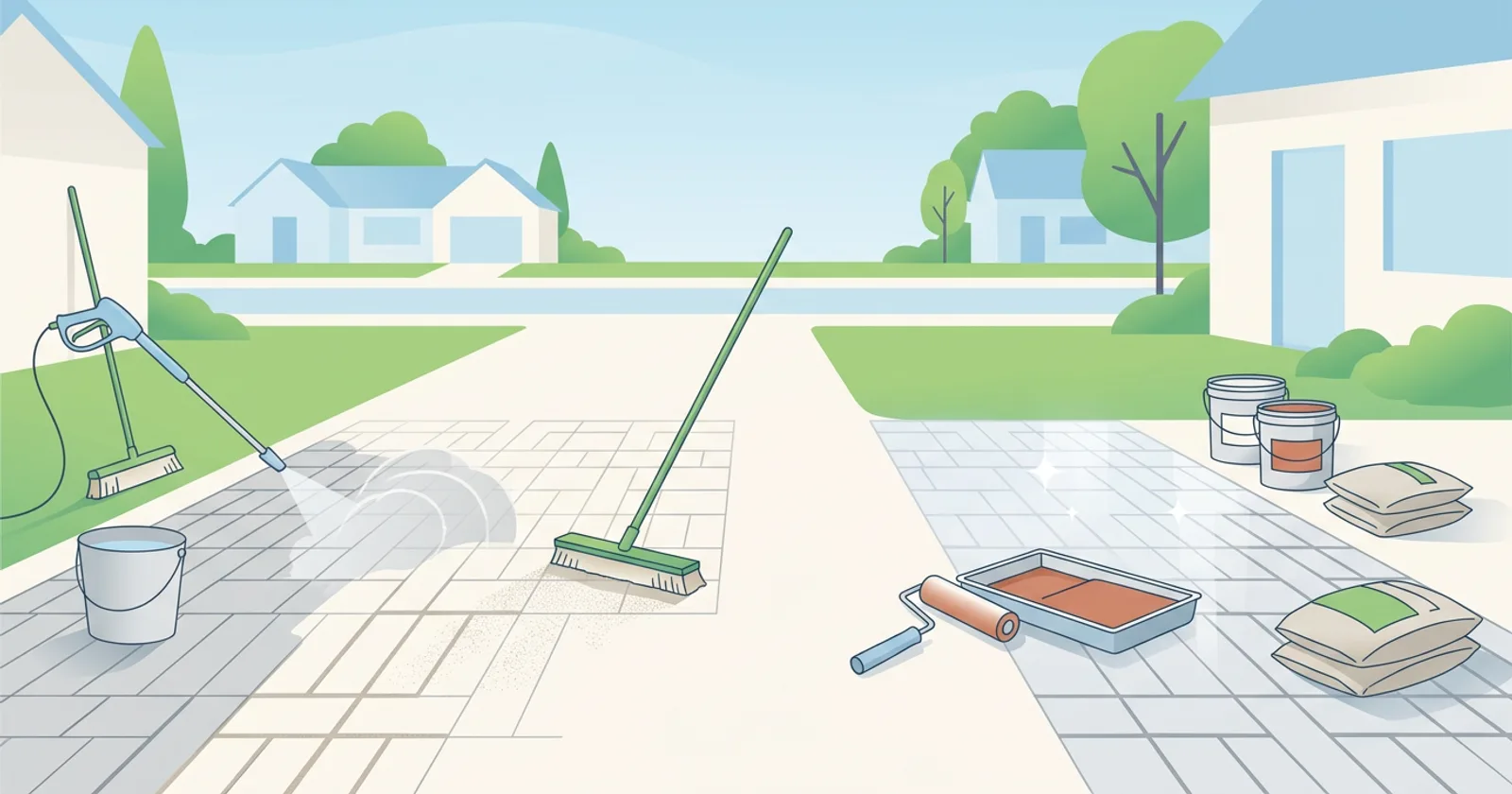
A homeowner on a pressure washing forum asked whether $800 just to sweep in polymeric sand was normal. Washers in the replies split: some called it high, others said it was fair once you count removing old sand, drying and compacting. Here’s what you’re paying for.
The three steps, and what each one fixes
1. Clean. Washing lifts dirt, algae and stains, and on a restoration it also clears out old joint sand. For a routine rinse, the concrete paver industry’s trade association says to use a low setting and a wide spray, because focused pressure can strip the paver surface or blast sand out of the joints. For tough spots, see what works on oil stains.
2. Re-sand. Polymeric sand is sand mixed with additives that harden once it’s watered. One maker’s label is strict:
- Pavers must be completely dry, or the polymer leaves a stain.
- Clean the joints to the full depth of the paver.
- Compact the sand before wetting it, then blow every bit of dust off the surface.
- Mist it with care: too little water and it won’t harden all the way down, too much and a white film floats onto the pavers.
- Put it down only when no rain is forecast for 24 hours.
That label lists 40 to 55 square feet per 50-pound bag for 1/4-inch joints, so a 400-square-foot patio takes roughly 8 to 10 bags. The label adds that coverage varies a lot with paver size, shape and depth.
3. Seal. Sealer is the optional step. The trade association says sealing helps resist stains like grease and wine, deepens color and helps hold joint sand, but isn’t necessary. It also needs reapplying every 3 to 5 years. One sealer maker’s natural-look product covers about 175 square feet per gallon, so that same patio takes about 2.3 gallons. Plan on buying three.
Why it takes days, not hours
Drying time is the hidden cost. One sealer maker’s steps:
- Remove stains and replace the joint material with polymeric sand.
- Wait at least 48 hours with no rain for the sand to harden.
- Clean the whole surface again.
- Wait another 48 hours with no rain so the sand and pavers are dry.
- Seal, then let it dry 24 hours before using the area.
That’s about five days, plus return trips. Some crews move faster: one washer on a pressure washing forum described washing on day one, sanding on day two and sealing on day three. Either way, the crew comes back more than once, and that’s built into the price. If the sealed surface later turns hazy or streaky, read about paver sealer problems.
What operators publish
Brand and company names appear here only to show whose prices these are.
| Operator | Where | Published price | What’s included |
|---|---|---|---|
| Craft Pavers | Boca Raton, FL | $1.50/sq ft up to 1,000 sq ft ($1,000 minimum); $1.25 for 1,000–2,500; $1.10 over 2,500 | Pre-treatment, pressure wash, polymeric sand, sealer, written warranty; stripping old sealer is an add-on |
| PaverCare | Dayton, OH | $3.25/sq ft up to 700 sq ft ($1,000 minimum); $3.00 for 701–1,500; $2.15 over 1,500 | Steam cleaning, weed and moss removal, re-sanded joints, joint-stabilizing sealer; repairs extra |
| Elowsky Lawn Services | Oakland County, MI | $600–$1,200 clean and seal (patios up to 400 sq ft); $1,200–$2,500 full restoration; $1.50–$4.00/sq ft typical | Clean and seal tops up joint sand; full restoration replaces all of it and relevels sunken pavers |
On a 400-square-foot patio, the Dayton operator’s small-job rate works out to $1,300. The Boca Raton operator’s rate would be $600, but its minimum lifts that to $1,000. Small jobs cost more per foot because the setup, drying and return visits don’t shrink with the patio. Compare that with a plain wash in our pressure washing cost guide.
Doing it yourself
A new homeowner asked on a pressure washing forum whether washing, resanding and sealing a pool deck was something to learn by trial and error. It’s doable, but the label steps above are where DIY jobs go wrong: the sand maker warns that damp pavers, leftover dust or too much water can leave stains or a white film. If you’re buying a machine for it, our electric or gas pressure washer guide covers what concrete needs.
Two rules from the trade association are worth knowing:
- If the sand sits more than half an inch below the paver edge, refill it. Plain dry masonry sand and a push broom work for a simple top-up.
- Permeable pavers are different. Don’t use polymeric sand or sealer on them, because both block the water they’re built to drain.
The same group suggests calling a professional if you’re sealing for the first time.
Timing in a freeze-thaw city
Weather sets the schedule. In Salt Lake City, NOAA’s 1991–2020 normals show about 112 days a year with a low of 32°F or colder and about 52 inches of snow. But June through August averages only about 2 inches of precipitation. The trade association says dry weather is critical for most sealers and calls summer the best season for sand and sealing. It also suggests checking joint sand each fall, before freeze-thaw cycles do more damage.
If you hire it out, get the scope in writing: old sand removed or just topped up, which sealer, and who handles stripping. Our questions to ask a washing company help with that call. Every number here traces to a source. See our methodology.
Sources
- Concrete Masonry & Hardscapes Association, Hardscaping for All Seasons: cmha.org/news-and-insights/hardscaping-for-all-seasons-year-round
- Sakrete, Paver Set Polymeric Sand data sheet (hosted by Lowe’s): pdf.lowes.com/productdocuments/432c46be-009f-4ece-b6a3-fd52f9c9aac7/16107764.pdf
- Alliance Gator, Gator Seal Signature Series Natural Look technical data sheet (July 2025): alliancegator.com/wp-content/uploads/documentation/tds/gator-sealers/alliance-tds-seal-natural-look-july-17-2025.pdf
- Craft Pavers, Pricing: craft-pavers.com/pricing
- PaverCare (Dayton, OH), Pricing: paverpatiocleaning.com/pricing
- Elowsky Lawn Services, Paver Restoration: elowskylawn.com/hardscaping/paver-restoration
- NOAA NCEI, 1991–2020 annual/seasonal normals, Salt Lake City International Airport (USW00024127): ncei.noaa.gov/data/normals-annualseasonal/1991-2020/access/USW00024127.csv
- Community discussion: r/pressurewashing, “Clean, sand, and seal” (May 2025): reddit.com/r/pressurewashing/comments/1khw4bw