Per deck, washers’ pages run roughly $150 to $600 for a typical backyard deck. A first cleaning on a deck neglected for years costs more, and sealing, re-sanding or paint stripping is priced on top.
Two questions matter as much as the price. Will the cleaning hurt the deck? And will the dirt, sand and chemicals end up in the water?
What washers publish
Company names appear here only to show whose prices these are.
| Washer | Where | Published price | What they note |
|---|---|---|---|
| Pressure Washing Cypress | Cypress, TX | $0.15–$0.30/sq ft for a concrete pool deck | General range from its cost page |
| Valley Pro Power Wash | Phoenix, AZ | $0.25–$0.50/sq ft; $149–$299 up to about 500 sq ft; $249–$449 for about 500–1,000 sq ft | Hard-water scale, sunscreen, algae and paver joints raise the price |
| Cool Breeze Premier Pressure Washing | Largo, FL | Flat rates from $50 (small), $110 (medium), $165 (large), $235 (extra large) | Loose items must be cleared first |
| Hydro Wash 360 | Jacksonville, FL | $200–$600 a visit for 400–1,000 sq ft; $500–$800 for a neglected deck | Sealing $1.50–$2.50/sq ft for pavers, $2.00–$3.50 for travertine; stripping old sealer adds $1.50–$3.00/sq ft |
| HydroSeal | Jacksonville, FL | Travertine sealing from $1.60/sq ft | Final price depends on condition and prep |
The Phoenix washer gives its own example. A 700-square-foot deck at $0.25 to $0.50 works out to $175 to $350. That’s before stains, minimums or add-ons. “Starting at” rates are floors, not quotes. Compare these with a plain driveway or patio wash in our pressure washing cost guide.
What drives the price:
- the surface
- years of neglect, since heavy buildup needs more cleaner and dwell time
- stains like hard-water scale and sunscreen residue
- add-ons
Re-sanding, sealing and stripping are separate jobs. Each has its own drying time.
Three surfaces, three jobs
Concrete is the quick end, but coatings vary. The Largo washer says cool deck, pavers, concrete and travertine each get their own method. It identifies the coating on site.
Pavers sit on joint sand. A concrete paver trade group warns that focused pressure can strip the paver surface or blast the sand out of the joints. It suggests a low setting with a wide spray. That’s what happened to one homeowner on a pressure washing forum. A trainee washed the travertine pool patio and left sand everywhere. Replies said the fix is new polymeric sand and sealer, not new stone. Our paver clean, sand and seal guide covers that job and its price.
Travertine is the touchiest. A travertine supplier says no single pressure or nozzle distance suits every installation. A crew should test a small hidden spot. It should stop if the stone, fill or joints start to erode. The same supplier says to keep vinegar, lemon and acidic bathroom cleaners off travertine.
Washers disagree on how gentle to be. On one trade forum, a poster said online advice ranged from a low-power wash to a mop only. A reply said they soft wash or use a surface cleaner. The Jacksonville washer soft-washes travertine only. Natural stone has its own quirks, covered in our guide to washing limestone, bluestone and flagstone.
Keeping the pool out of it
Before the crew starts, ask how they’ll handle:
- Loose debris and sand. Sweep it away from the pool before any water goes down.
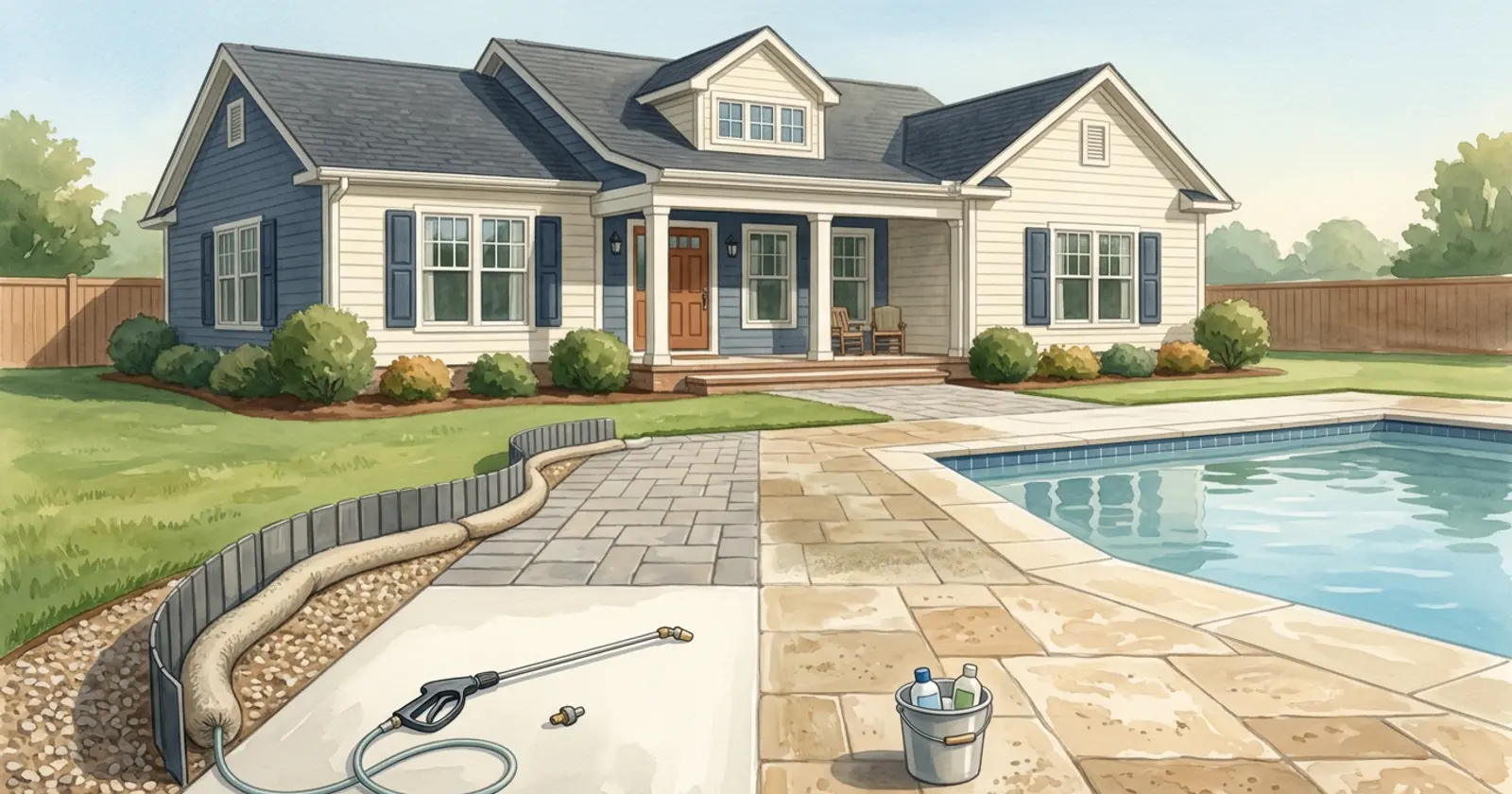
- Runoff direction. One washer planning a paint-stripping job described laying water tubes along the pool edge to stop runoff.
- The pump and skimmer. For messy work, washers in the same thread suggested three steps. Shut the pump off, cover the pool and add a fine sock to the skimmer basket.
- The filter afterward. Two pool-equipment makers say to clean the filter when its gauge reads about 10 psi above its clean starting pressure.
- Lawn fertilizer and gunk. A salt-chlorine generator maker’s guide warns that phosphates or nitrates in pool water use up chlorine as fast as it’s made. Keep lawn fertilizer residue and other gunk out of the pool.
Runoff that leaves the yard matters too. Florida’s Sarasota County defines an illicit discharge as anything entering the storm drain system that isn’t solely rainwater. The county lists household cleaners, paints and chlorinated pool water as examples. It says the system doesn’t treat water before it reaches creeks and bays. Paint chips or cleaner may end up in your pool, and you may have to drain it. If so, the county wants chlorine at or below 0.01 mg/L and pH between 6.5 and 8.5 first. Check your own city or county’s rules.
Paint and stain removal costs most
Stripping is a different job from washing. The Jacksonville washer adds $1.50 to $3.00 a square foot to strip old sealer before resealing. In one community thread, a washer planned to charge about $3,200 to strip paint and stain from a 1,900-square-foot pool area. Replies urged a test spot first. If the paint came from another trade’s overspray, see our guide to paint overspray and drips.
Wash or reseal?
A yearly wash is maintenance. Resealing is the bigger, less frequent cost. By the Jacksonville washer’s schedule, it’s about every 2 to 3 years for concrete and 3 to 5 for travertine. If a recent sealer looks cloudy or striped, read about paver sealer problems before paying for another coat. For the screens over a lanai, see our pool cage cleaning guide.
Get the scope in writing:
- surface type and cleaner
- how runoff is kept out of the pool
- whether sand or sealer is included
Our questions to ask a washing company help with that call. Every number here traces to a source. See our methodology.
Sources
Based on 15 sources · How we price
- Pressure Washing Cypress (Cypress, TX), How Much Does It Cost to Pressure Wash a Concrete?: pressurewashingcypress.com/how-much-does-it-cost-to-pressure-wash-a-concrete
- Valley Pro Power Wash (Phoenix, AZ), How Much Is It To Get My Pool Deck Power Washed in Phoenix?: valleypropowerwash.com/how-much-is-it-to-get-my-pool-deck-power-washed-in-phoenix
- Cool Breeze Premier Pressure Washing (Largo, FL), Pricing: coolbreezepw.com/pricing
- Hydro Wash 360 (Jacksonville, FL), How to Clean and Seal a Pool Deck in Jacksonville: hydrowash360.com/blog/pool-deck-cleaning-jacksonville
- HydroSeal (Jacksonville, FL), Travertine & Pool Deck Sealing: hydrosealpavers.com/paver-sealing/travertine-sealing
- Concrete Masonry & Hardscapes Association, Hardscaping for All Seasons: cmha.org/news-and-insights/hardscaping-for-all-seasons-year-round
- TravertineMart, Pressure Cleaning Travertine Pavers: travertinemart.com/buyers-guide/pressure-cleaning-travertine-pavers
- TravertineMart, How to Clean Travertine Tiles: travertinemart.com/buyers-guide/how-to-clean-travertine-tiles
- Hayward, Better Filters: hayward.com/why-hayward/explore-products/better-filters
- Pentair, Cleaning and Maintaining Your Pool Filters: pentair.com/en-us/education-support/water-education-center/pool-and-spa-education/cleaning-and-maintaining-your-pool-filters.html
- Pentair, IntelliChlor SCG Quick Start Guide and Tips: pentair.com/content/dam/extranet/nam/pentair-pool/pool-manuals/intellichlor/IntelliChlor_Quick_Start_Guide_and_Tips_English.pdf
- Sarasota County, Community Stormwater Tips: scgov.net/government/stormwater/watersheds/community-stormwater-tips
- Community discussion: r/pressurewashing, a pool patio after a pressure wash (March 2026): reddit.com/r/pressurewashing/comments/1rzd320
- Community discussion: r/pressurewashing, stain and paint removal around a pool (May 2026): reddit.com/r/pressurewashing/comments/1td1nf0
- Community discussion: PressureWashingResource, travertine tile pool decking (October 2024): pressurewashingresource.com/community/t/travertine-tile-pool-decking/39176