That’s what happened to one homeowner who asked about it on a home forum in August (community discussion). A neighborhood kid pressure washed the pool patio, and afterward stones were missing on the far side, making barefoot walking painful. Replies suggested the surface may already have been deteriorating, and that the wand finished the job. Here’s what cleaning, sealing and repair cost, and how to avoid that outcome.
Why stones come out
One sealer made for exposed aggregate says it protects against water seepage and aggregate loosening, which is the case for sealing it.
Pressure is the other factor. One floor paint maker’s directions say to keep a pressure washer at 1,750 psi or lower to avoid damaging concrete. One reply in the forum thread noted that this kind of pea-gravel surface doesn’t need much pressure to start losing the fine material between stones.
What it costs
| Job | Published price per sq ft | 400 sq ft pool deck | 1,000 sq ft driveway |
|---|---|---|---|
| Pressure wash only (Twisted Nozzle, Houston area) | $0.20 to $0.40 | $80 to $160 | $200 to $400 |
| Seal only (A-1 Concrete Leveling) | $0.40 to $0.90 | $160 to $360 | $400 to $900 |
| Seal only (Twisted Nozzle) | $0.50 to $2 | $200 to $800 | $500 to $2,000 |
| Seal only (Sam the Concrete Man) | $1.20 to $1.75 | $480 to $700 | $1,200 to $1,750 |
| Clean and seal together (A-1 Concrete Leveling) | About $1.00; minimum $300 to $400 | About $400 | About $1,000 |
These are the companies’ general concrete prices, not quotes for exposed aggregate specifically; totals are our arithmetic. Prices from each company’s own page, checked October 2026. How we research: methodology.
Rough exposed aggregate can take more sealer than smooth concrete, as the coverage numbers below show, so ask how a quote accounts for that.
Sealer coverage and coats
- Solvent-based, made for exposed aggregate: one maker’s data sheet recommends two thin coats and gives a net coverage of 100 sq ft a gallon on exposed aggregate. That’s about 4 gallons for a 400 sq ft deck and 10 for a 1,000 sq ft drive.
- Water-based: another maker lists 200 to 300 sq ft a gallon on exposed aggregate, and says porosity varies so much that test panels should be made first.
The solvent sheet also says to apply only when surface and air temperatures are between 50°F and 90°F, and to let the surface dry 24 hours after washing. On a pool deck, ask whether the sealer will be slick when wet before you choose. Our guide to stamped concrete clean and reseal covers slip and resealing intervals for decorative concrete.
Repairing popped stones
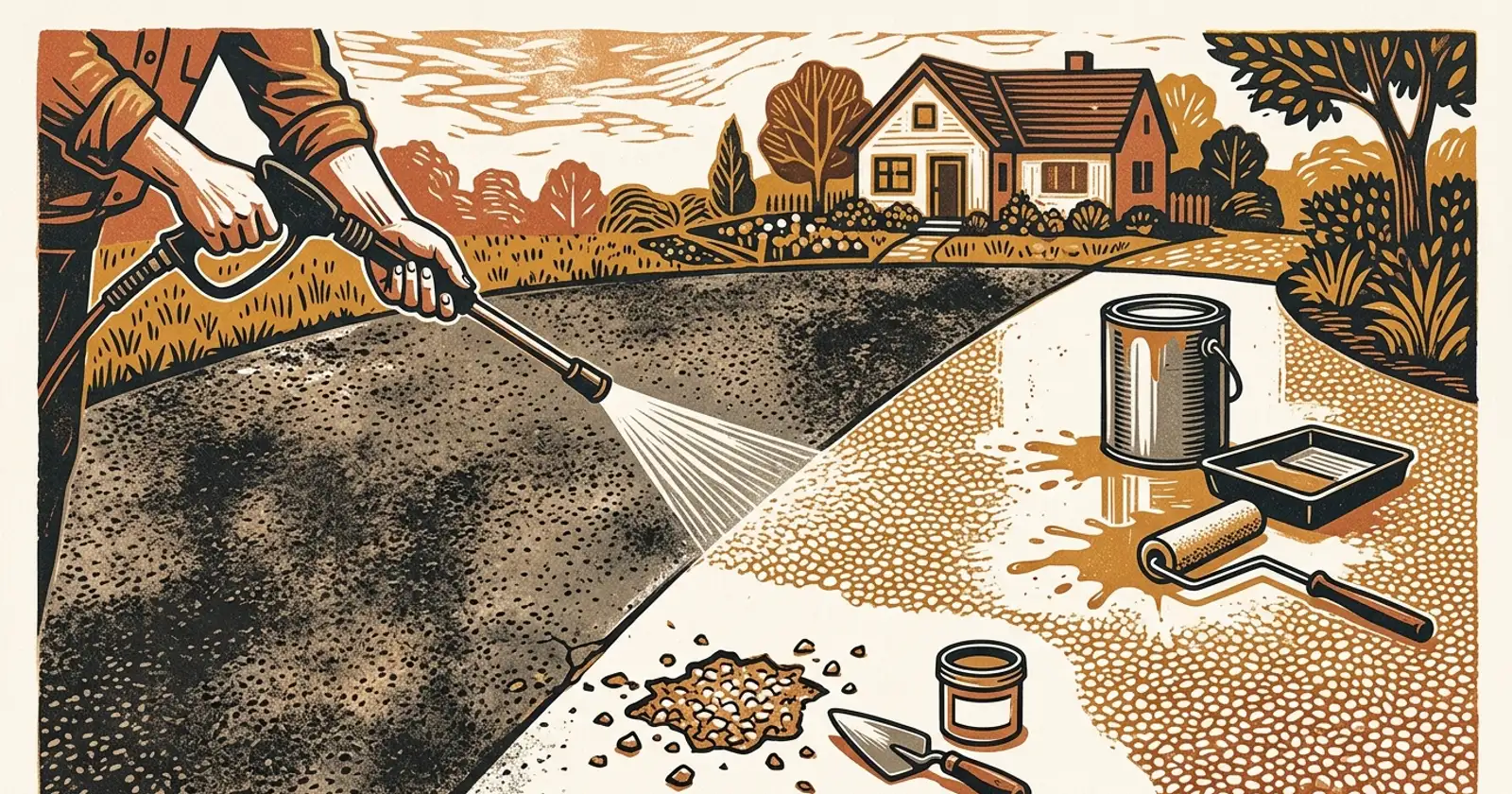
There’s no standard published price for patching exposed aggregate; get it quoted. In the forum thread, one reply described one approach for shallow damage, not a tested standard: chip out anything loose, clean to bare concrete, brush on a bonding agent, trowel in a stiff sand-and-cement repair mortar, and press matching stones into the surface before it sets. Ask how the contractor will match the stone size and color.
If a hired washer caused the damage, our guide to whether it’s wash damage or older wear covers how to tell and how to raise it.
Before you hire
- Ask what pressure and tip they’ll use on exposed aggregate.
- Ask whether cleaning and sealing are priced together, and the minimum.
- Ask which sealer, how many coats, and whether it’s slick when wet.
- For a plain concrete drive, compare with our driveway sealing guide.
Sources
Based on 7 sources · How we price
- Community discussion, r/homeowners, how to fix an exposed aggregate finish after pressure washing (Aug 2026): reddit.com/r/homeowners/comments/1vo7deh
- Twisted Nozzle Pressure Washing, driveway pressure washing cost (Houston area): twistednozzlepressurewashing.com/blog/driveway-pressure-washing-cost
- A-1 Concrete Leveling, concrete sealing cost: a1concrete.com/concrete-repair-learning-center/concrete-sealing-cost
- Sam the Concrete Man, how much does sealer cost: samtheconcreteman.com/blog/2022/02/15/how-much-does-sealer-cost
- Eagle Premium Coat exposed aggregate sealer, product data (PDF): images.thdstatic.com/catalog/pdfImages/6b/6b21638f-e816-4e60-815f-0f07d31f75eb.pdf
- SpecChem, Aqua Shine Decorative Sealer product data (PDF): buildsite.com/pdf/specchem/Aqua-Shine-Decorative-Sealer-Product-Data-2981839.pdf
- Sika (DRYLOK), Floor Paint Latex product data sheet (PDF): usa.sika.com/dam/dms/us01/v/drylok-floor-paintlatex.pdf