That drop isn’t automatic, though. One company’s rate goes up on very large jobs, and stains, slopes and a missing water supply can push any quote back up. Here’s how to read a big-flatwork quote.
Why the rate drops
Every job starts with the same fixed work: driving out, unloading, hooking up hoses and packing up. A Wilmington, North Carolina, washer puts it plainly on its pricing page. You’re “not just paying for square footage.” You’re also paying for mobilization, which is travel and setup.
Minimum charges are how washers cover that. On a small driveway, the minimum sets the price. On a big one, the per-square-foot rate takes over. One Nashville company shows the same idea from the other side. It charges $0.22 a square foot for home concrete, but $0.14 to $0.18 for commercial flatwork, which tends to be bigger jobs.
What published rates look like at three sizes
These are our calculations from each company’s own published rate. The 600-square-foot column is a typical two-car driveway.
| Company (area) | Published rate | 600 sq ft | 3,000 sq ft | 5,000 sq ft |
|---|---|---|---|---|
| KC Splash (Kansas City) | $0.25/sq ft, $300 minimum | $300 (minimum; $0.50/sq ft) | $750 ($0.25) | $1,250 ($0.25) |
| Southern Pro Exteriors (Nashville) | $0.22/sq ft, $149 minimum | $149 (minimum; about $0.25) | $660 ($0.22) | $1,100 ($0.22) |
| Husser (Seattle area) | From $325 per 500 sq ft to 3,000, then $75 per extra 100 | $650 (about $1.08) | $1,950 ($0.65) | $3,450 ($0.69) |
The first two show the classic drop. Above the minimum, the rate holds steady, so the per-square-foot cost falls fast and then levels off. The Seattle-area company prices in 500-square-foot blocks, so a 600-square-foot job pays for 1,000. Past 3,000 square feet its add-on rate is higher than its block rate, so the price per square foot creeps back up.
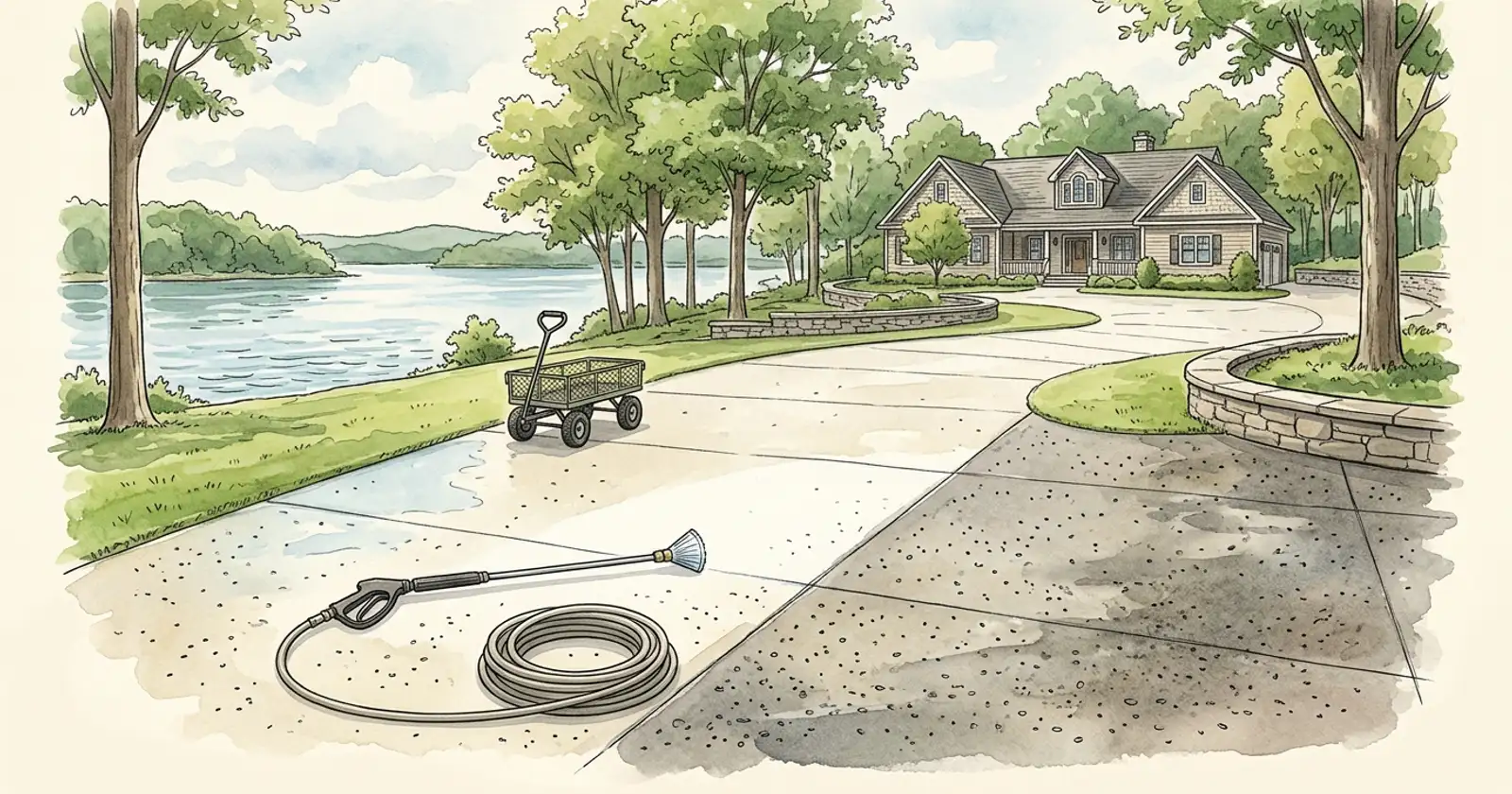
The lesson for a lake-house owner with 4,000 square feet of drive and paths is to ask every washer for the total, not just the rate. Then divide by your square footage to compare.
What pushes the price back up
Stains. The Nashville company lists rust, oil or battery stain treatment at $45 to $95 per stain area, on top of the concrete rate. A San Antonio company names severe oil stains, tire marks and large square footage as its main driveway cost factors. See what works on oil stains.
Condition and access. The Wilmington washer says quotes run higher for heavy staining, cleaners that need pre- or post-treatment, and access or water limits. Those include no nearby spigot, long hose runs, tight gates and cars that can’t be moved.
Surface. The Seattle-area company prices by material and by how much buildup has to come off. It also cleans aggregate. If part of your flatwork is pavers, our paver cleaning and sealing guide covers that cost.
Travel. The Kansas City company adds $50 beyond 20 miles from its shop. Lake houses are often out of town, so ask about trip fees.
Lake houses and “no chemicals”
Many lake-house owners ask for a water-only wash to protect the lake. A University of Michigan guideline for contractors working on its campus shows how one state treats wash water. For washing with soap or other additives, one option is approval from the state environmental agency (EGLE) to discharge to the ground as a mobile power washer. Even then, runoff can’t leave the site or enter drains. Washing with no additives has its own conditions, starting with drinking-quality water. Rules differ by state and town, so ask the washer what applies at your address.
Water-only is a fair request near a lake, but it has limits. Our guide to why water-only washes leave concrete blotchy explains what to expect. For the dock and seawall, see cleaning a dock without polluting the lake. For typical prices on a normal-size job, see our pressure washing cost guide. For how we check every number here, see our methodology.
Sources
Based on 6 sources · How we price
- KC Splash, residential pricing (driveway and concrete rate, minimum, travel fee): kc-splash.com/pricing
- Southern Pro Exteriors (Nashville), home page with pricing: southernproexteriors.com
- Husser Window and Gutter Cleaning, pricing for Seattle and Eastside services: husserwindowcleaning.com/services/pricing-for-seattle-and-eastside-services
- Hardshore Exteriors (Wilmington, NC), Typical cost per square foot to pressure wash concrete: hardshoreexteriors.com/pressure-washing-cost
- San Antonio Pressure Washing & Painting, pricing: sanantoniopressurewashingpainting.com/pricing
- University of Michigan EHS, Exterior Cleaning and Powerwashing for Contractors Guideline (revised 3/17/2022): ehs.umich.edu/wp-content/uploads/2017/02/CP-EC-SWM-Exter-Cleaning-Power-Wash-Cntrtrs.pdf