At those van rates, 10 vans washed monthly come to roughly $2,400 to $7,200 a year.
This guide is for the business owner or fleet manager who pays the bill. Writing the quote as a washer? See bidding your first commercial job.
What fleet washers publish
| Vehicle | Published price per wash | Who publishes it (area) |
|---|---|---|
| Cargo vans and pickups | $40 to $60 | South Mountain Auto Detail (Phoenix) |
| Box trucks | $50 to $90 | South Mountain Auto Detail (Phoenix) |
| Car, van or pickup, monthly | $20 to $25 | Britewash (Maine, New Hampshire, Massachusetts) |
| Straight trucks, monthly / weekly | $44 to $49 / $40 to $44 | Britewash (Maine, New Hampshire, Massachusetts) |
| Box trucks, 10-unit minimum | From $45 | WNY Pressure Wash (Western New York) |
| Box trucks and tractor trailers | $35 to $75 | PBD Pressure Washing (Metro Atlanta) |
These are exterior-wash prices, mostly for recurring service. The Atlanta company says larger or heavily soiled vehicles can reach $150 a wash. The Phoenix company says a first wash on a neglected fleet costs more. Then a lower recurring rate keeps it clean.
What 10 vans cost
Washers price per vehicle, so the math is simple:
- At the Phoenix van rate, 10 vans cost $400 to $600 a visit. Monthly, that’s $4,800 to $7,200 a year.
- At the New England small-vehicle rate, 10 vans cost $200 to $250 a visit. Monthly, that’s $2,400 to $3,000 a year.
That’s a wide gap for the same 10 vans, so get at least three bids. Watch the minimum, too. The Western New York company requires 10 units. A business with four trucks may not qualify for its fleet rate at all.
How often to wash
More washes can mean a lower price per wash. The New England company says weekly or biweekly service almost always brings the lowest per-truck cost. Dirt doesn’t build up between visits. Its straight trucks drop from $44–$49 monthly to $40–$44 weekly.
The Phoenix company says recurring weekly or biweekly contracts cut the per-vehicle cost by 10 to 25 percent. Most fleets there run biweekly. Delivery and high-mileage routes move to weekly.
Pick the schedule that matches how your vans look to customers, not the lowest per-wash price. Twice a month means about twice as many visits, even at a lower rate.
Where the wash water goes
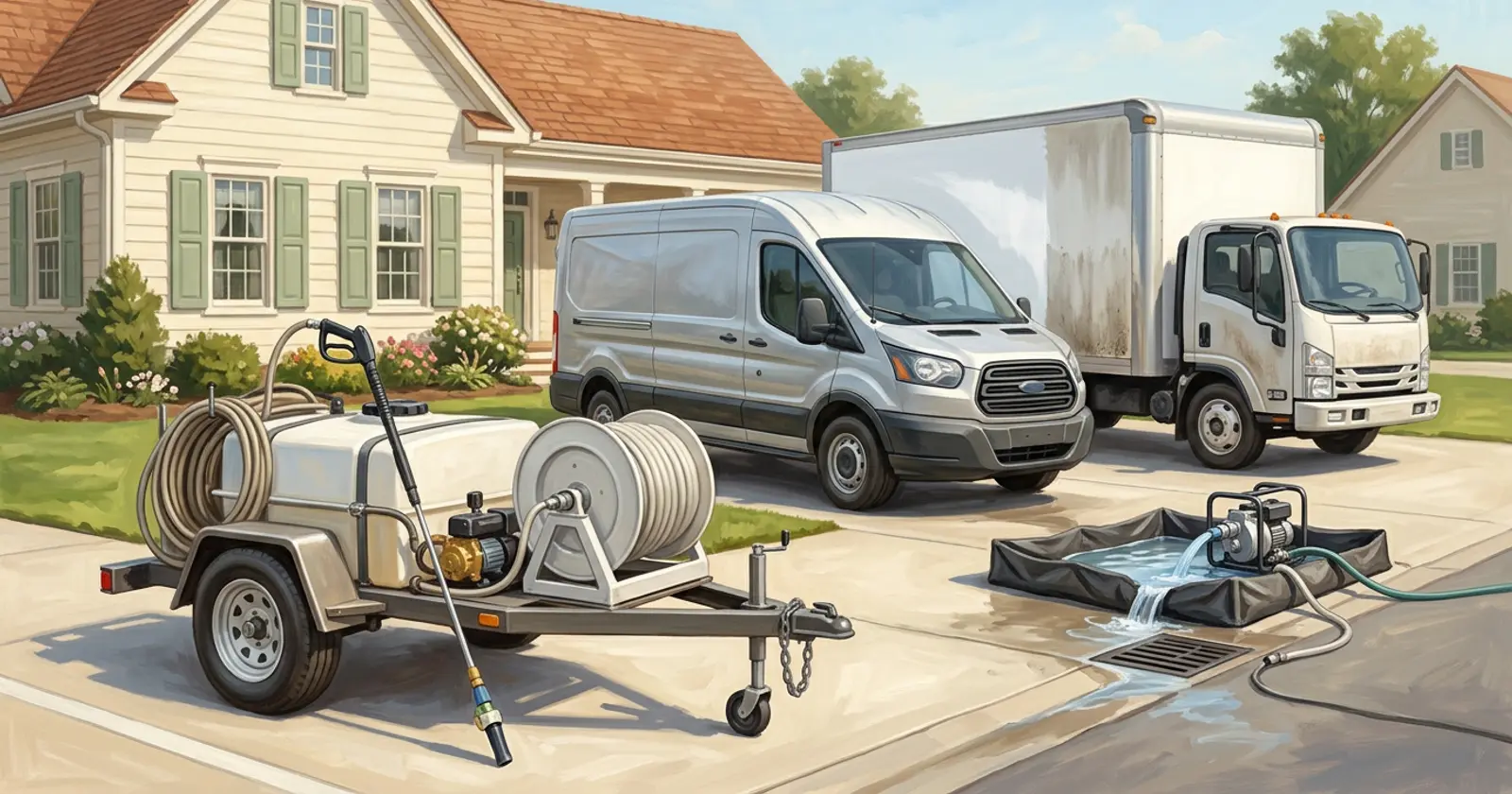
Most owners don’t think about this until it’s a problem. The EPA says vehicle wash water can carry sediment, detergents, oils, grease and heavy metals. Its guidance was written for city-run fleets, but it’s a useful benchmark. It says washing outside a facility plumbed to the sanitary sewer should avoid direct discharges to storm drains. It says to use berms and a vacuum to capture the water instead.
Storm drains are not the only concern. The EPA notes that sending wash water to the sanitary sewer takes the sewer authority’s permission. It may need special treatment.
Cincinnati shows why local rules matter. The Metropolitan Sewer District of Greater Cincinnati says about 40% of its system is combined sewers, mostly in the city and older suburbs. Those pipes carry sewage and stormwater together. In heavy rain they can overflow into creeks and the Ohio River. Its rules make a “point source” discharge to its sewers unlawful without a permit. They list vehicle maintenance operations as point sources.
On a washing forum in June 2026, a washer was offered a fleet account. He said water reclaim was a must. As he’d heard it, the previous washer was fired for not recovering the water. If a washer can’t explain where your water goes, keep looking. This isn’t legal advice. Call your city’s stormwater or sewer office before the first wash.
What the contract should say
- Units and price. List the vehicle count, the price per vehicle type, and any minimum.
- Scope. Body, wheels and glass, plus add-ons. The New England company lists an undercarriage flush at $18 a unit and trailer washouts at $32 to $38.
- Schedule. Set the day and time window, and what happens on a rain day.
- Water and power. Say who supplies them, and how the runoff is captured and disposed of.
- Paperwork. Get a certificate of insurance before the first wash.
- Exit. Spell out how either side can cancel.
For a vetting checklist, see questions to ask a washing company. If you also need the lot or dumpster pad cleaned, our restaurant and storefront cost guide covers flatwork prices.
Doing it in-house
Washing your own vans can work, but it isn’t free. The Atlanta company estimates an in-house truck wash takes 45 minutes to an hour, counting setup and cleanup. Its estimate is for trucks. Vans are smaller.
You’ll also need equipment that can cut road grime. Our guide to hot-water pressure washers covers what heat costs to buy and run. Our water use guide shows how to estimate gallons from a machine’s flow rate. The runoff rules above apply to your own staff, too.
In an April 2026 forum thread, a company employee said an outside washer had charged $75 a truck before he took over. He said the mobile setup his company was building had taken more work than he expected. Our methodology page explains how we check these numbers.
Sources
Based on 9 sources · How we price
- South Mountain Auto Detail, Fleet Washing Prices Phoenix AZ 2026: southmountainautodetail.com/fleet-washing-prices-phoenix-az-2026-south-mountain-auto-detail
- Britewash, Fleet Washing Cost: 2026 Prices for Trucks & Trailers in ME, NH & MA: britewash.com/fleet-washing-prices
- WNY Pressure Wash, Commercial Fleet Washing: wnypressurewash.com/fleet-washing
- PBD Pressure Washing, Fleet Washing vs DIY: The Real Cost Per Truck: pbdpressurewashing.com/blog/fleet-washing-vs-diy-cost-comparison
- U.S. EPA, Stormwater Best Management Practice: Municipal Vehicle and Equipment Washing: epa.gov/system/files/documents/2021-11/bmp-municipal-vehicle-and-equipment-washing.pdf
- Metropolitan Sewer District of Greater Cincinnati, CSOs, SSOs, and Public Sewer Backups: msdgc.org/programs/wet-weather-program/csos-ssos-and-sewer-backups
- Metropolitan Sewer District of Greater Cincinnati, Vehicle Maintenance Operations Form Instruction Sheet: jobs.msdgc.org/sites/default/assets/downloads/Customers/Industrial-Users/vehicle_maint_ops_form_instructions.pdf
- Community discussion: r/pressurewashing, “What pricing on fleet washing and recovering the water” (June 2026): reddit.com/r/pressurewashing/comments/1tx6ag9
- Community discussion: r/pressurewashing, “Fleet washing?” (April 2026): reddit.com/r/pressurewashing/comments/1sbxzjh