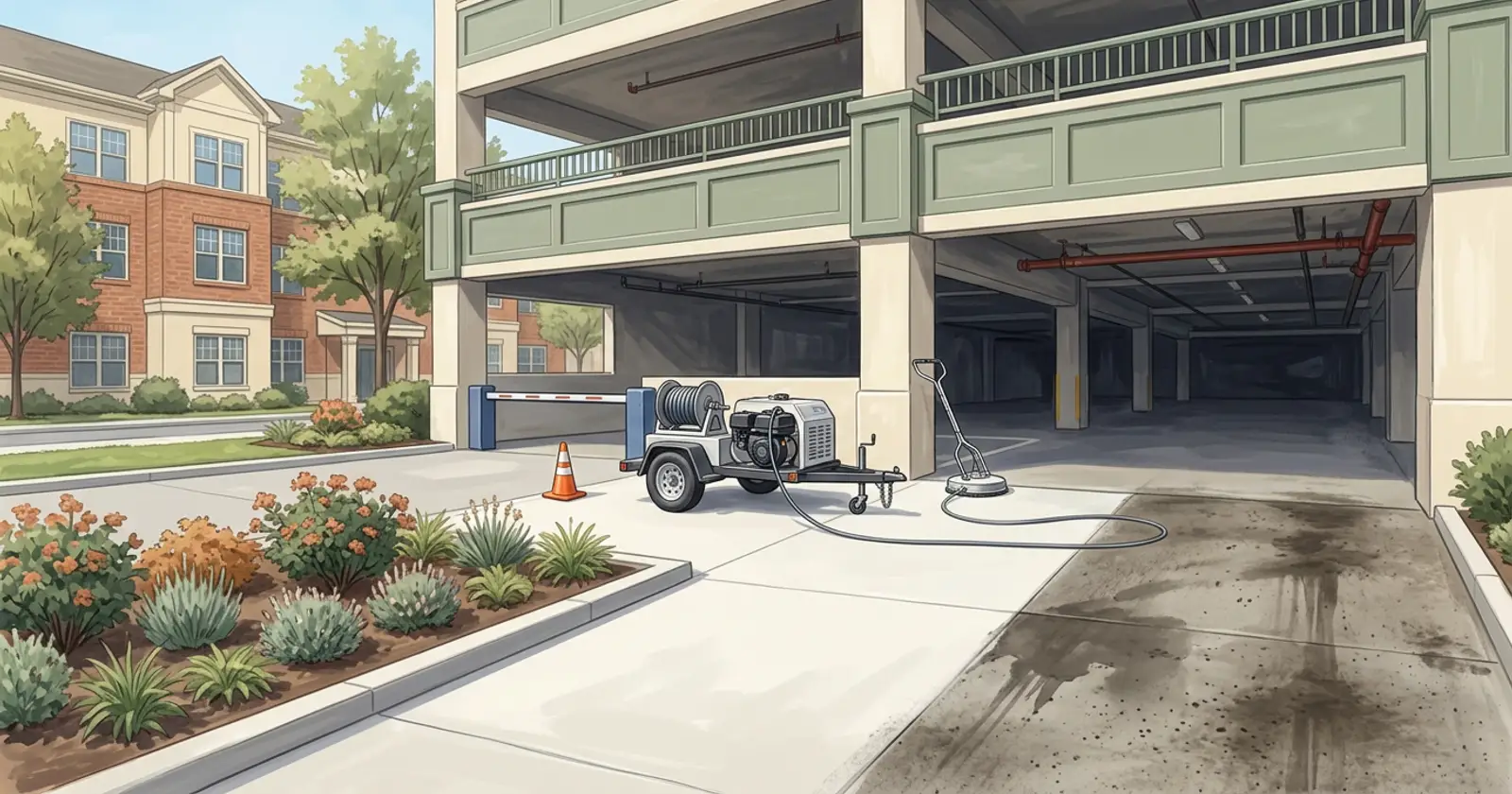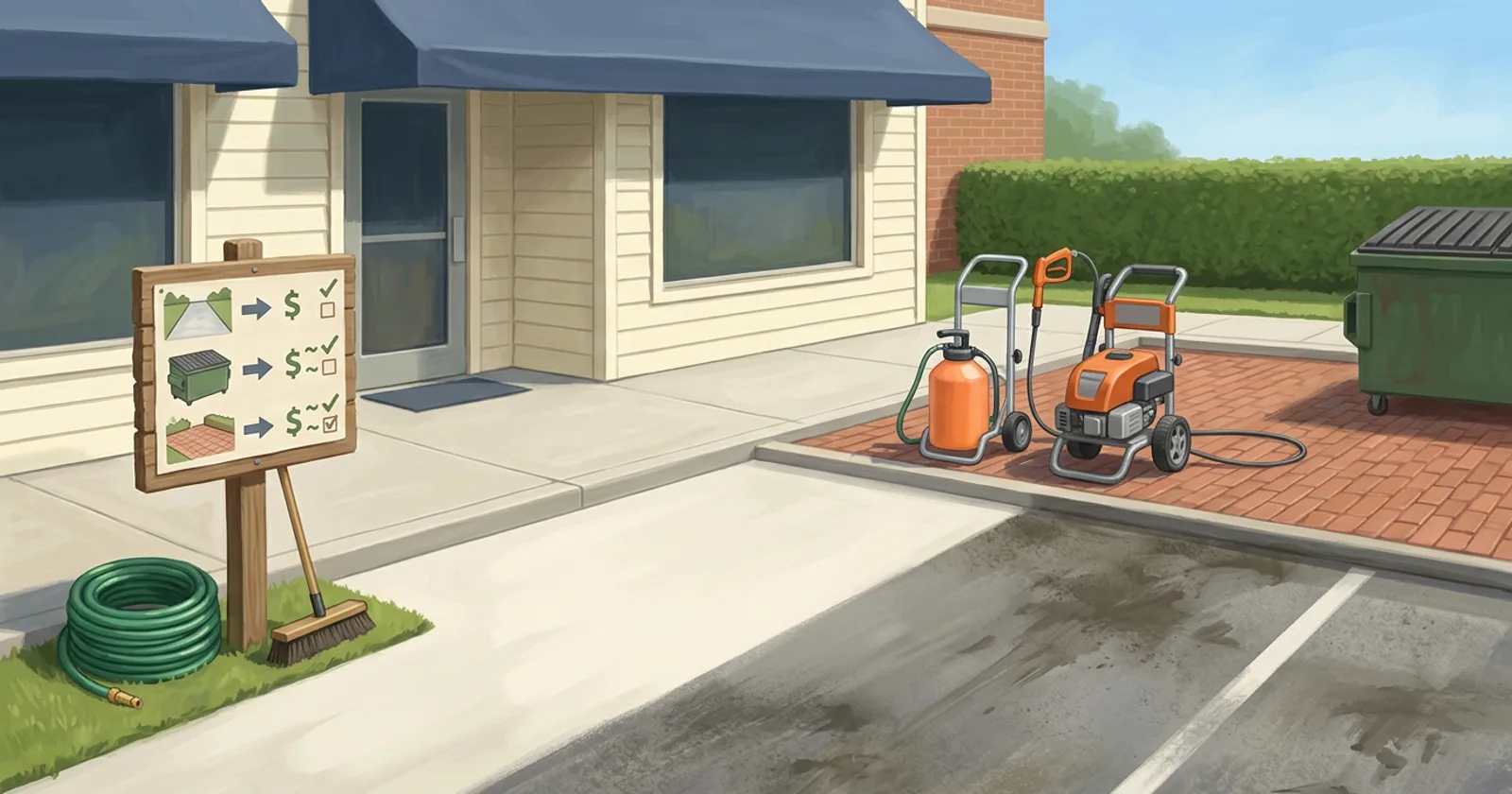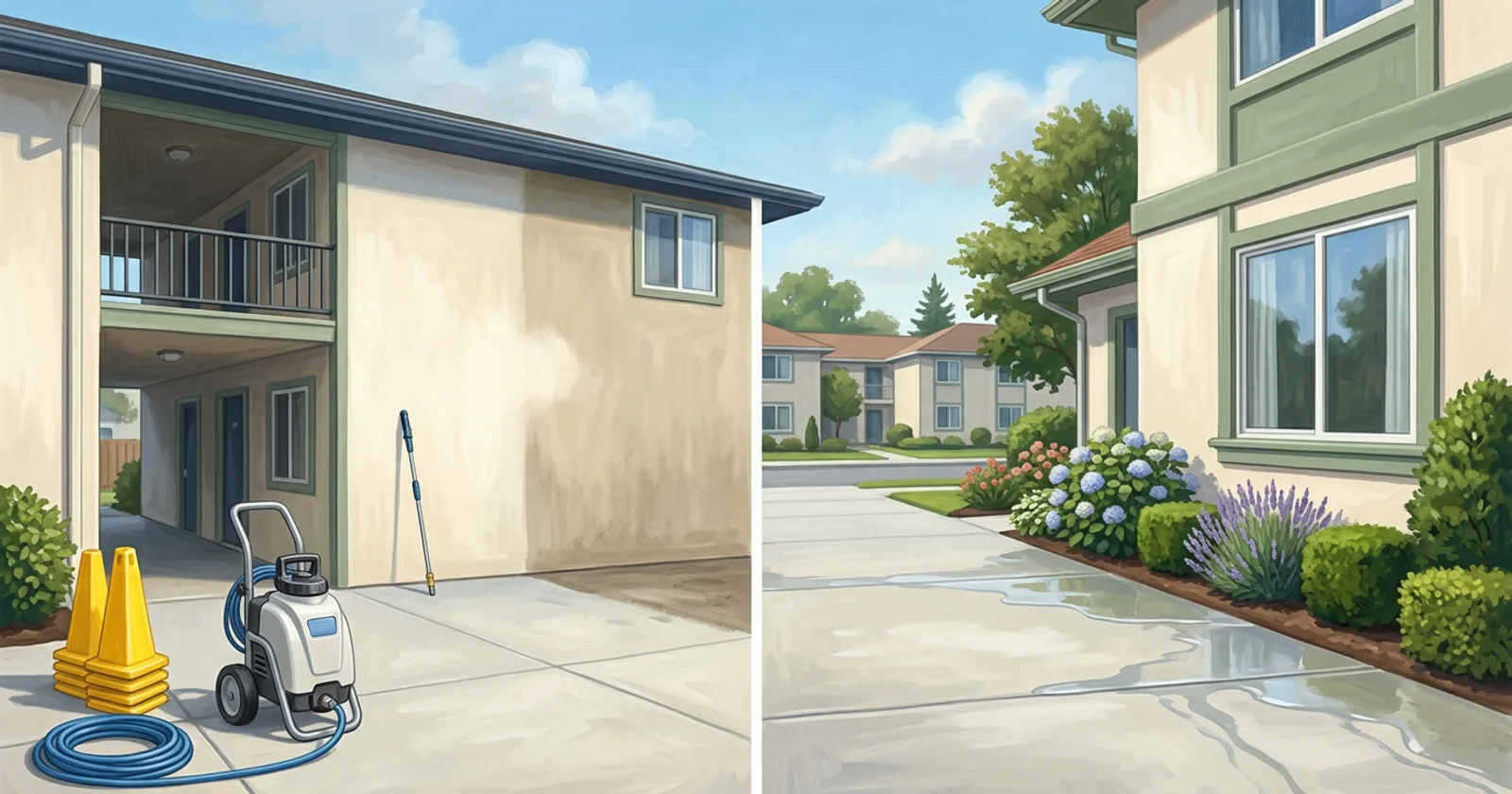
Those figures come before breezeways, concrete and dumpster pads. This guide is for the manager or owner who sets the budget and approves the bid. If you’re the washer writing it, see bidding your first commercial job. Garages have their own math in our parking garage cost guide. Retail pads are covered in what restaurants and storefronts pay.
What washers publish
| What’s priced | Published price | Who publishes it (area) |
|---|---|---|
| Building exteriors, soft washed | $0.15 to $0.40 per sq ft | First Choice Power Washing (Lexington, KY) |
| Small 12-unit complex, building exteriors | $1,500 to $3,000 | First Choice Power Washing (Lexington, KY) |
| Building exteriors | $0.15 to $0.35 per sq ft | Klein Pressure Washing (Houston area) |
| Breezeways and stairwells, quarterly | $8 to $15 per unit | Klein Pressure Washing (Houston area) |
| Annual program, 200-unit complex | $8,000 to $15,000 | Klein Pressure Washing (Houston area) |
| Commercial building washing | $0.15 to $0.90 per sq ft | PSI Pressure Washing (New Jersey) |
The Kentucky and Texas ranges sit almost on top of each other. The New Jersey range runs higher at the top. That company says size, height, access and surface type drive where a job lands. A bid well outside these ranges deserves a question, not a no.
What that means per building
Washers price walls by the square foot and then add it up. The Kentucky company’s own worked examples show how:
- Four two-story vinyl buildings, about 20,000 sq ft of wall at $0.20, come to about $4,000. That’s roughly $1,000 a building.
- Six three-story buildings, about 65,000 sq ft at a volume rate of $0.18, come to about $11,700. That’s roughly $1,950 a building.
Height is the big jump. A third story means more wall, longer reach and slower rinsing. The Houston-area company says outright that three-story buildings cost more than two-story ones.
Breezeways and stairwells
Breezeways are usually a separate line. They’re slow, detailed work around doors, rails and outlets. The Houston-area company prices them at $8 to $15 a unit per quarterly visit. For a 120-unit property, that’s about $960 to $1,800 a visit. At four visits, it’s $3,840 to $7,200 a year.
On a trade forum, a washer was bidding 30 three-story breezeways, each 70 feet long. The upper floors had composite decking. Ground level was concrete, and the walls were fiber cement. An experienced reply said to price by square foot, cover outlets and avoid spraying under residents’ doors. Ask your bidders how they’ll handle the same things.
Brick, siding and stained wood
Surface changes the method. The Kentucky company says siding and painted surfaces get soft washed at low pressure. Brick and concrete can take more.
Spot cleaning works better on brick than vinyl. In a forum thread, a washer was quoting a 15-building complex. The manager had sticker shock from earlier bids, so the washer was weighing spot treatment. One reply said brick can be spot treated. But a cleaned patch of vinyl will show against the rest of the wall.
Stained wood scares good washers off. In a 2026 thread, a washer looked at an apartment building with faded stained wood. The washer’s first thought was to walk away. The worry was being blamed for any change in the wood’s look. If your buildings have stained wood, decide first whether you want it restored or just protected. Say so in the request. Our guide to cleaning cedar siding explains why wood is different.
How often to budget
The Houston-area company recommends washing building exteriors once a year. It says twice a year where shade or north-facing walls grow mildew. The New Jersey company says most commercial buildings do well with once or twice a year. Breezeways and dumpster pads usually need more.
Recurring plans cost less per visit. The Kentucky company says many contracts offer 10 to 20 percent off for quarterly or semi-annual service. Our guide to annual maintenance plans covers the same trade-off for houses.
Local conditions matter too. A northern Colorado owner on a property management forum cited summer dust, wildfire debris and winter salt on buildings. One reply came from someone who had asset managed buildings in the Denver metro. That person said facade cleaning is usually budgeted once or twice a year. It depends on how dirty it gets and which sides face the public.
Where the wash water goes
This line separates a careful bid from a cheap one. The EPA says polluted runoff in municipal storm sewer systems is often discharged untreated into local water bodies. Fort Collins puts it plainly. Its stormwater runs from storm sewers into the creeks and the Poudre River without treatment. Car washes, by contrast, drain to the treatment plant.
Rules differ by city, and this isn’t legal advice. Call your city’s stormwater office before work starts. Make the bid say which drains get blocked, how the water is captured and where it ends up.
What to require in the bid
- Basis: square feet, per building or per unit, and exactly which buildings, breezeways and concrete are included.
- Method: soft wash or pressure for each surface, and how stained wood, windows and outlets are protected.
- Water: a written runoff and disposal plan.
- Residents: a notice and schedule plan. Our tenant’s guide to wash-and-paint notices shows what residents see.
- Paperwork: a certificate of insurance before the first visit.
Photograph cracks, peeling paint and old stains before work starts. Our guide to damage vs what was already there explains why. For vetting, see questions to ask a washing company. Our methodology page explains how we check these numbers.
Sources
Based on 8 sources · How we price
- First Choice Power Washing, How Much Does Apartment Complex Pressure Washing Cost in Lexington, KY?: firstchoicepowerwashing.com/how-much-does-apartment-complex-pressure-washing-cost-in-lexington-ky
- Klein Pressure Washing, Pressure Washing for Apartment Complexes: best.kleinpressurewashing.com/pressure-washing-for-apartment-complexes
- PSI Pressure Washing, Building Washing for Better Curb Appeal in 2026: pressurewashingnewjersey.com/building-washing-curb-appeal
- U.S. EPA, Stormwater Discharges from Municipal Sources: epa.gov/npdes/stormwater-discharges-municipal-sources
- City of Fort Collins, Stormwater: fortcollins.gov/Services/Utilities/Other-Utilities-Pages/Water/Stormwater
- Community discussion: PressureWashingResource.com, “Apartment Breezeway Advice” (2024 to 2025): pressurewashingresource.com/community/t/apartment-breezeway-advice/38910
- Community discussion: PressureWashingResource.com, “Can you spot treat walls - Apartment Complex” (October 2024): pressurewashingresource.com/community/t/can-you-spot-treat-walls-apartment-complex/39208
- Community discussion: PressureWashingResource.com, “Apartment Cleaning / Stained Wood Question” (July 2026): pressurewashingresource.com/community/t/apartment-cleaning-stained-wood-question/40992