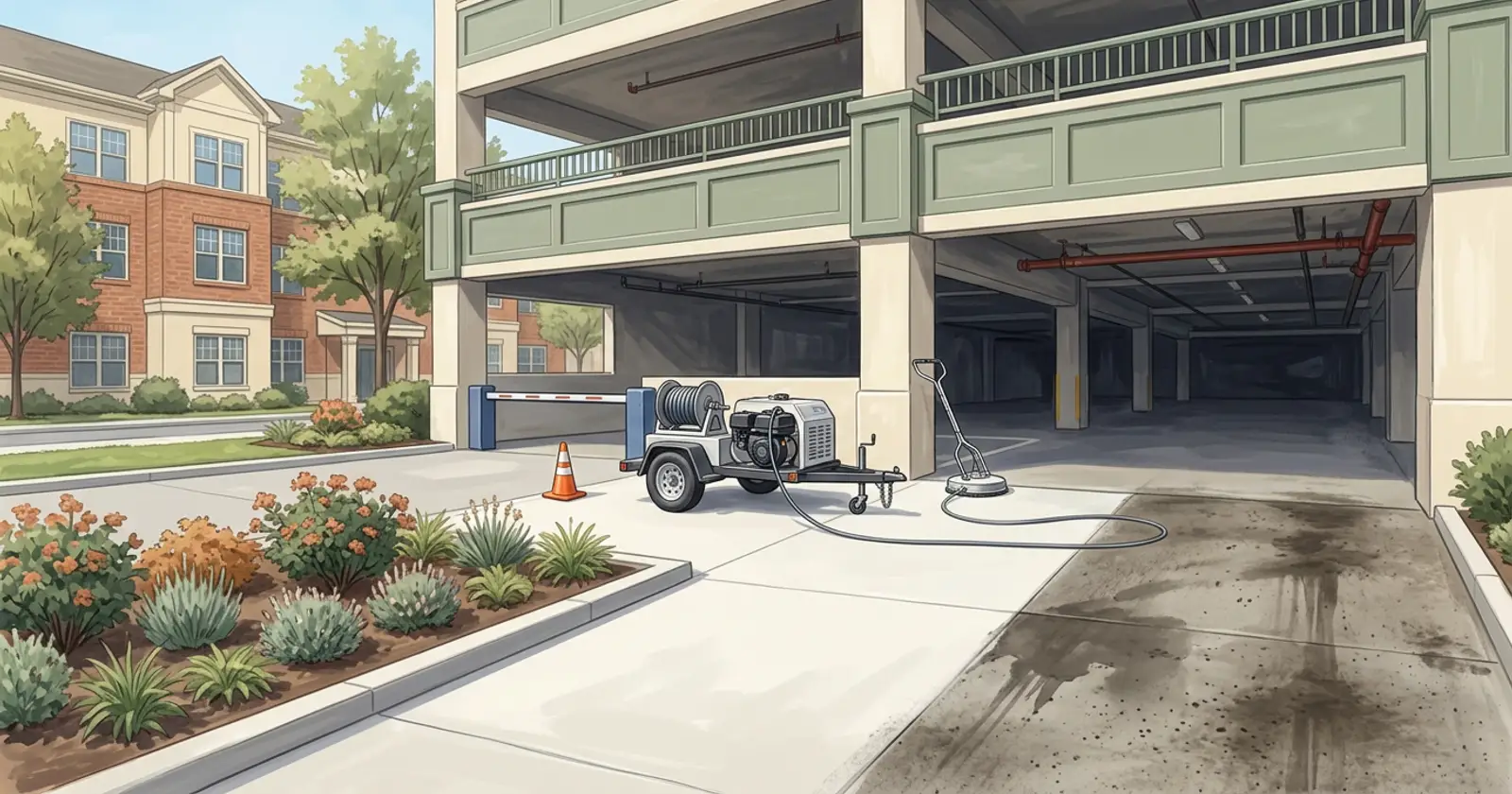
An enclosed or underground deck often lands at the high end. The slow part isn’t the scrubbing. It’s moving the dirty water out, keeping the air safe and working around cars at night.
This guide is for the property manager or board who has to approve the bid. If you’re the washer writing it, see bidding your first commercial job. For storefronts and restaurant pads, see what restaurants and storefronts pay.
What contractors publish
| Pricing basis | Published price | Who publishes it (area) |
|---|---|---|
| Multi-level garage, per sq ft | $0.10 to $0.25 | CRI Washing Dallas (Dallas-Fort Worth) |
| Garage, per parking space | $8 to $20 | CRI Washing Dallas (Dallas-Fort Worth) |
| Small garage or ramps only, flat | $500 to $2,500+ | CRI Washing Dallas (Dallas-Fort Worth) |
| Garage cleaning, per sq ft | $0.10 to $0.25 | My Guy Services (Indianapolis) |
| Parking garage, per sq ft | $0.08 to $0.20, wastewater recovery included | Valley Pro Power Wash (Phoenix) |
Two things to notice:
- The ranges are close. Three companies in three regions land between 8 and 25 cents a foot. A bid far outside that deserves a question.
- What’s included varies. The Phoenix company folds wastewater recovery into its garage price. Others may list it as an extra.
For scale, the Dallas company says a 48,000 sq ft garage can run $4,800 to $9,600. Heavy oil and grease cost more. A 17,000 sq ft single-level deck at $0.10 to $0.25 a foot would come to $1,700 to $4,250. Measure your levels from the plans before you ask for bids.
Why enclosed decks take longer
Water has nowhere easy to go. An open lot drains in every direction. A closed garage may have one door and a few floor drains. On a trade forum, an Oklahoma washer described a 17,000 sq ft enclosed garage. It had one door for drainage and one water spigot. The washer asked whether 20 cents a foot was enough. One reply said the only garage they ever washed ran long because squeegeeing the water out took forever. Another said porous old asphalt is slow to rinse.
Stains don’t all come out. Oil, tire marks and leaf tannins soak into concrete. In another forum thread, a washer showed a semi-underground deck where a dripping pipe kept the concrete wet. Hot water at about 180°F and a surface cleaner made it look much better, but not new. An experienced operator advised telling the client up front that some stains will “lessen but not remove.” Our guides to oil stains on concrete and leaf tannin stains explain why.
Utilities may be thin. The Dallas contractor says the price goes up if on-site supply is limited. That happens when it has to truck in water or run generators. Night or weekend work and traffic control add planning time too.
Where the wash water goes
This is the line that separates a careful bid from a cheap one. The EPA says polluted runoff in city storm systems is often discharged untreated into local water bodies. Its good-housekeeping guidance says to pressure wash where wastes can be captured for proper disposal. Its fact sheet covers vehicle and equipment washing outside a plumbed area. Small jobs can use berms with a wet/dry vacuum. Larger ones can use a vacuum truck. It adds that permission from the sewer authority comes before anything goes to the sanitary sewer.
Oklahoma City is a good example of how cities frame it. The city’s stormwater team marks inlets with messages like “Dump No Waste” and “Drains to River.” It says anything dumped in a storm drain reaches local waterways untreated. Rules differ by city, and this isn’t legal advice. Call your city’s stormwater office before work starts. Make sure the bid says who handles capture.
Air inside the garage
Gas engines and closed decks are a dangerous mix. A CDC report describes a 1994 case in the District of Columbia. Five workers were treated for carbon monoxide poisoning after running two gasoline pressure washers in an empty underground garage. The garage exhaust fan was off. NIOSH says CO can build up within minutes even where a space seems well ventilated. It advises keeping the pump and engine outdoors, away from air intakes, with only the wash line inside. This isn’t safety advice. Ask where the machine will sit and whether the crew uses CO monitors.
What to ask before you sign
- Basis: per square foot, per space or flat, and which levels and ramps are included.
- Water: which drains get blocked, how water is captured, and where it’s disposed.
- Equipment: hot water or cold, which degreaser, and where the engine runs.
- Schedule: nights or weekends, level by level, and how tenants are notified.
- Stains: which marks will only lighten.
- Paperwork: a certificate of insurance before the first visit.
Photograph cracks and old stains first. Our guide to damage vs what was already there explains why. For general vetting, see questions to ask a washing company. For buildings too tall to reach from the ground, see drone washing vs a lift. Our methodology page explains how we check these numbers.
Sources
Based on 10 sources · How we price
- CRI Washing Dallas, How Much Does Professional Parking Garage Washing Cost in Dallas?: criwashingdallas.com/post/how-much-does-professional-parking-garage-washing-cost-in-dallas
- My Guy Services, Commercial Pressure Washing Prices in Indiana: myguyservicesllc.com/commercial-pressure-washing-prices
- Valley Pro Power Wash, Pressure Washing Prices Phoenix AZ 2026: valleypropowerwash.com/pressure-washing-prices-phoenix-az-2026
- U.S. EPA, Stormwater Discharges from Municipal Sources: epa.gov/npdes/stormwater-discharges-municipal-sources
- U.S. EPA, Pollution Prevention/Good Housekeeping for Municipal Operations (PDF): epa.gov/sites/default/files/2015-11/documents/guidance_document.pdf
- U.S. EPA, Stormwater Best Management Practice: Municipal Vehicle and Equipment Washing (PDF): epa.gov/system/files/documents/2021-11/bmp-municipal-vehicle-and-equipment-washing.pdf
- City of Oklahoma City, Storm Water Quality News bulletin (November 2021): content.govdelivery.com/accounts/OKOKC/bulletins/2f90aed
- CDC MMWR, Carbon Monoxide Poisoning from Use of Gasoline-Fueled Power Washers in an Underground Parking Garage, District of Columbia, 1994: cdc.gov/mmwr/preview/mmwrhtml/00037050.htm
- NIOSH, Preventing Carbon Monoxide Poisoning from Small Gasoline-Powered Engines and Tools (96-118a): cdc.gov/niosh/docs/96-118a
- Community discussion: PressureWashingResource.com, “Are my expectations too high? Re: Stain Cleaning” (March 2025): pressurewashingresource.com/community/t/are-my-expectations-too-high-re-stain-cleaning/39637