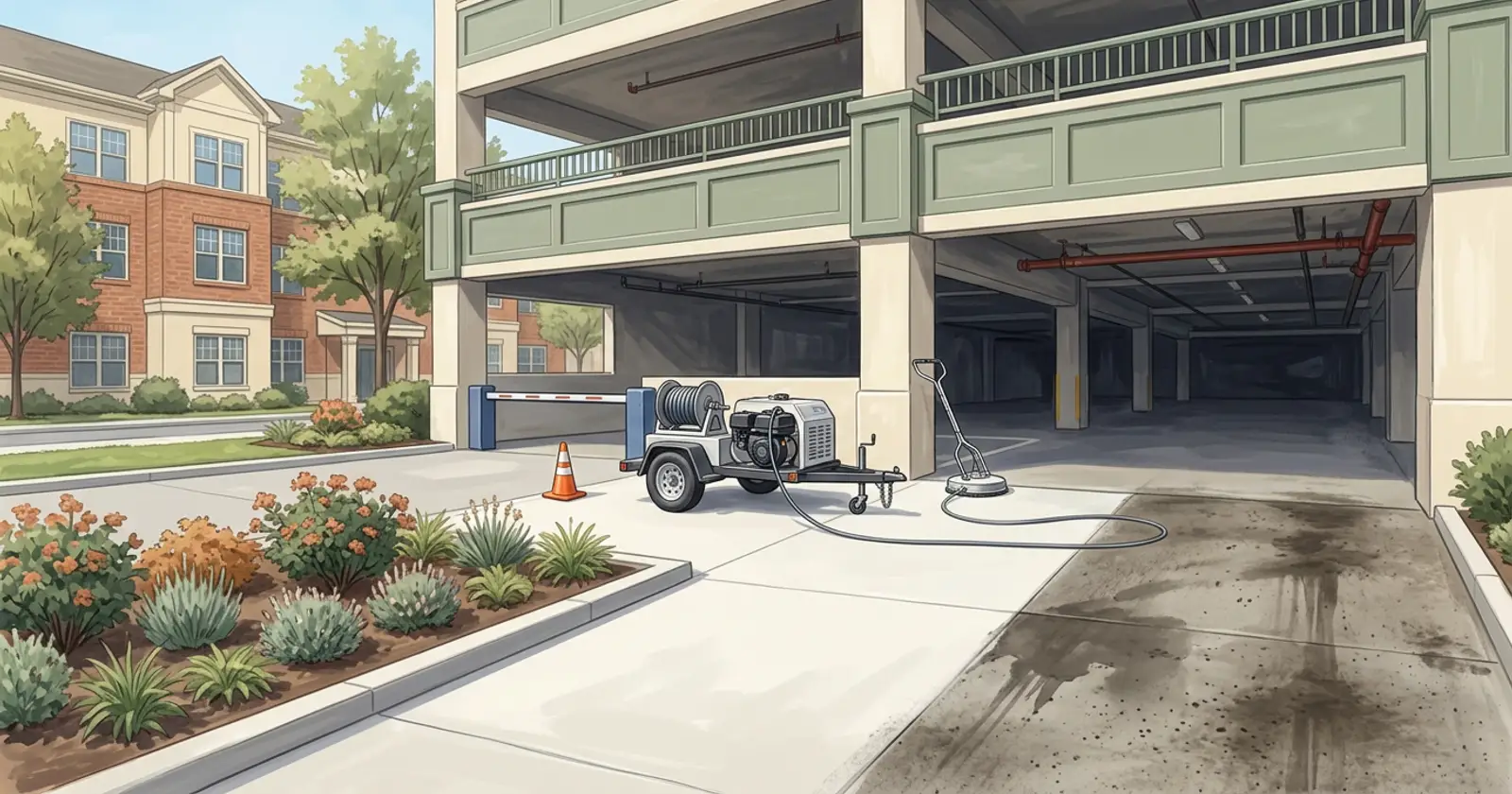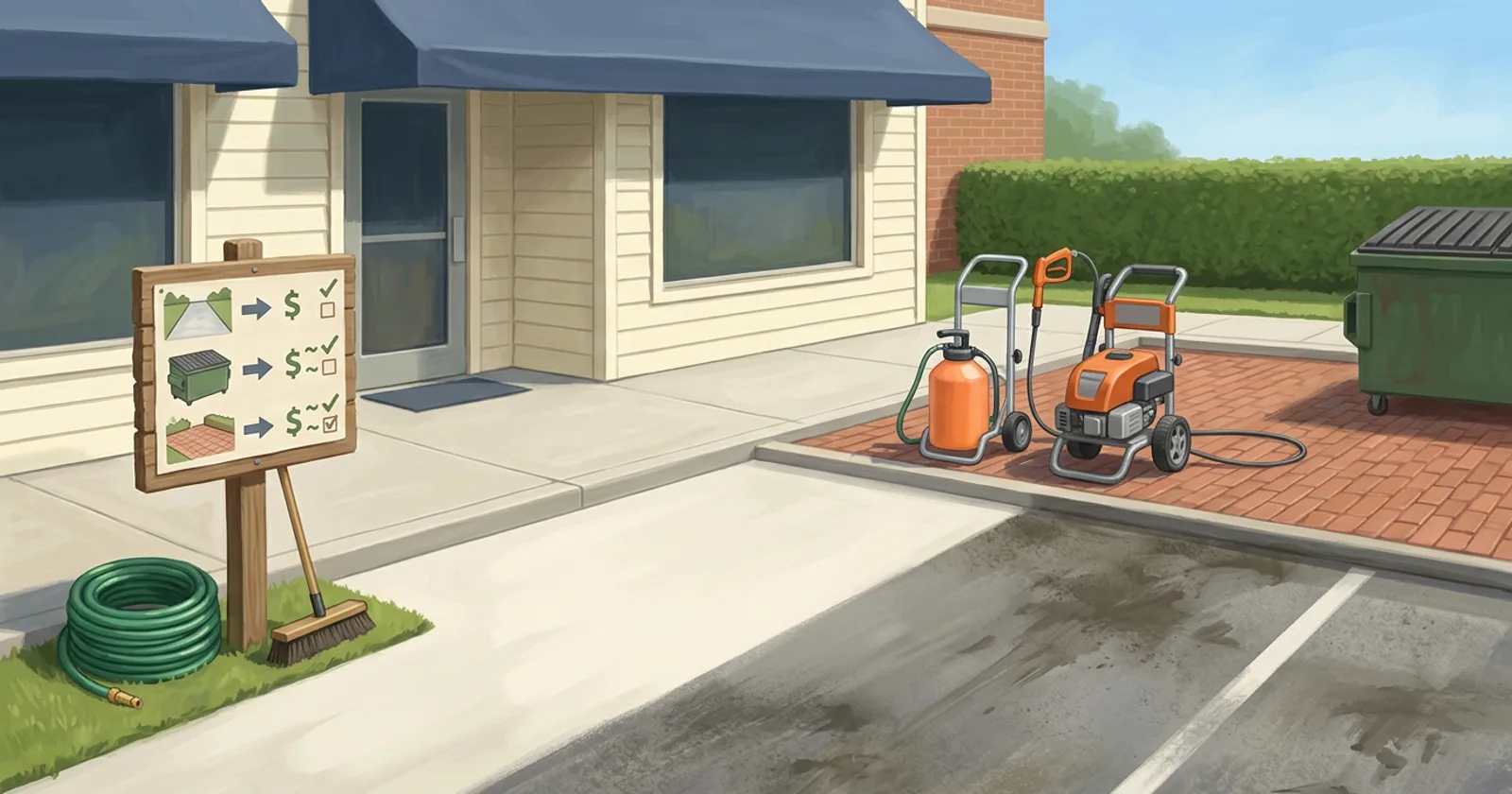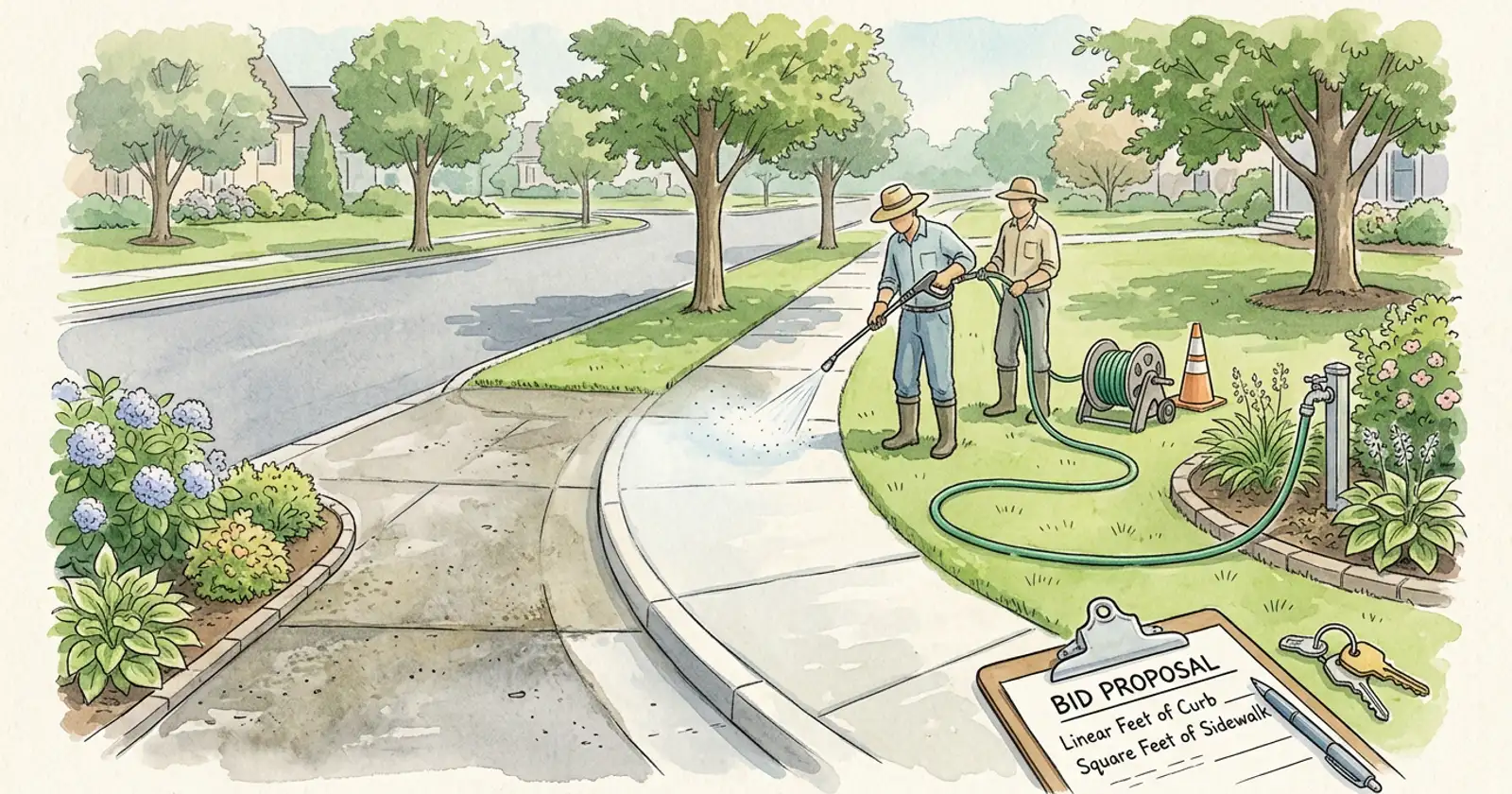
Boards start asking in late winter. In a community discussion last April, a washer was pricing an 89-unit, three-story townhome community where the HOA was paying for the wash. Curb and sidewalk jobs raise the same questions at a larger scale.
How flatwork is priced
Sidewalks and aprons: by the square foot. One Indianapolis-area commercial price list puts sidewalks and walkways at $0.20 to $0.30 a square foot. A Nashville-area washer lists concrete at $0.22 a square foot with a $149 minimum, a Kansas City washer at $0.25, and a San Antonio company at $0.35 with a $250 starting price. A 4-foot walk 250 feet long is 1,000 square feet: about $200 to $350.
Curbs: by the linear foot. Published curb rates are rare, so the best public record is what washers tell each other. In one trade forum thread about 6,000 feet of curb, a washer said the job would need to be at about $0.25 to $0.30 a foot. In another, on two miles of HOA curb, one said they charge no less than $0.40 a foot, another $0.45 for curb plus $0.15 a square foot for sidewalks, and a third about $0.85 a foot for heavily stained curb with pre- and post-treatment. Take those as what posters said, not a survey. At $0.25 to $0.45, 1,000 feet of curb comes to $250 to $450.
| Surface | How it’s priced | Published or quoted range | Who says so |
|---|---|---|---|
| Sidewalks, aprons, pads | Per sq ft | $0.20 to $0.35 (minimums $149 to $250) | My Guy Services price list; Southern Pro Exteriors; KC Splash; San Antonio Pressure Washing & Painting |
| Plain concrete curb | Per linear ft | About $0.25 to $0.45 (one poster: $0.85, heavy stains) | Pressure Washing Resource threads 11327 and 27373 (posters’ own rates) |
| Pace, one worker | Feet or sq ft per hour | Posters say about 600 ft of curb an hour (250 on heavily stained curb); 1,500 to 2,000 sq ft of walk an hour | Pressure Washing Resource threads 27373 and 29561 |
Pace matters because many washers price long runs by the day. One forum poster said to figure an eight-hour day for one person at about 600 feet an hour of curb with a turbo nozzle; another on the same thread reported about 250 feet an hour on very dirty curb with two people. If a bid looks like a day rate rather than a per-foot rate, that is why.
The water-source problem
A house wash runs off the customer’s spigot. A mile of curb does not. In a trade forum thread on sidewalk pricing, one washer’s formula was linear feet times width times price per square foot, plus water and a nuisance factor. The water line in that formula is real money, and it shows up three ways:
- Hauling. The crew fills a tank at the shop and drives back when it runs dry. Water weighs enough that a tank limits trailer size; see how much a full water tank weighs. Our guide to how much water a wash uses shows how fast a 4-gallon-a-minute machine empties one.
- Residents’ taps. On a 2024 forum thread about 1.5 miles of curb and 33,000 square feet of flatwork, the board had told the washer residents’ water was off limits, and the poster said the county did not rent hydrant meters. Replies ranged from buying a meter and backflow setup to simply paying a homeowner about $30 to use their spigot (one poster’s suggestion).
- A hydrant meter. Utilities issue temporary meters for hydrant or jumper connections. The City of Naples, Florida form, for example, lists a one-time application fee, an installation and removal fee, a daily fee after 90 days, a deposit, and water billed at current rates plus a 25 percent surcharge.
Ask which of the three the bid assumes. A washer who has not thought about it will either lose money or come back for a change order.
Rules that apply to community jobs
In Collier County, where Naples sits, the county’s irrigation rules say washing exterior home surfaces is allowed anytime with low-volume pressure-cleaning equipment or a hose with an automatic shutoff nozzle, as long as the water drains to a pervious surface or a recycling system. Street curbs drain to storm inlets, so a bid should say how the crew keeps rinse water and any cleaner out of them. Our guide to washing during water restrictions covers how other cities handle it.
What the bid should list
- Linear feet of curb and square feet of walk, apron and pad, with a unit price for each.
- Water source: hauled, residents’ taps with permission, or a hydrant meter, and who pays the utility.
- What happens to rinse water at storm inlets.
- Water-only or a pre-treatment, and what the cleaner is.
- Certificate of insurance naming the association.
- The resident notice and car-moving schedule, street by street.
Boards that have already hired a washer for house washing will recognize most of this list from community-wide jobs. Courts are a separate line item; see cleaning HOA tennis and pickleball courts. Operators bidding their first association job can start with bidding commercial pressure washing jobs.
For how we check facts and choose sources, see our methodology.
Sources
Based on 8 sources · How we price
- My Guy Services, Commercial Pressure Washing Prices: myguyservicesllc.com/commercial-pressure-washing-prices
- Southern Pro Exteriors, services and prices: southernproexteriors.com
- KC Splash, Pricing: kc-splash.com/pricing
- San Antonio Pressure Washing & Painting, Pricing: sanantoniopressurewashingpainting.com/pricing
- City of Naples Utility Permits, Temporary Water Meter Application (PDF): naplesgov.com/media/64896
- Collier County 311, Irrigation Restrictions (other outdoor water uses): colliercountyfl.qscend.com/311/knowledgebase/article/37602
- Community discussion, curb pricing (6,000 ft): pressurewashingresource.com/community/t/curb-pricing/11327
- Community discussion, softwashing an 89-unit townhome community: pressurewashingresource.com/community/t/softwashing-townhome-community/40801