A penetrating silane or siloxane sealer slows the water and salt that cause winter pitting, but it can’t save a badly made or cured slab. If the driveway was poured this year, how you treat it this winter matters more than any sealer.
In 2025, a reader asked a newspaper home column whether sealing is really needed or just a racket. Years earlier, a garage forum member found small craters on a one-year-old driveway. They were where cars had parked, and they showed up after its first winter.
Why salt pits a driveway
The ready-mixed concrete industry’s guide calls it scaling. The surface flakes or peels after freezing and thawing. Moderate scaling can take off 1/8 to 3/8 inch of the surface mortar and expose the stones.
Salt isn’t the only cause. The same guide lists several others:
- too little entrained air
- too much salt on concrete that lacks strength, air or curing
- finishing the slab while water was still on the surface
A sealer can’t change how your slab was made. University of Maryland Extension adds that overusing some de-icers can speed up the freeze-thaw cycles that damage concrete.
Where winters are long, that adds up. NOAA’s 1991–2020 normals show how. Buffalo, New York, averages about 95 inches of snow a year and about 124 days with a low at or below 32°F.
Penetrating vs film sealers
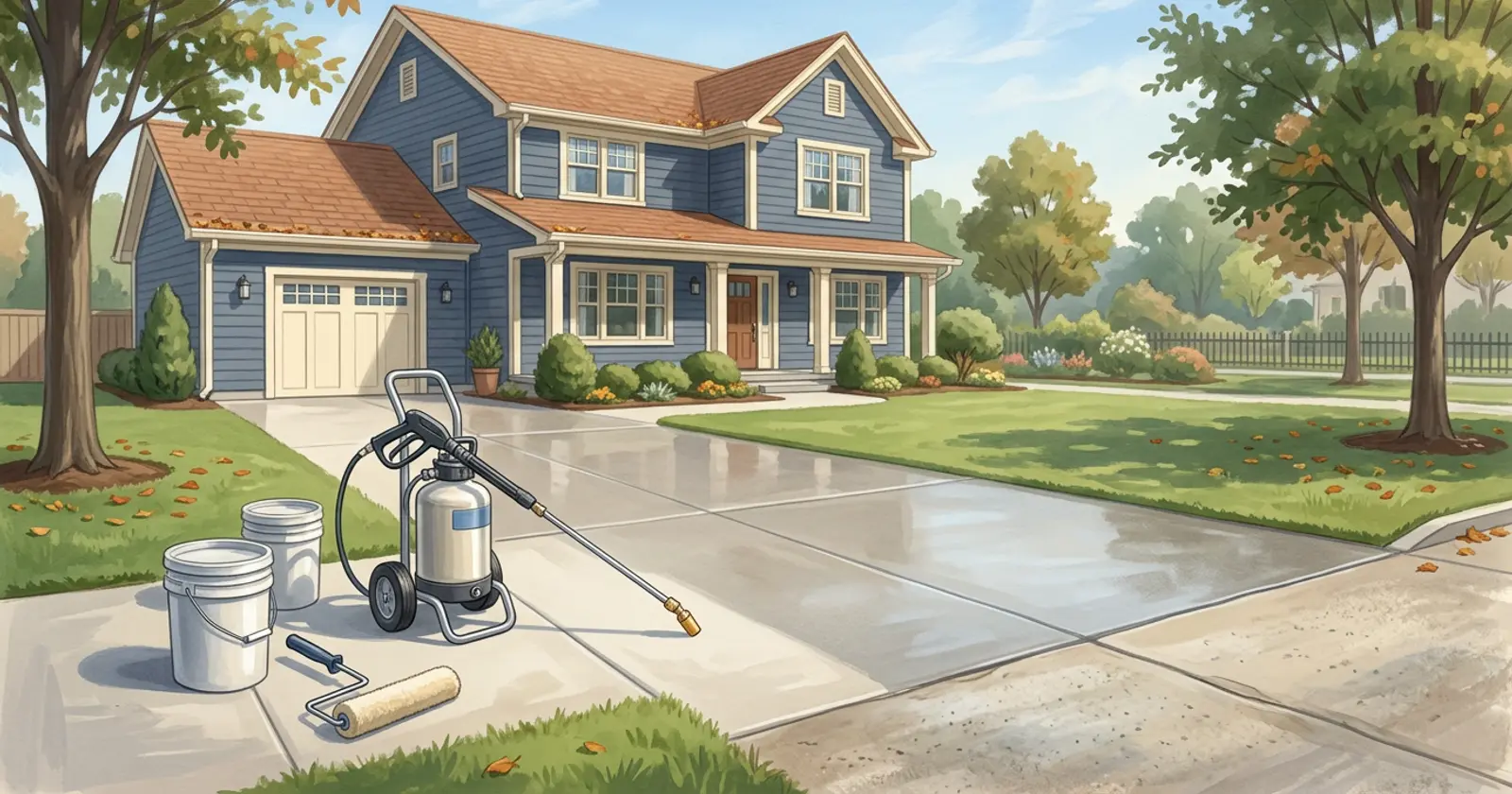
Penetrating sealers (silane, siloxane or a blend) soak in and line the pores, so nothing sits on top. The ready-mixed concrete guide recommends a breathable silane or siloxane sealer to protect new concrete before winter. One commercial silane data sheet reports an average penetration of 0.20 inch and no change in appearance. In a highway-research cube test, it reports 87% to 96% less absorbed chloride.
Film sealers (acrylics) leave a coat on top that can add gloss or a wet look. One acrylic data sheet says it protects against scaling, but it needs more warmth to go on. One sealer maker says acrylics usually need reapplying every 1 to 3 years. Its silane-siloxane sealers can go up to 7 to 10 years.
Weather is the real deadline in fall:
- Silane: one data sheet asks for 40°F or warmer air and surface. It allows frost-free surfaces down to 20°F and wants no rain for 4 hours.
- Acrylic: one data sheet asks for at least 50°F, with no drop below 50°F for 24 hours.
The ready-mixed concrete guide calls late summer the ideal time for surface treatment. So October is workable for a penetrating sealer on a mild, dry day. It’s often too late for an acrylic.
What contractors charge
Company names appear here only to identify the pages we checked.
| Company (page) | Published price | Details on the page |
|---|---|---|
| A-1 Concrete Leveling (national) | $0.40 to $0.90 per sq ft to seal; about $1.00 to clean and seal | A 650 sq ft driveway about $260; minimum about $300 to $400 |
| Sam the Concrete Man (2022 page) | $1.20 to $1.75 per sq ft | Varies with concrete quality and stamped vs regular |
| ProShield Concrete Sealing (Twin Cities, MN) | $1 to $3 per sq ft | 400 to 600 sq ft driveway $700 to $800; 700 to 1,000 sq ft $1,000 to $1,500 |
Across the full $0.40 to $3 range, a 2-car driveway of about 600 square feet comes to $240 to $1,800. A 3-car one of about 900 square feet comes to $360 to $2,700. Minimums can lift small jobs.
Cleaning is part of the job. One silane data sheet says to remove dirt, oil and old coatings first, by power washing if needed. Old oil spots may need their own treatment. See what works on oil stains. For wash-only prices, see what pressure washing costs.
Doing it yourself? That silane sheet lists 250 to 400 square feet per gallon. So a 600-square-foot driveway takes about 1.5 to 2.4 gallons per coat. Ask any contractor which sealer they use and how much they spread. Ask whether cleaning is included and what the minimum is.
New concrete in its first winter
- Before sealing: one silane data sheet wants the concrete at 80% of its design strength, typically 14 to 28 days.
- Before freezing: the cement industry’s guidance says new exterior concrete should air dry for 30 days.
- De-icers: that guidance says keep them off for three months, longer if the concrete was placed in fall or winter. The ready-mixed concrete guide is stricter: no calcium or sodium chloride in the first year. It suggests clean sand for traction and hosing off salt that drips from cars.
A fall 2025 trade-forum thread covered sealing a driveway poured that summer. One pressure washer said to go easy on pressure on concrete that new.
Picking a de-icer
University of Maryland Extension’s table compares common melts:
- Magnesium chloride: works to -13°F; listed as not damaging concrete or metal.
- Calcium chloride: works to -22°F; damages concrete and metal.
- Rock salt (sodium chloride): works to 18°F; damages concrete and metal.
- Potassium chloride: works to 25°F; listed as OK on old concrete.
Its note adds that sodium and calcium chloride are especially hard on newly poured concrete. Spread any melt thinly, before ice forms. Never use fertilizer. The concrete guide warns that ammonium sulfate and ammonium nitrate attack concrete. Maryland law bans fertilizer as an ice melt.
Already pitted or white?
A sealer won’t fill pits. The concrete guide says to remove weak material and add a thin bonded resurfacing. Not sure whether a wash caused it? See wash damage vs damage that was already there. A white crust is a different problem. See white haze on brick, pavers or stone. Pavers follow their own process. See paver clean, sand and seal and faded pavers.
Every number here was checked against its source. Our methodology explains how.
Sources
Based on 13 sources · How we price
- National Ready Mixed Concrete Association, CIP 2: Scaling Concrete Surfaces (copy hosted by Prairie Materials): prairie.com/wp-content/uploads/sites/4/2024/12/02p_ScalingConcreteSurfaces.pdf
- Portland Cement Association, Prevent Scaling (archived copy, May 2024): web.archive.org/web/20240521125430/https://www.cement.org/learn/concrete-technology/durability/prevent-scaling
- University of Maryland Extension, Melting Ice Safely: extension.umd.edu/resource/melting-ice-safely
- NOAA NCEI, 1991–2020 annual normals, Buffalo Niagara International Airport (USW00014733): ncei.noaa.gov/data/normals-annualseasonal/1991-2020/access/USW00014733.csv
- Sika, Sikagard H 1001 Product Data Sheet (June 2025): usa.sika.com/content/dam/dms/us01/1/sikagard-h-1001.pdf
- SealMaster, Concrete Sealer Technical Data Sheet SMT-250: Sealmaster.net/pdf/specification/Sealmaster%20spec%20sheets/concrete-sealer.pdf
- Foundation Armor, How Much Does it Cost to Seal a Concrete Driveway? (2017): foundationarmor.com/articles/cost-to-seal-a-concrete-driveway
- PROSOCO, The High Cost of Replacing Damaged Driveways and Sidewalks (2024): prosoco.com/how-to-maintain-your-driveway-and-sidewalk
- A-1 Concrete Leveling, Concrete Sealing Cost: a1concrete.com/concrete-repair-learning-center/concrete-sealing-cost
- Sam the Concrete Man, How Much Does Sealer Cost? (2022): samtheconcreteman.com/blog/2022/02/15/how-much-does-sealer-cost
- ProShield Concrete Sealing, Concrete Sealing Cost in Minnesota: proshieldconcretesealing.com/concrete-sealing-cost-in-minnesota
- Daily Herald, “Do I really need to seal my driveway?” (June 2025): dailyherald.com/20250626/home-and-garden/do-i-really-need-to-seal-my-driveway
- Community discussion: Garage Journal, “Protecting driveway cement” (2014): garagejournal.com/forum/threads/protecting-driveway-cement.263792