Here is how to clean each floor type, how to tell salt from damage, and how to keep next winter’s slush off the slab.
Why the floor turned white
Every mile of salted road leaves brine on your tires, and it drips off in the garage. The water evaporates and the salt stays behind as a white crust. In Albany, New York, the National Weather Service puts the 1991 to 2020 seasonal snowfall normal at 59.2 inches, so snowy-winter regions have a lot of salted road to drive on.
Salt residue dissolves. That is the test: if warm water clears it, it was salt. A white haze that survives a rinse may be efflorescence (minerals from the concrete) or a worn sealer; our guide to white haze on brick, pavers and stone covers the tell-tale signs.
The three-step clean
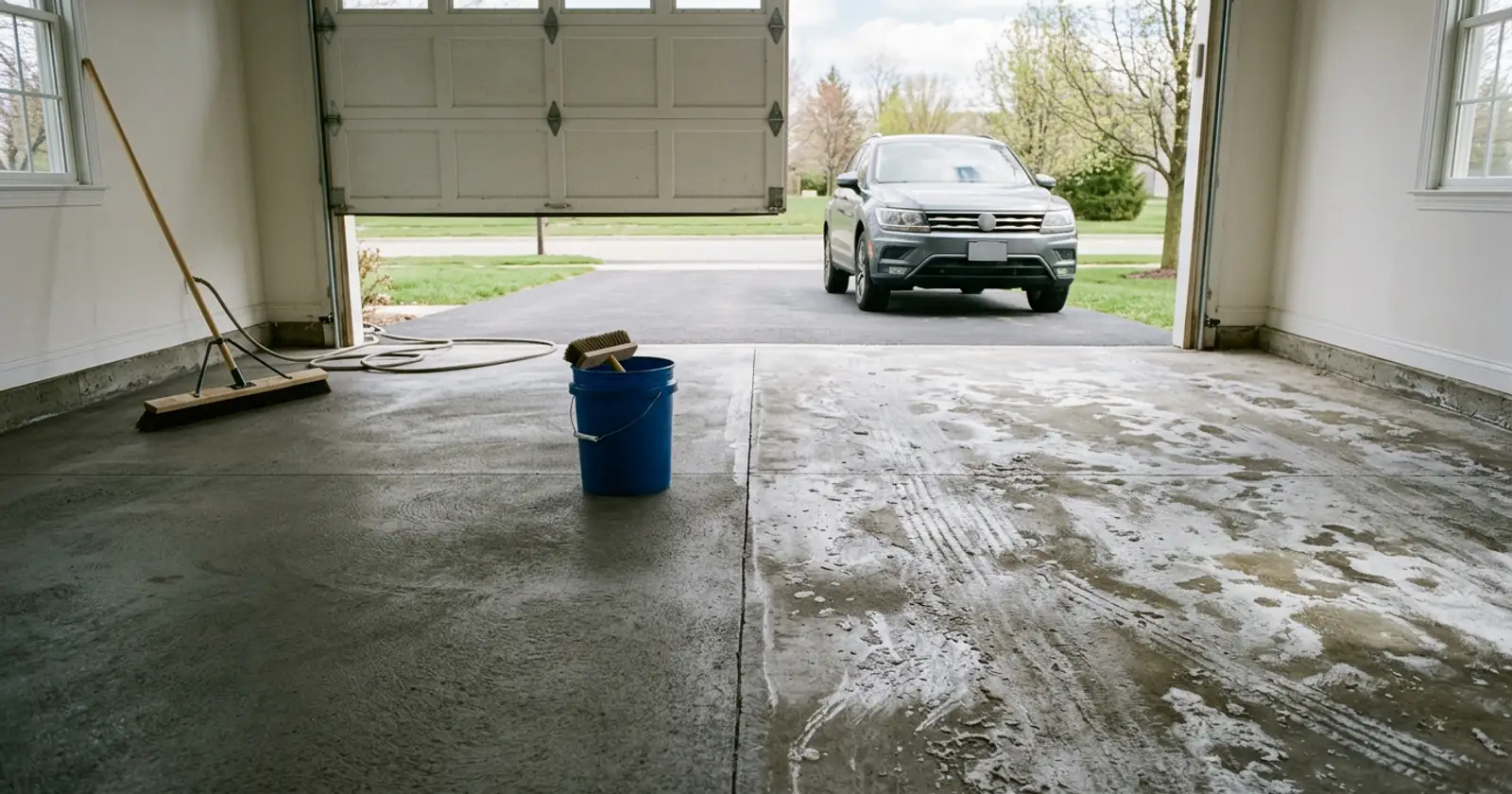
1. Dry sweep first. Sand and salt grit scratch a coated floor, so get the loose material out with a broom or shop vacuum before any water goes down. One coating installer’s care page says to sweep regularly to remove debris that can eventually cause scratches.
2. Dissolve and rinse. Warm water and a stiff deck brush will lift salt crust. On coated floors, installers call for a mild, pH-neutral cleaner, and one says to avoid harsh chemicals, bleach or ammonia because they can degrade the finish. Work from the back wall toward the door so the water runs out, not under the drywall. Squeegee the floor dry.
3. Inspect while it is wet. Dark, even concrete is fine. Pits where the surface paste has flaked off are scaling, covered below. Oil spots that stay dark after the rinse need a degreaser; see oil stains on concrete.
| Floor type | Use | Avoid | Who says so |
|---|---|---|---|
| Bare concrete | Dry sweep, warm water, stiff brush, degreaser on oil spots | Ammonium-based deicers; any deicer in the slab’s first year | Pennsylvania Aggregates and Concrete Association scaling sheet (citing PCA) |
| Sealed concrete | Same as bare; check whether water still beads before re-sealing | Acid etch on a sealed surface unless you are stripping it | Rust-Oleum EpoxyShield technical data sheet |
| Epoxy or polyaspartic coating | Sweep or vacuum, damp mop with a pH-neutral cleaner, rinse, squeegee | Bleach, ammonia, harsh or abrasive cleaners; rubber-backed mats | NuWave Garages care page; GarageExperts blog |
Coatings themselves shrug off salt. One maker’s data sheet says its clear garage coating has excellent resistance to salt, oil and gasoline. The weak points are edges, control joints and chips, where brine can reach bare concrete.
Is the concrete damaged?
A concrete association’s spring fact sheet describes the pattern well: homeowners find pock marks and blemishes on exterior flatwork each spring where the top paste can be picked off while the aggregate bond underneath stays sound. It calls this a topical condition known as scaling, common in the colder climates of the Northeast. A garage floor sees the same thing where brine pools under the tires and freezes on cold nights.
Deicers make it worse. The same sheet says deicers tend to amplify freeze-thaw deterioration, warns never to use ammonium sulfate or ammonium nitrate because they will easily destroy a concrete surface, and says to avoid deicers entirely in the slab’s critical first year.
So surface pitting on an old floor is usually a surface problem. Wash it, let it dry, and consider a penetrating sealer; the same sheet notes a sealer also keeps chloride-laden moisture from migrating into the slab. Our guide to sealing a concrete driveway before winter explains what a penetrating sealer does against salt, and you can ask a supplier whether a given product suits an indoor slab.
What a pro charges
Most washers price garage floors like any other concrete, by the square foot, with a job minimum. Published rates run $0.22 to $0.35 a square foot, with minimums of $149 to $300. A 2-car garage floor is about 450 to 500 square feet, the area a 2.5-car coating kit is sized for. At those rates the floor alone comes to $99 to $175, so the minimum usually sets the price: expect about $150 to $300. Flatwork prices for the driveway outside are in our pressure washing cost guide.
Ask the washer how they will keep water off the walls and out of the house. A garage interior is one of the few jobs where the rinse water has nowhere to go but the door.
Keeping it off the slab next winter
- A containment mat. One mat maker says its mats keep garage floors free of mud, sleet, snow and road salt and can hold up to 64 gallons of water. You squeegee the melt out the door instead of letting it soak the concrete.
- Squeegee melt water the same day rather than leaving brine to dry.
- Skip rubber-backed mats on a polyaspartic floor. One installer says they can leach into the coating; it recommends PVC mats.
- Seal bare concrete before the first freeze.
For how we check facts and choose sources, see our methodology.
Sources
Based on 10 sources · How we price
- Pennsylvania Aggregates and Concrete Association, Scaling (fact sheet citing Portland Cement Association research, PDF): pacaweb.org/uploads/documents/PIS_Scaling.pdf
- National Weather Service Albany, Seasonal Snowfall Totals 1884 to present (PDF): weather.gov/media/aly/Climate/ALB_Seasonal_Snowfall_Totals.pdf
- Rust-Oleum, EpoxyShield Clear Finish Floor Coating Kit technical data sheet (PDF): rustoleum.com/-/media/7F0C3D32E416460B8843AD1FD66C500C.ashx
- Diamond Tool Store, Rust-Oleum EpoxyShield Garage Floor Coating 2.5 Gallon Kit (kit coverage): diamondtoolstore.com/a/s/products/epoxyshiled-garage-floor-coating
- NuWave Garages, Maintaining Residential Polyaspartic Floors: nuwavegarages.com/maintaining-residential-polyaspartic-floors-in-windsor-co
- GarageExperts, 5 Safe Cleaning Hacks for Your Garage FX Flooring: garageexperts.com/boise/why-us/blog/the-experts-blog/residential/5-safe-cleaning-hacks-for-your-garage-fx-floorin
- AutoFloorGuard, containment mats: autofloorguard.com
- KC Splash, Pricing: kc-splash.com/pricing
- Southern Pro Exteriors, services and prices: southernproexteriors.com
- San Antonio Pressure Washing & Painting, Pricing: sanantoniopressurewashingpainting.com/pricing