Each one needs a different fix, and the wrong cleaner can turn a cosmetic problem into permanent damage. Here’s how to tell them apart before you, or a pro, reach for acid.
Start with where the white shows up
Look at the pattern first. It’s free and it narrows things down fast.
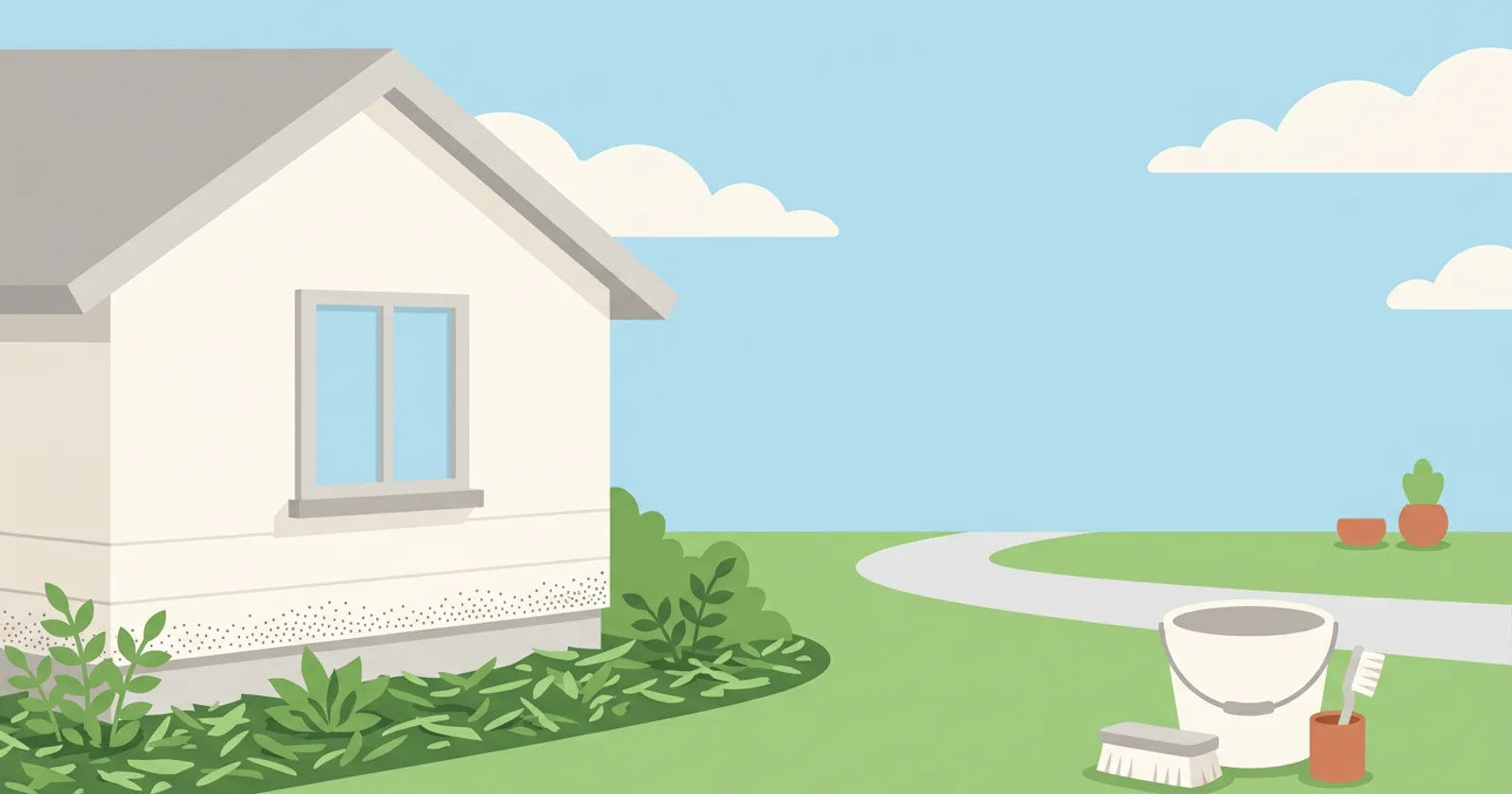
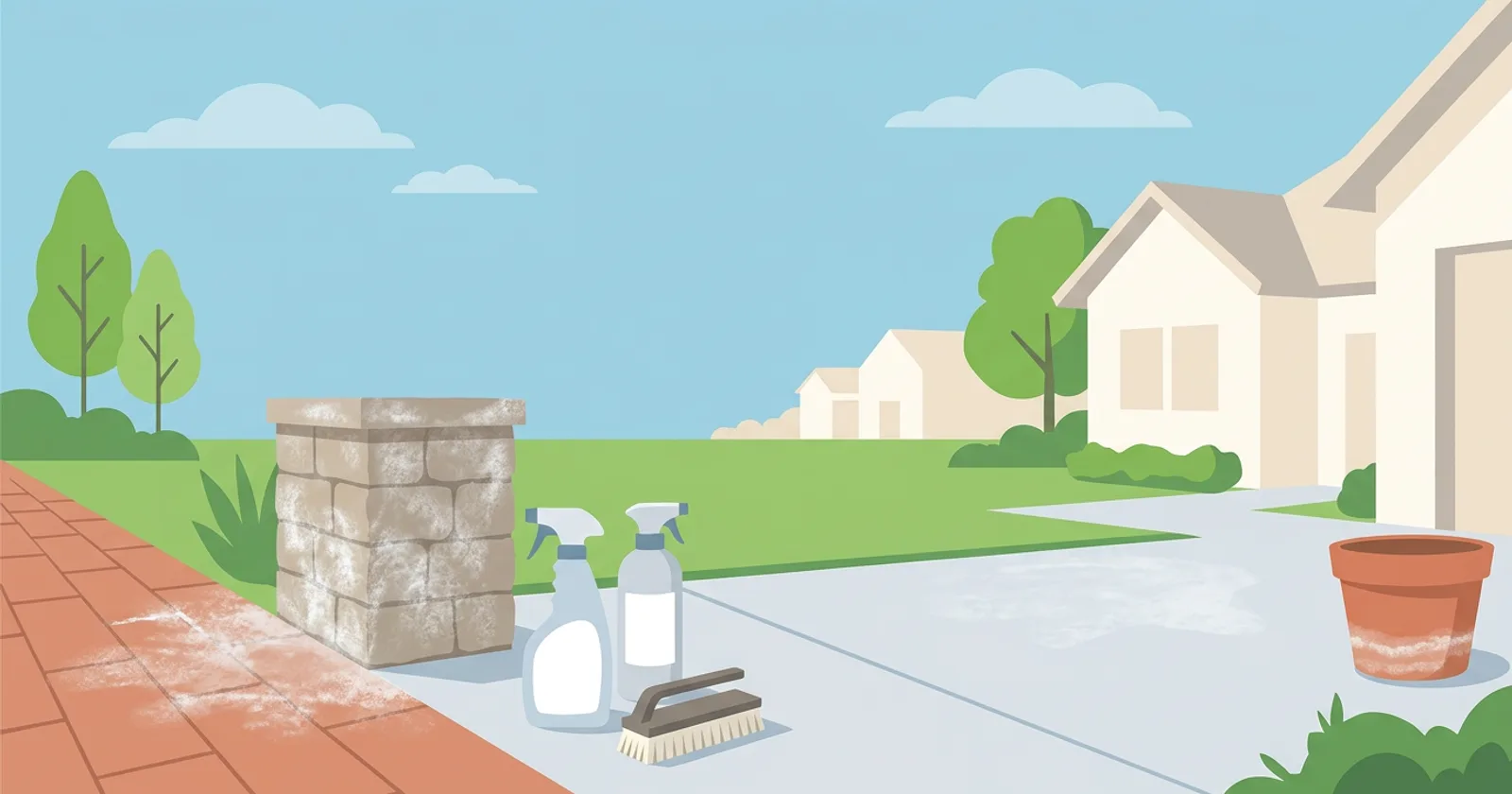
- Efflorescence forms when water carrying dissolved salts reaches the surface, evaporates and leaves the salts behind. Brick industry guidance lists poorly aimed landscape sprinklers, leaky pipes and faulty drains among the water sources. The same guidance lists adjacent soil as a source of the salts, so look low on walls and on retaining walls.
- Sealer blush only happens on sealed surfaces. The white is a milky look in the sealer film itself.
- Hard-water scale follows the spray. If the white lines up with a sprinkler’s arc, suspect the water, the same way orange streaks point to iron in our guide to sprinkler rust stains.
- Polymeric sand haze shows up on newly sanded pavers when sand wasn’t fully removed from the paver surface.
Three quick tests
1. The wet test. Spray a hazy spot with a hose. One paver maker explains that efflorescence disappears when wet and reappears as the paver dries. A haze that stays white while wet may point to the sealer instead.
2. The dry-brush test. On dry masonry, scrub a small spot with a stiff fiber brush. Brick industry guidance says light efflorescence can often be removed by dry brushing. If it smears off as powder, that’s a good sign.
3. The vinegar drop. Hard-water scale is calcium carbonate, and a city water utility’s fact sheet recommends white vinegar to loosen those deposits. If a few drops soften or dissolve the white on brick or concrete, suspect minerals. Some efflorescence is calcium carbonate too, so read this alongside the pattern. Skip this test on marble, limestone or travertine. The National Park Service warns that acidic cleaners can etch and dissolve acid-sensitive stones like these.
What removes each one
| Cause | Typical clue | What usually fixes it | What to avoid |
|---|---|---|---|
| Efflorescence | Powdery; vanishes when wet; near water sources | Stop the water, let it dry, dry-brush; a cleaner made for efflorescence if it persists | Repeated hosing in cool, damp weather |
| Sealer blush | Milky film on a sealed surface | Solvent-based sealer: re-dissolve with the maker’s solvent. Water-based: strip and reseal | Sealing again over damp concrete |
| Hard-water scale | Follows sprinkler spray; softens with vinegar | White vinegar on acid-safe surfaces; fix or re-aim the water | Any acid on marble, limestone or travertine |
| Polymeric sand haze | Next to joints after new sand | Hot water or vinegar with a nylon brush, or a haze remover | General masonry cleaners on the polymer |
| Silica or acid-etched surface | Nothing above touches it | Gentle scrubbing; a stone restoration pro | Stronger acids |
Efflorescence on new brickwork, less than a year old, often fades on its own, and brick guidance suggests allowing about a year of weathering. If it shows up later, the guidance links it to water getting in or poor drainage, so fix that first. Paver efflorescence stops when the paver’s supply of calcium hydroxide runs out, which happens faster where rain and sun alternate.
Sealer blush is almost always moisture trapped under the film, according to one sealer maker’s troubleshooting guide. The solvent fix only works on solvent-based sealers. Water-based ones have to be stripped and redone.
Hard water is common in some cities. San Antonio’s water utility says its typical hardness runs 15 to 20 grains per gallon, roughly 257 to 342 mg/L. The U.S. Geological Survey calls anything above 180 mg/L “very hard.”
When to stop before you etch
The worst outcome is a haze you created. Brick guidance warns that unbuffered muriatic acid can cause “acid burn,” especially on lighter brick. It also says cleaning dry masonry, or rinsing poorly, can leave a “white scum” of its own. The National Park Service adds that the wrong acid can leave a silica deposit that may be impossible to remove.
Operators run into this, too. On a trade forum, one washer tried three cleaners on a white brick wall without success at first. Another member suggested an earlier strong acid wash may have altered the brick permanently. In another thread, a stone patio was hazed by silica from well water, and replies said ordinary acids won’t touch silica; scrubbing was the realistic option. A film after sealing has its own causes, covered in white film, lines and a brown tint on sealed pavers.
What to ask a pro
- What do you think the white is, and what test told you?
- Will you do a test patch and let it dry before judging it? Brick guidance suggests about 20 square feet.
- Will you pre-wet the surface and rinse until the runoff is clear?
- What pressure? Brick guidance caps rinsing at 400 psi at the nozzle unless the brick maker allows more.
- Is the cleaner safe for my surface, and will you stop if it’s silica or etching?
Our questions to ask a house washing company cover insurance and the rest of the call. If marks show up after a wash, see how to tell wash damage from damage that was already there, and for uneven concrete, driveway stripes after pressure washing. For typical prices, see pressure washing costs. Here’s how we check every claim: our methodology.
Sources
- Brick Industry Association, Technical Note 23A, Efflorescence: Causes and Prevention (2019): gobrick.com/media/file/23a-tn23a.pdf
- Brick Industry Association, Technical Note 20, Cleaning Brickwork (2018): gobrick.com/media/file/20-cleaning-brickwork.pdf
- National Park Service, Preservation Brief 1, Cleaning and Water-Repellent Treatments for Historic Masonry Buildings: nps.gov/orgs/1739/upload/preservation-brief-01-cleaning-masonry.pdf
- Cambridge Pavers, Managing Efflorescence: cambridgepavers.com/managing-efflorescence
- Direct Colors, How to Fix a Failed Concrete Sealer (Peeling & Blushing): directcolors.com/blogs/dcu/how-to-fix-concrete-sealer
- City of Scottsdale, Hard Water Facts: ww2.scottsdaleaz.gov/Assets/ScottsdaleAZ/Water/Water+Quality/hard-water-fact-sheet.pdf
- San Antonio Water System, Water Quality FAQs: saws.org/your-water/water-quality/saws-water-quality-concerns/faqs
- U.S. Geological Survey, Hardness of Water: usgs.gov/special-topics/water-science-school/science/hardness-water
- Community discussion, PressureWashingResource forum, “Efflo or what?” (2026): pressurewashingresource.com/community/t/efflo-or-what/40751
- Community discussion, PressureWashingResource forum, “Silica on stone” (2026): pressurewashingresource.com/community/t/silica-on-stone/41062