Most of these can be fixed without new pavers. The fix depends on what kind of sealer went down, so start there. If you’re still pricing the job, see what a paver clean, sand and seal includes. If the white showed up on unsealed brick or stone, start with our guide to white haze on brick, pavers or stone.
Match what you see to the likely cause
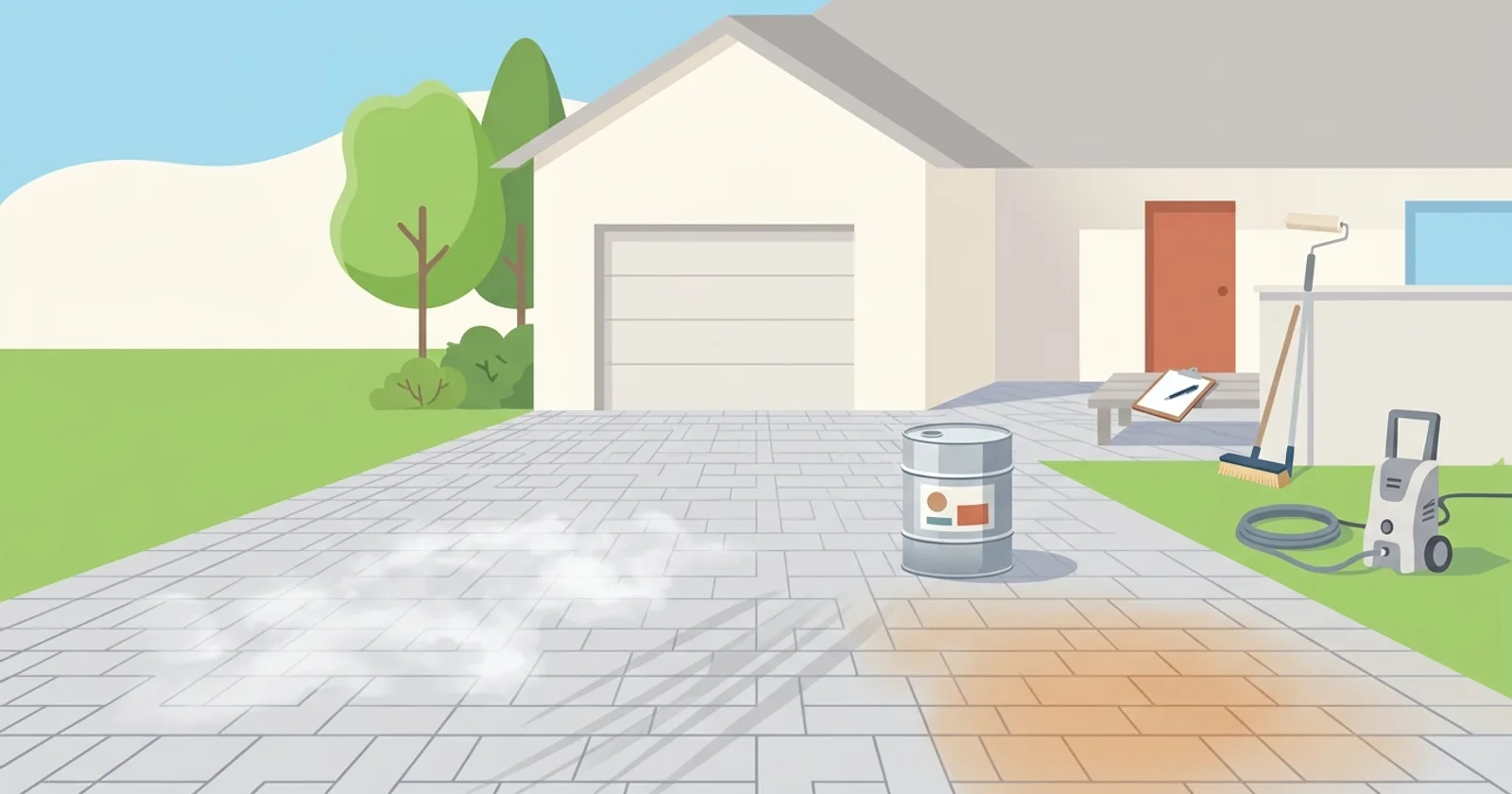
| What you see | Likely cause | Usual fix |
|---|---|---|
| Milky or cloudy white film, often days later | Moisture trapped under the film; damp pavers or dew during cure | Solvent sealer: re-flow with the maker’s solvent. Water-based: strip and reseal |
| Lines, stripes or roller marks | Uneven film: overworked or overloaded roller, no wet edge | Ask what the sealer maker advises before adding coats |
| White spots that flake or scrape | Puddled sealer that dried too thick | Ask the crew to remove the thick spots and even out the area |
| White or light grey powder | Efflorescence or polymeric sand haze, not the sealer | An efflorescence cleaner; see our white haze guide |
| Brown, dirty or rusty tint | Residue, rust or minerals sealed in; sometimes the sealer’s color boost | Test-spot cleaning first; strip if it’s under the film |
The milky white film
One concrete-sealer maker says milky haze is almost always trapped moisture. Either the surface was damp when it was sealed, or condensation formed under the film as it cured. Its rule: keep the surface at least 5°F above the dew point through application and cure.
A paver maker warns of the same whitish film when moisture is trapped or when a second coat goes on before the first has fully set. It advises letting pavers dry “a bit longer than you think.”
The fix depends on chemistry. The concrete-sealer maker says its solvent product can re-flash a cured solvent-based sealer, dissolving the film so trapped moisture escapes and it cures clear. It warns that this won’t work on water-based sealers, which must be stripped. It also says to confirm the surface is dry first, or the milkiness comes back.
This matches what operators report. In one pressure washing community thread from May 2025, a crew’s solvent-sealed patio turned white about a week after sealing. Replies pointed to moisture and suggested a solvent re-flow, with stripping as the fallback.
Lines, stripes and roller marks
Lap lines are an application problem. One coatings maker lists the usual causes: overworking the roller, overloading it, and not keeping a wet edge. It says each pass should overlap the last by 2 to 3 inches. It also says spraying is best on porous surfaces, because a roller is bound to leave marks.
The paver maker adds a step: apply thin, even passes and back-roll to even out lap marks. One paver-sealer data sheet tells applicators to spray in 60-square-foot sections and then roll off the excess.
Puddles are the other culprit. A pro in a community thread said sealer left pooled on textured pavers dried into white, scab-like spots that could be scraped off. If your stripes run in neat, even bands, the lines may come from the wash, not the sealer. Our guide to driveway stripes after pressure washing covers that, since sealer can make wash marks stand out more.
The brown or dirty tint
A brown tint has more possible causes, so test before you treat. One sealer data sheet tells crews to remove oil, grease and rust stains, plus trapped efflorescence, before sealing. Anything left behind can end up under the film.
In a trade-forum thread from July 2025, a homeowner’s patio turned brown after a penetrating sealer. Replies raised two ideas. One was minerals reacting with the sealer and bringing up rust-like spots. The other was dirt or sand residue that wasn’t fully rinsed off before sealing. A strong cleaner used undiluted then lightened the color of some edge pavers. That’s a good reason to insist on a small test spot.
Also check whether the whole surface simply looks darker. The paver maker says a wet-look sealer deepens paver color. That’s the product working, not failing.
Humid summers make all of this harder
Wilmington, NC shows why timing matters. NOAA’s records for the airport show average morning humidity of 85% to 89% from July through September, and a normal July low of 73°F. August and September each average more than 8 inches of rain.
Warm, wet nights mean dew, and dew on a sealer that’s still curing is how blush starts. One sealer data sheet also asks for a surface that is cool to the touch, between 32°F and 85°F. That leaves a narrow window on a summer day. A crew that reschedules for weather is doing it right.
Asking the crew to come back
- Get the product name and whether it’s solvent- or water-based. That decides whether it’s a re-flow or a strip.
- Ask what fix the sealer maker recommends for this problem, and to see it on a small test area first.
- Ask how they checked dryness and the dew point before sealing.
- Get the redo in writing, including who pays for stripping.
Don’t rely on product warranties. One sealer maker’s warranty only replaces product and excludes removal costs. One paver maker’s warranty excludes efflorescence and polymeric sand haze, and doesn’t cover labor. If you need to tell old damage from new, see wash damage vs damage that was already there. Our questions to ask a house washing company can help you get the scope in writing next time. How we check every claim: our methodology.
Sources
- Direct Colors, How to Fix a Failed Concrete Sealer (Peeling & Blushing): directcolors.com/blogs/dcu/how-to-fix-concrete-sealer
- Direct Colors, How to Apply Concrete Sealer: Step-by-Step Guide: directcolors.com/blogs/dcu/how-to-apply-concrete-sealer
- Unilock, Paver Sealing Pros and Cons Explained: unilock.com/diy/paver-sealing-pros-cons
- Unilock, Warranty Terms (2020): unilock.com/wp-content/uploads/2020/05/Unilock-Warranty-Terms-2020_HR.pdf
- Duraamen Engineered Products, How to avoid lap lines and roller marks while applying concrete sealers: duraamen.com/blog/concrete-sealer-application
- Alliance Gator, Gator Seal Signature Series Natural Look technical data sheet (July 2025): alliancegator.com/wp-content/uploads/documentation/tds/gator-sealers/alliance-tds-seal-natural-look-july-17-2025.pdf
- NOAA NCEI, Comparative Climatic Data, relative humidity (data through 2023): ncei.noaa.gov/sites/default/files/2024-11/relhum23.txt
- NOAA NCEI, 1991–2020 monthly normals, Wilmington International Airport, NC (USW00013748): ncei.noaa.gov/data/normals-monthly/1991-2020/access/USW00013748.csv
- Community discussion, PressureWashingResource forum, “Brown Stain on Pavers After Sealing” (July 2025): pressurewashingresource.com/community/t/brown-stain-on-pavers-after-sealing/40239