Few lot washers post prices. Two of the three dealer-service pages we checked asked for a call or a quote request. So the figures below mix one published rate with numbers washers have shared on trade forums over the years. Treat them as a starting range, not a market survey.
What dealer lot washing costs per car
| What’s included | Reported price per car | Source (area, year) |
|---|---|---|
| Biodegradable soap and spot-free rinse, touchless | From $2.50 ($1.00 for Carsmetology dealerships) | Carsmetology, published price (southeast Michigan) |
| Deionized-water rinse, no hand drying, 20+ cars | $1.25; $1.45 to $2.00 under 20 cars | Trade-forum report (Oregon, 2009) |
| Spray and wipe, twice a week | $1 a car, $2 a truck, SUV or van; $50 minimum under 40 vehicles | Trade-forum report (Arizona, 2009) |
| Rinse and chamois wipe, no soap, about every 10 days | About $0.75 | Trade-forum report (Dallas–Fort Worth, 2018) |
| Rinse and towel dry, 88-car lot | $4.50 | Trade-forum report (Maryland and Delaware, 2009) |
The same handful of numbers shows up across nine years of posts. One washer said in 2009 that pricing hadn’t changed in 15 years. Even so, bids on the same lot can differ a lot.
What 300 cars every two weeks costs
A dealer asking for 300 cars washed every other week is asking for 26 visits a year. Here’s how that pencils out:
- At $1.25 a car: $375 a visit, or about $9,750 a year.
- At $2.50 a car: $750 a visit, or about $19,500 a year.
That’s a $9,750 gap for the same lot, so compare bids line by line. Check whether the price covers soap or only a rinse, whether trucks and SUVs cost extra and whether there’s a per-visit minimum.
Running a washing business and pricing this job? Our guide to bidding your first commercial job covers the paperwork commercial buyers ask for. Our trip charges and minimums guide helps when the lot is a long drive away.
Why spot-free water drives the price
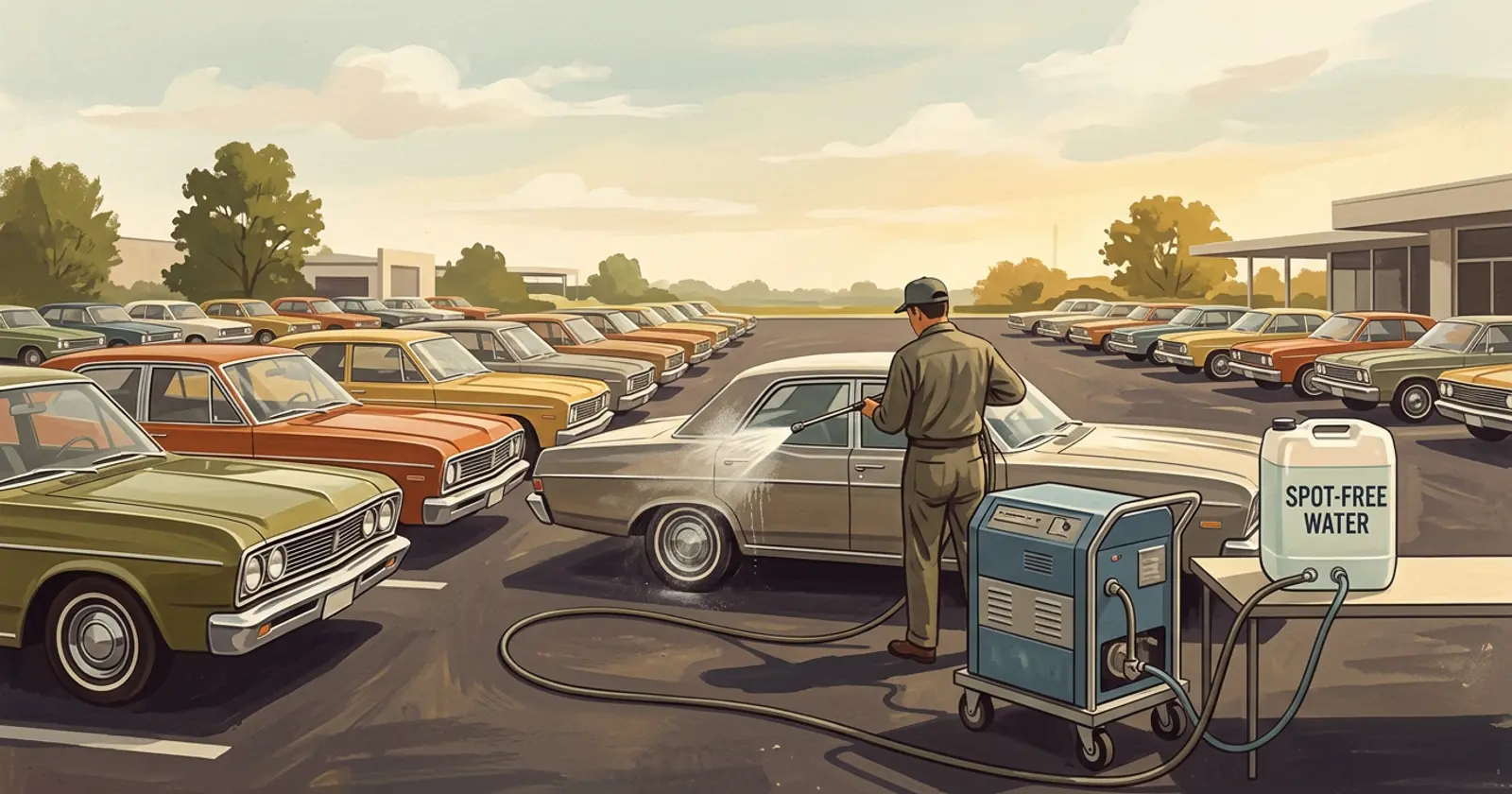
Spots form when tap water dries and leaves its dissolved minerals behind, such as calcium, magnesium and iron. A deionized (DI) rinse strips those minerals out, so cars air dry clean. That’s why most lot washes skip towels, and why a washer without spot-free water needs a crew to wipe every car.
DI water isn’t free to make. One maker lists a small DI tank (0.5 cubic feet of resin) at $484.95. Its chart says that tank makes about 559 gallons from water with 200 ppm of dissolved solids, before the resin is used up. At under two gallons a car, 300 cars use a little under 600 gallons, so that tank would barely cover one visit. In softer water the same tank lasts much longer.
So a washer in a hard-water area spends more on resin per car. Ask how they make spot-free water and how they check it. A simple meter reading is the usual test. For more on what minerals do to glass, see our guide to spots on windows after a wash.
Schedules, weather and the dealer’s own lot
Season. A southeast Michigan detailer offers its lot wash only from March to November. Another forum washer said they washed down to about 28 degrees, then stopped because the runoff froze into ice. A Georgia poster said crews came weekly but went every other week in winter, when less dirt was blowing around.
Rain and sprinklers. One washer warned that rain can leave black lines from weather stripping that need a hand wash. He said cars parked near lawn sprinklers will spot no matter what the washer does. Move inventory away from sprinkler spray, or expect spots.
Damage and insurance. Washers on forums worry about dents and scratches being blamed on them. Ask for a certificate of insurance before the first wash. Do a quick walk-around on new arrivals so everyone knows what was already there.
The wash water
A rinse-only lot wash is mostly clean water, but soap and grime still run off a paved lot. Local stormwater rules decide what’s allowed. Our fleet washing cost guide covers what EPA guidance says about vehicle wash water and storm drains. If you also want the pavement cleaned, our water use guide explains how to estimate gallons from a machine’s flow rate.
Our methodology page explains how we check these numbers.
Sources
Based on 6 sources · How we price
- Carsmetology, Dealership Lot Washing: carsmetology.com/product/lot-washing
- Pro Wash Detail, Car Dealership Lot Washing & In-House Detail: prowashdetail.net/services/car-dealerships.html
- Iron County Pressure Washing, Car Dealership Cleaning: ironcountypressurewashing.com/services/car-dealership-cleaning
- Wash On Wheels, Car Washing For A New Dealer: washonwheels.net/news-notes/car-washing/car-washing-for-a-new-dealer-working-out-the-bugs
- US Water Systems, Allegro DI Spot-Free Rinse Tank System: uswatersystems.com/products/allegro-di-spot-free-rinse-tank-system
- Obsessed Garage, DI Water Systems And How They Work For Car Washing: obsessedgarage.com/blogs/og-knowledge-base/di-water-systems