This piece covers the drive. For your base rates, see how much to charge for pressure washing. To price the job from a map so you don’t drive out twice, see quoting without driving out.
The question owners keep asking
In December 2025, a pressure washing subreddit asked how far owners had driven for a job. Was it worth it, and did they have a minimum? Replies ran from 70 miles to three hours one way. One owner charged travel time both ways and priced the job from customer photos first. Another drove about 80 miles each way for two neighbors, and the second one backed out. He said the gas ate about half the day’s pay.
An older trade-forum thread from 2018 gives the most common fixes:
- Group the far jobs into one day.
- Ask the customer to bring in neighbors.
- Raise the minimum with distance.
One owner there said he wouldn’t drive an hour each way for less than about $600 unless business was slow. The two hours in the truck could earn money closer to home.
What the drive costs
The IRS sets a standard mileage rate each year. Its notice says an independent contractor studies the fixed and variable costs of running a car to set it. For 2026 the business rate was 72.5 cents a mile from January to June. The IRS raised it to 76 cents for July 1 to December 31.
Treat that number as a floor. It’s built from car costs, and a truck pulling a water tank is heavier. See water tank weight and trailer rules. Your fuel and repair receipts show how far above it you run. This is pricing math, not tax advice.
The rate covers the vehicle only. Drive time needs its own line.
How washers publish travel terms
| Washer (area) | Home zone | Farther out | Minimum |
|---|---|---|---|
| KC Splash (Kansas City metro) | Free within 20 miles of the shop | $50 travel fee beyond 20 miles | $300 per visit; mix services to reach it |
| Exterior Experts (Cookeville, TN) | No fee in three nearby towns | “Small travel surcharge” for outlying towns, by distance | Not listed |
| First Response Pressure Wash (Hampton, VA) | No fee in Hampton and Newport News | Travel adjustment stated in the quote | Not listed |
| Clean Slate (North Clarendon, VT) | 20 minutes or less: small jobs fine | 40 minutes to an hour-plus: a full house or several jobs together | Not listed |
| Gleaming Gutters (Charlotte, NC) | Not listed | Not listed | $249 |
From each washer’s own page, checked 2026-10-09.
A flat fee is simple, but check what it covers. At 76 cents a mile, a $50 fee pays for about 66 round-trip miles of driving. That’s roughly 33 miles each way, before any drive time.
Draw zones in minutes, not miles
Rural Vermont shows why minutes can matter more than miles. The state transportation agency counts 8,517 of its 15,756 public road miles as dirt or gravel in 2026. That’s more than half. Barnard and Chester are on its list of the top five dirt-road towns. Both sit in the outer tier of one Rutland County washer’s service map, which sorts towns by drive time.
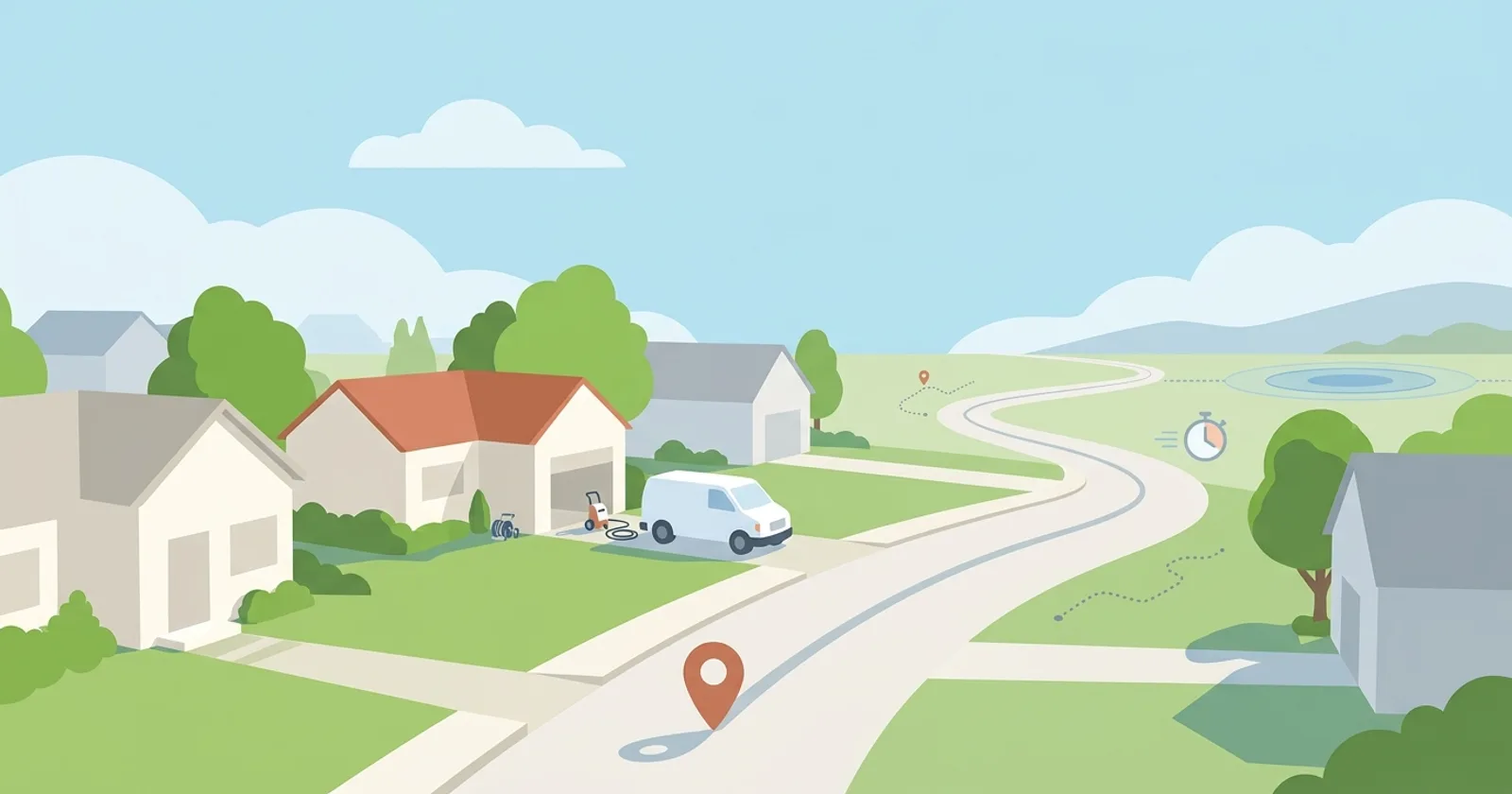
Set three rings around your shop:
- Home zone. Short drives. Any job at or above your normal minimum.
- Middle zone. A flat trip fee, or a request to group with a neighbor.
- Far zone. A higher minimum ticket, and booked only on days you’re already out there.
A far-zone minimum worksheet
Fill in your own numbers. This example is made up: 50 miles each way, an hour each way, and a $150 driveway.
| Line | How to figure it | Example |
|---|---|---|
| Vehicle | Round-trip miles x the IRS rate (or your higher real cost) | 100 x $0.76 = $76 |
| Drive time | Round-trip hours x your target hourly rate | 2 x $60 (made up) = $120 |
| The job | Your normal price for the work | $150 |
| Far-zone minimum | Add the three | $346 |
Say three customers in that town book the same day. Then the $196 trip cost splits to about $65 each. That’s the case for a “we’re in your area on the 14th” message to past customers and neighbors. Lead sources covers ways to reach them.
When to refer it instead
Some calls won’t reach your far-zone minimum, even after grouping. Refer them to a closer washer. One Virginia company’s page says that if it can’t serve an area, it will tell the customer who can. If far calls keep coming, your prices or zones may need a look. See close rate and booked-out weeks.
How we got these numbers
Travel terms come from each washer’s own page. The mileage rates come from the IRS, and road miles from the Vermont Agency of Transportation. Forum posts show what owners ask and say they do. They are not data. Our methodology explains the checks.
Sources
Based on 9 sources · How we price
- IRS, standard mileage rates (2026 by period): irs.gov/tax-professionals/standard-mileage-rates
- IRS Notice 2026-10 (2026 rates, annual cost study): irs.gov/pub/irs-drop/n-26-10.pdf
- Vermont Agency of Transportation, road mileage statistics: vtrans.vermont.gov/planning/maps/stats
- KC Splash, residential pricing (Kansas City): kc-splash.com/residential-pressure-washing-pricing
- Exterior Experts, pricing (Cookeville, TN): exteriorexperts.co/pricing
- First Response Pressure Wash, service areas (Hampton, VA): 911pressurewash.org/service-areas
- Clean Slate, service area (North Clarendon, VT): cleanslatevt.com/service-area
- Gleaming Gutters, Charlotte pressure washing: gleaminggutters.com/pressure-washing-charlotte
- Community discussion (2018, older): pressurewashingresource.com/community/t/how-much-do-you-charge-for-travel/15606