“More pressure gets a green court clean faster.”
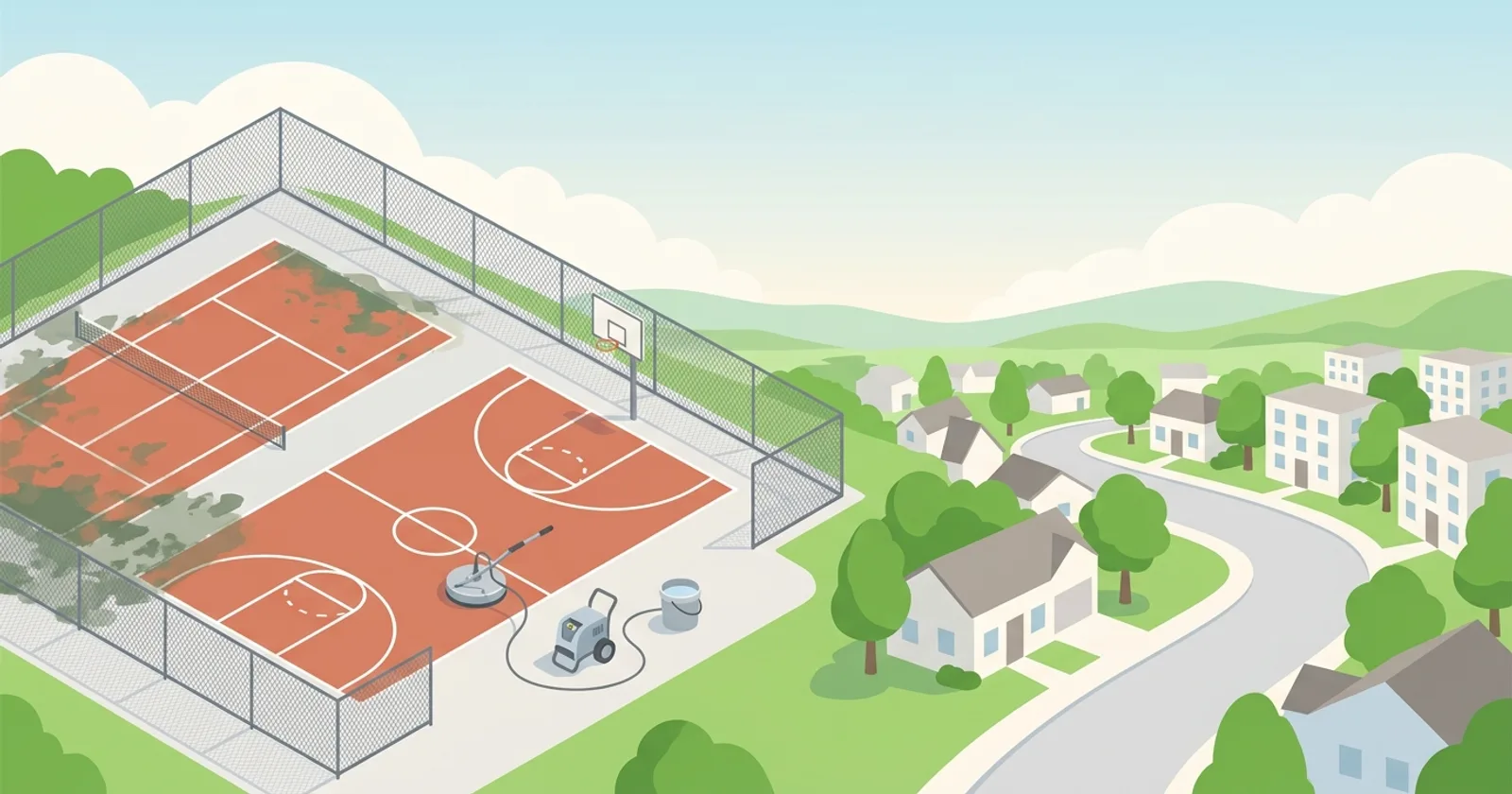
The record: The coating maker’s 2024 manual says to be very careful not to get a wand tip too close to the surface, as it may damage and strip the coatings. It calls surface cleaners ideal because they minimize the striping a wand leaves. A court-surface maker’s hard-court guide allows pressure washing for spring opening at a maximum of 1,500 psi, with walk-behind rotary equipment best suited.
What it does to the price: A stripped or worn coat brings resurfacing closer; the coating maker’s resurfacing FAQ puts the average at $12,000 to $20,000.
“Wash the court as often as the budget allows.”
The record: The manual suggests cleaning about once a month and says rinsing with water is usually enough. It also says to clean only when the court is visibly dirty, because frequent scrubbing and pressure washing can strip the sand out and wear the surface early.
What it does to the price: The maker’s standard resurfacing cycle for its acrylic surfaces is 5 to 8 years. Over-washing eats into that.
“The acrylic coating is what grows the mold.”
The record: The maker says acrylic coatings do not support fungus growth. Spills, decaying matter and other debris feed it, and leaves and pine needles are breeding grounds for mold and mildew. Our guide to leaf stains on concrete and pavers explains why those brown shadows linger.
What it does to the price: The maker’s FAQ says a court that hasn’t been cleaned or properly maintained will likely cost more to resurface, since mold, moss and fungus removal may have to come first.
“Bleach will ruin an acrylic court.”
The record: The coating maker’s mold mix is 2 parts household bleach to 1 part water, scrubbed gently with a soft brush and rinsed after a few minutes. The court-surface maker allows a bleach solution approved by the EPA for outdoor use alongside pressure washing for algae growth.
What it does to the price: Write the maker’s ratio into the scope, plus a small test area, which one maker says avoids discoloration. Our article on soft washing and pesticide licenses explains why some states care who applies it.
“Puddles on the court just dry off.”
The record: The builders’ association defines a birdbath as standing water over 1/16 inch after an hour of drying at 70°F in sunlight. It says birdbaths may cause staining or peeling. The coating maker adds that dirt collects in standing water and says to remove it as often as possible.
What it does to the price: Birdbath patching takes extra time and materials, which the maker says can add to the cost of resurfacing. Ask the washer to note any low spots they see.
Bottom line
A board’s cheapest move is a gentle, maker-approved wash on a schedule the surface can take, with photos of cracks and faded spots taken before the crew starts. Our guide to when the HOA hires the washer covers the contract, bidding commercial jobs shows what associations usually request, and wash damage vs damage that was already there helps if anyone asks later. How we check sources: methodology.
Sources
Based on 4 sources · How we price
Checked 2026-11-04. Maker guides are quoted for what they say about their own surfaces.
- SportMaster Sport Surfaces, How Much Does it Cost to Resurface a Tennis Court?: sportmaster.net/faq_resurface
- SportMaster Sport Surfaces, Maintenance Manual (2024): sportmaster.net/wp-content/uploads/SportMaster-Maintenance-Manual-2024.pdf
- Har-Tru, Hard Court Maintenance: hartru.com/pages/hard-court-maintenance
- American Sports Builders Association, Birdbaths (position paper, rev. 2023): sportsbuilders.org/resource/resmgr/position_papers/position_tennis/revised-2023/birdbaths,_rev_2023.pdf