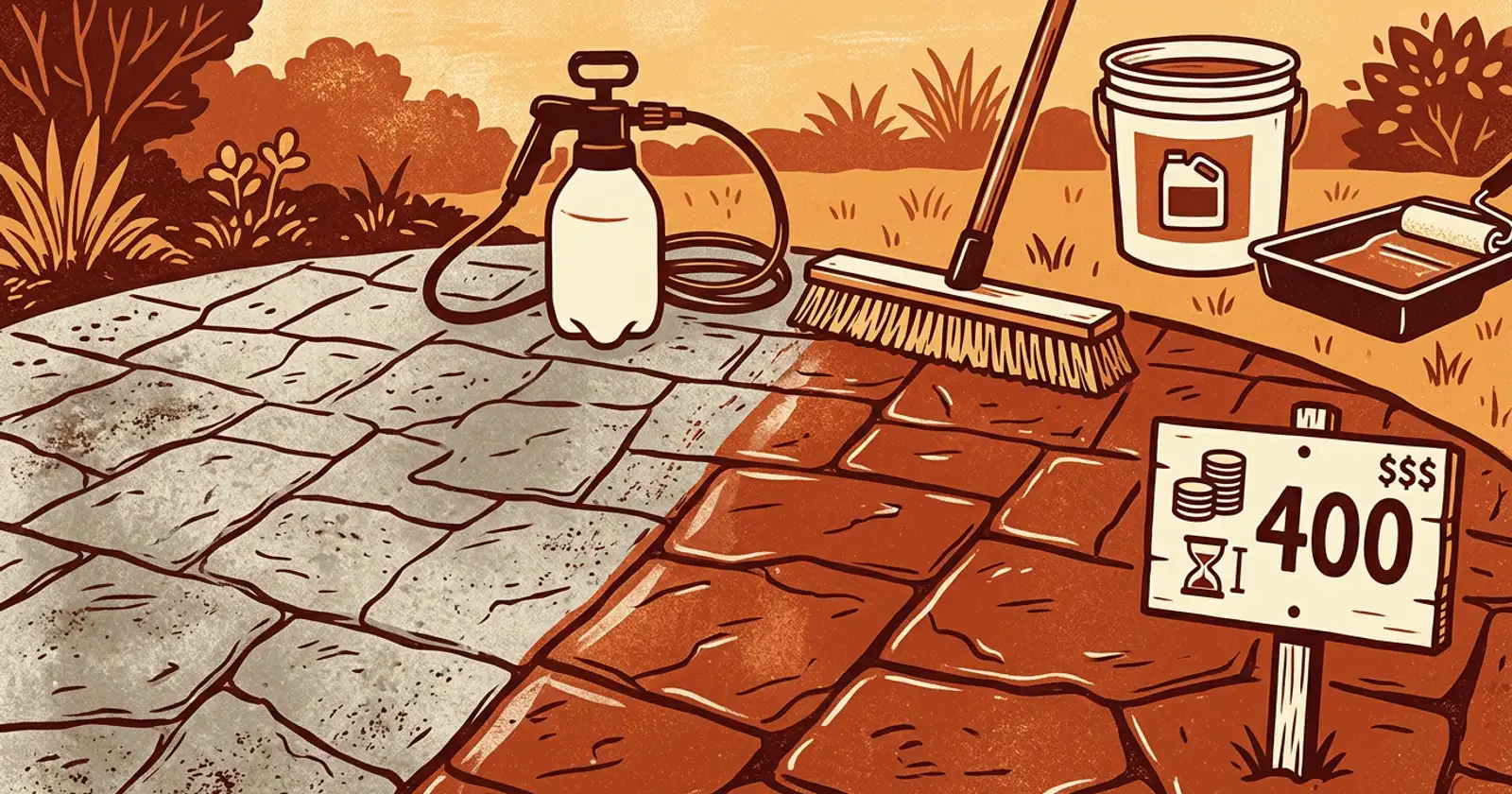
The wash is the easy part. The sealer is what brings the color and sheen back, so most of the price, and most of the risk, is in that step.
What contractors charge
| Job | Published price | Who publishes it (area) |
|---|---|---|
| Professional reseal, including power washing, sand and two coats | $1 to $2 per sq ft; $400 to $800 for a 400 sq ft patio | Patrick Breen Stamped Concrete (South Jersey) |
| Reseal every 2 to 3 years | $0.75 to $1.50 per sq ft | B.G. Concrete (Chicago area) |
| Concrete cleaning and sealing together | About $1.00 per sq ft | A-1 Concrete Leveling (national) |
| Recolor: clean, stain and reseal | $3 to $8 per sq ft | Zion Outdoors (Texas) |
The low end is a straightforward wash and recoat on a sound sealer. The New Jersey contractor says the top of its range is for concrete in worse shape or that needs stripping. Recoloring is a different, bigger job.
On a 400 sq ft patio, $0.75 to $2 a foot works out to $300 to $800. A recolor at $3 to $8 a foot would be $1,200 to $3,200.
Why the sealer is the whole job
Stamped concrete gets its wet-look color from the top coat. When that wears through, the New Jersey contractor says, the color looks dull, flat or chalky, and water soaks in instead of beading. It recommends resealing every two to three years. Patios in heavy sun or traffic may need it every two years, and shaded, lightly used ones can sometimes go three.
It uses a solvent-based acrylic that it says typically lasts two to three years in South Jersey before recoating. It applies two thin coats, because thick coats trap solvent and cause bubbling.
Cleaning without losing color
Washers worry about pulling color out. On one trade forum, a washer planning a clean and reseal for a picky customer asked whether his surface cleaner would strip color. One reply suggested starting at about 1,000 to 1,200 psi and only going higher if no color runs. Another said a patio of his came out lighter after cleaning, and he had warned the homeowner first. Ask for a small test spot before the full job.
Keeping it from going slick
Glossy sealers can be slippery when wet. A washer on the same forum said the only sealer he’d used that looked good, a spray-on acrylic, got very slick when wet. Contractors handle it two ways:
- Silica sand. The New Jersey contractor broadcasts a thin layer of fine silica sand that embeds in the sealer for traction.
- An anti-slip sealer. It suggests a sealer with a built-in anti-slip additive for pool decks, steps and walkways, with a lower, more matte sheen.
Pick based on use. A gloss finish suits a dining patio. A pool deck or front steps call for grip.
When the old sealer has failed
White haze, flaking and peeling usually mean the old sealer is failing. The New Jersey contractor says that kind of sealer needs stripping before resealing. It also warns that moisture trapped under a new coat causes white haze, bubbling and peeling. If it rains between washing and sealing, it waits another 24 hours.
What looks like efflorescence is sometimes the sealer. One washer posted white patches on a sealed, stained driveway, and experienced washers guessed it was failed sealer, not efflorescence. Our guides to white haze on masonry and paver sealer problems help you tell them apart.
Freeze-thaw country
In Toledo, Ohio, the low drops to freezing or below on about 123 days a year. The Chicago-area contractor ties its two-to-three-year reseal cycle to freeze-thaw climates. For plain concrete and penetrating sealers, see our guide to sealing a driveway before winter salt.
Pavers are a different job; see paver clean, sand and seal costs. Sealing needs dry weather, so read our guide to rain on wash day before you book. Our methodology page explains how we check these numbers.
Sources
Based on 8 sources · How we price
- Patrick Breen Stamped Concrete, How to Reseal Stamped Concrete: patrickbreenstampedconcrete.com/blog/how-to-reseal-stamped-concrete
- B.G. Concrete, Stamped Concrete Cost in 2026: bgconcreteinc.com/stamped-concrete-cost
- A-1 Concrete Leveling, How Much Does Concrete Sealing Cost?: a1concrete.com/concrete-repair-learning-center/concrete-sealing-cost
- Zion Outdoors, How Much to Recolor Stamped Concrete: zionoutdoors.com/how-much-does-it-cost-to-recolor-stamped-concrete
- NOAA NCEI, 1991-2020 Annual Normals, Toledo Express Airport: ncei.noaa.gov/data/normals-annualseasonal/1991-2020/access/USW00094830.csv
- Community discussion: Pressure Washing Resource, “Stamped concrete patio” (September 2025): pressurewashingresource.com/community/t/stamped-concrete-patio/40448
- Community discussion: Pressure Washing Resource, “A little help, correct sealer?” (July 2025): pressurewashingresource.com/community/t/a-little-help-correct-sealer/40240
- Community discussion: Pressure Washing Resource, “Efflorescence on Sealed, stamped and stained concerte” (October 2026): pressurewashingresource.com/community/t/efflorescence-on-sealed-stamped-and-stained-concerte/41198