A homeowner on a pressure washing forum said a 1,500 PSI unit worked great on the sidewalk but was “falling short when it comes to reaching the second floor.” They were eyeing a 3,400 PSI gas machine. With peeling paint on wood siding, one reply said hiring a professional might be more practical. More pressure was the wrong fix.
PSI, GPM and what your siding can take
A pressure washer manual sums up the two numbers. PSI is pressure: the higher it is, the more “stripping power.” GPM is the flow: the higher it is, the more rinsing power. Flow also sets your water bill, which house wash water use breaks down.
Siding makers care about PSI. One vinyl siding maker says to use a 40-degree tip and set the pressure between 1,500 and 2,400 PSI. A fiber-cement maker says to stay below 1500 psi, with a wide fan tip kept at least 6 feet from the wall. A vinyl siding trade group adds that some makers don’t recommend power washing at all.
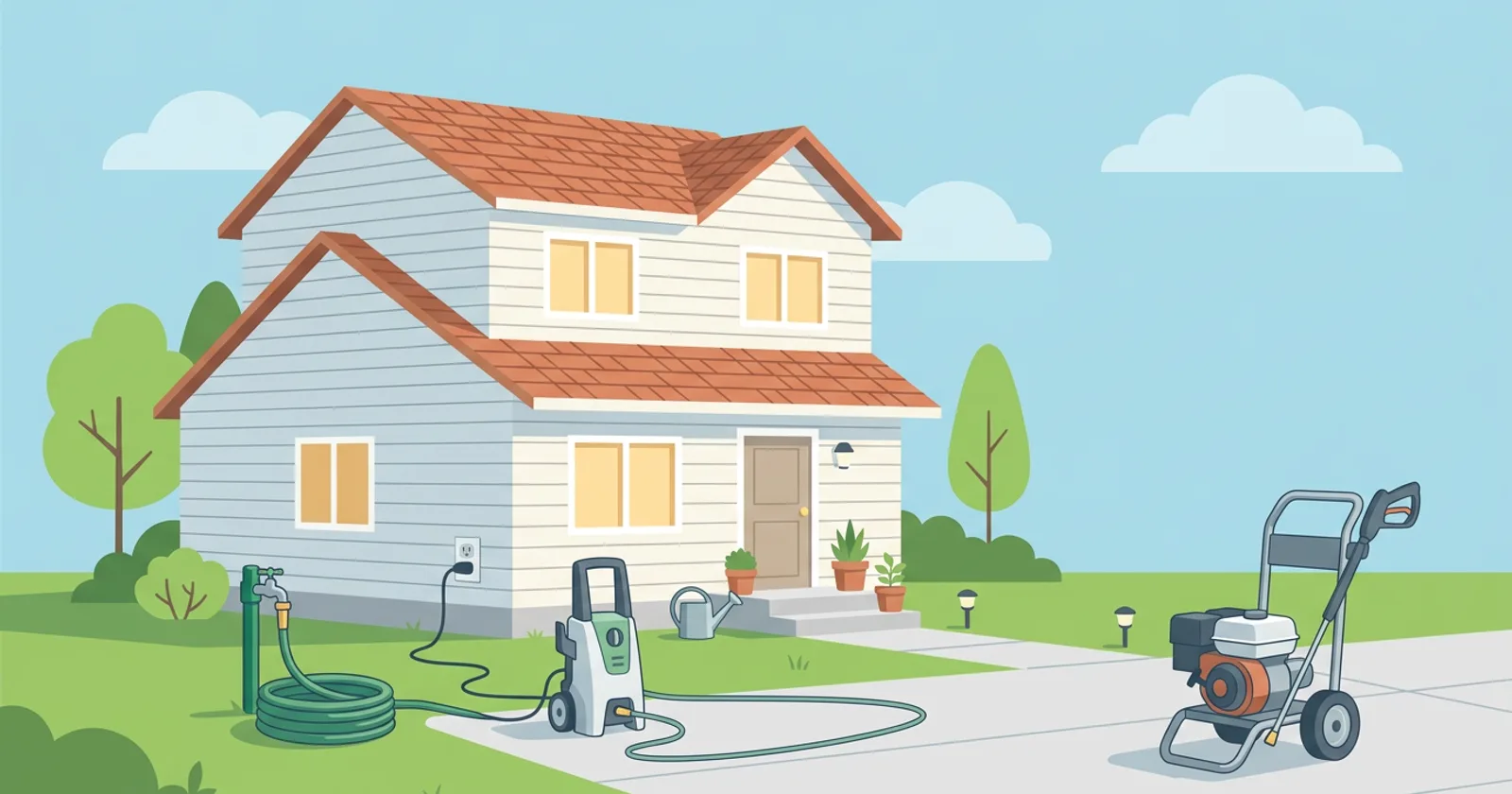
So a 3,200 PSI gas unit, run flat out, is above both ranges, and you’d spend the job turning it down. A 1,800 PSI electric already sits inside the vinyl range.
| Corded electric example | Homeowner gas example | |
|---|---|---|
| Model | Greenworks 1800 PSI, 1.1 GPM | Expert Power Wash 3,200 PSI, 2.5 GPM (212cc) |
| Price on maker’s site (Oct 2026) | $109.99 | $400 on sale ($699 regular) |
| Power | 120-volt outlet; manual says extension cord not recommended | Gasoline engine; outdoors only, away from windows and doors |
| Fits vinyl range (1,500–2,400 PSI)? | Yes | Only if turned down |
| 15” surface cleaner it suits | Craftsman CMZPWSC15: up to 3,000 PSI and 1.7 gpm | Westinghouse: max 3400 PSI, 2.7 GPM |
The gas unit costs about $290 more on sale ($400 minus $109.99), and about $589 more at its regular price.
Stories: why more PSI won’t fix the second floor
The same vinyl siding maker says to hold the power washer straight at eye level and not aim it upward, because water may collect behind the siding and cause leaks, streaks and decay. Spraying a second story from the lawn is that upward angle.
Climbing doesn’t help. A pressure washer manual says not to use the machine on a ladder, because the spray’s kickback could make you slip or fall.
One option is to wash the first floor yourself and hire out the rest. Our house washing cost guide shows what one-story and two-story washes cost, and our questions to ask a house washing company helps you vet who you hire.
Surfaces: siding vs concrete
Concrete is where a gas unit’s extra flow pays off, since more GPM means more rinsing power. A round surface cleaner with rotating jets helps on flat slabs. Stripes left behind are a common result, explained in why driveways stripe after washing.
Match the cleaner to the machine. One 15-inch cleaner is rated for washers up to 3,000 PSI and 1.7 gpm, which suits a small electric. Another lists a max of 3400 PSI and 2.7 GPM, which suits a homeowner gas unit.
If you only do the driveway once a year, compare what a pro charges in our pressure washing cost guide before you buy a gas machine for it. For a wood deck, see deck prep before you stain.
Spigot and outlet: check before you buy
Your water. One electric washer’s manual asks for a steady supply of at least 5 gallons per minute at 20 PSI. Quick test: time how long your spigot takes to fill a 5-gallon bucket. If it’s 60 seconds or less, you’re getting at least 5 GPM. Another manual lists “not enough water supply” as a reason a unit won’t reach high pressure.
Your outlet (electric). One maker says to use a dedicated 120-volt receptacle rated at 15 or 20 amps, with other appliances on that circuit turned off. It says an extension cord is not recommended. If you must use one, it should be an outdoor-rated 3-prong cord, no longer than 50 feet, with at least 14 AWG wire. Another electric washer comes with a GFCI plug built into its cord.
Your air (gas). Gas engines give off carbon monoxide. One gas manual says to run the washer only outside, far away from windows, doors and vents, and never in a garage or shed, even with the door open. Another says to keep at least 5 feet of clear space on every side, including overhead. Whichever you buy, see our guide to winterizing a pressure washer before the first freeze.
If you live in California
In 2021, the California Air Resources Board (CARB) approved rules making new small off-road engines zero-emission from model year 2024. Generators and large pressure washers were the exception: their standards tightened by 40 to 90 percent in 2024 and are set to reach zero in model year 2028.
The rules apply to makers and sellers of new engines. CARB says they don’t require current owners to stop using the gas tools they already have. CARB also notes zero-emission equipment is quieter. Check CARB’s small off-road engine page for the latest before you buy.
The short version
Pick electric for siding, a spigot that passes the bucket test and an outlet nearby. Pick gas for lots of concrete, no outlet close by, and a spot well away from the house. Either way, the second story needs low pressure or a pro. For how we checked these numbers, see our methodology.
Sources
- Ply Gem, Siding Care & Maintenance: plygem.com/siding/support/care-maintenance
- James Hardie, Homeowner Care & Maintenance Guide: pdf.lowes.com/productdocuments/f7acba9c-93fd-44ed-93ca-2c98e8c9a527/04317931.pdf
- Polymeric Exteriors Product Association, Cleaning and Maintenance: polymericexteriors.org/why-polymeric/cleaning-and-maintenance
- Simpson, Pressure Washer Use and Care Manual (7114140): simpsoncleaning.com/wp-content/uploads/7114140-11x17-1.pdf
- Greenworks, 1800 PSI 1.1 GPM Cold Water Electric Pressure Washer: greenworkstools.com/products/1800-psi-1-1-gpm-cold-water-electric-pressure-washer
- Greenworks, EPW-1800 pressure washer manual: greenworkstools.com/cdn/shop/files/P0802810-01_5106102_EPW-1800_pressure_washer_manual.pdf
- Expert Power Wash, 3,200 PSI 2.5 GPM Cold Water Gas Pressure Washer: expertpowerwash.com/products/3-200-psi-2-5-gpm-cold-water-gas-pressure-washer-powerease-212cc-engine-and-cp-axial-pump
- Craftsman, 15” Surface Cleaner (CMZPWSC15): craftsman.com/en-us/product/cmzpwsc15/15-surface-cleaner
- Westinghouse, Surface Cleaner for Pressure Washers: westinghouse.com/products/westinghouse-surface-cleaner-for-pressure-washers
- Briggs & Stratton, pressure washer operator’s manual: apw-inc.com/Image/GetDocument/en/2653/briggs%20and%20stratton%2c%20020503-00%2c%20mnl.pdf
- Craftsman, 3100 MAX PSI pressure washer Quick Setup Guide: apw-inc.com/Image/GetDocument/en/2876/craftsman%2c%20580.752590%2c%20mnl.pdf
- California Air Resources Board, small off-road engine rules approved (news release): ww2.arb.ca.gov/news/carb-approves-updated-regulations-requiring-most-new-small-road-engines-be-zero-emission-2024
- California Air Resources Board, SORE FAQ: ww2.arb.ca.gov/sites/default/files/barcu/regact/2021/sore21/carb_sore_faq.pdf
- Community discussion, Pressure Washing Resource forum: pressurewashingresource.com/community/t/help-cleaning-my-two-story-house-and-im-a-beginner/39252