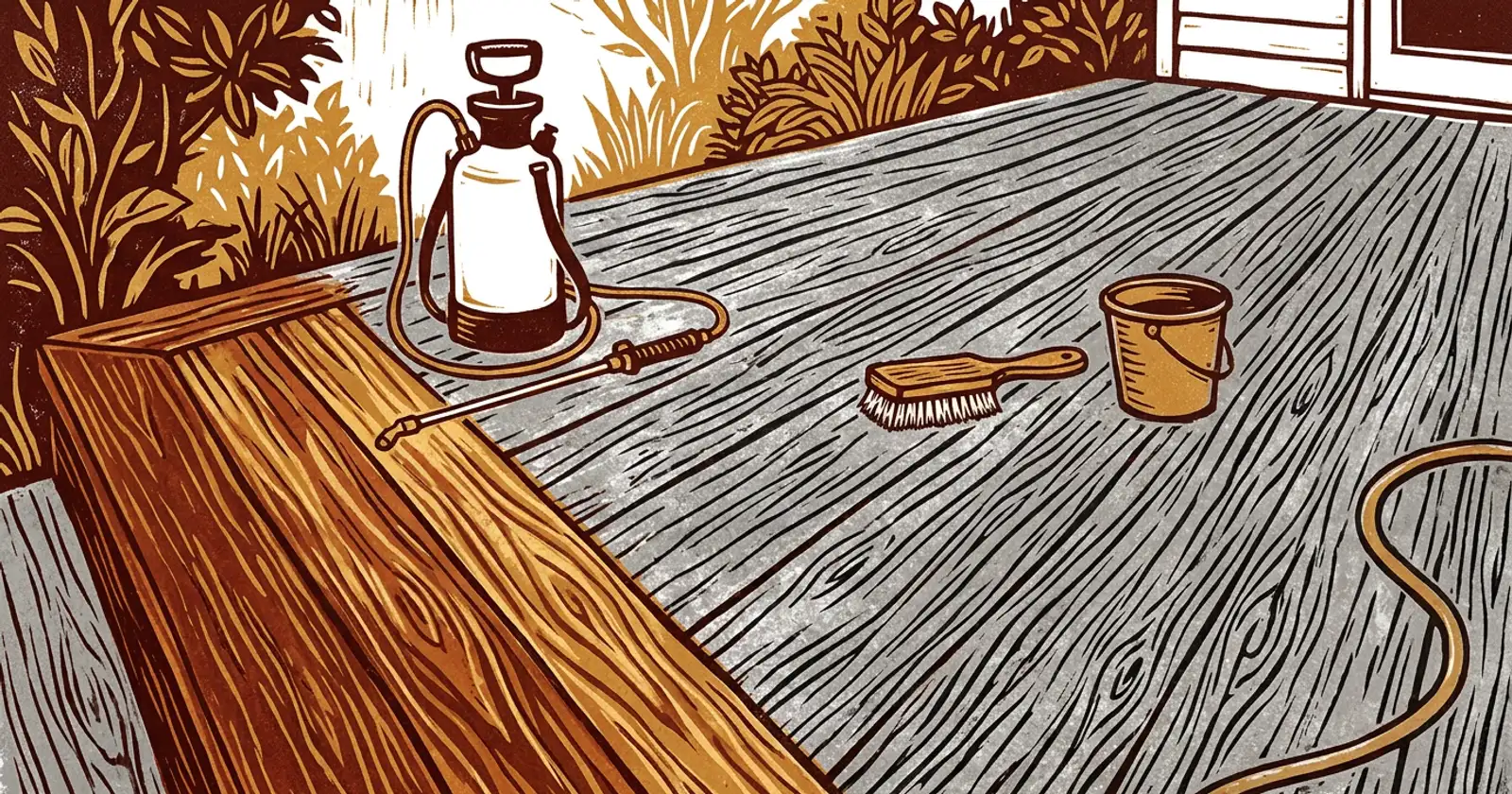
In July 2025, a pressure washer on a trade subreddit got a log cabin request. The washer wasn’t sure what to use if bleach was out. In September 2026, a homeowner asked how much pressure it takes to get pine pollen off logs resealed a couple of years earlier. One reply said to skip pressure. Use mild soap from a pump sprayer, then a gentle hose rinse.
The finish makers mostly agree with that reply.
Why logs need a lighter touch
Water gets in and stays. A U.S. Forest Service lab report covers protecting log homes. It says storm water does little harm if it runs off quickly. But water caught in joints, crevices or checks soaks in and dries out very slowly. Decay can start there. The report calls the joints between logs “possible water-trapping zones.” That’s what the chinking is for.
Pressure finds the gaps. One log finish maker says a pressure washer “will definitely test the sealant system of a home.” It expects water to get inside. It suggests someone stand indoors with towels, marking leak points to seal later.
The protection may be thin. The same lab report says borate wood preservatives applied to the surface can be “rapidly depleted” by liquid water. Soaking surface-treated logs works against protection you paid for.
The lab’s goal is to keep the wood’s moisture content below 20%. So drying fast after a wash matters.
What the makers and the lab say
| Question | What the source says | Source |
|---|---|---|
| Routine wash, finish not being recoated | 1 cup log cleaner per gallon of water | Perma-Chink Systems, Cleaning Guidelines |
| Wash before a maintenance coat | 2 cups per gallon, no more than 7 days before; pressure washing not recommended | Perma-Chink Systems, Cleaning Guidelines |
| Pressure, if used for prep | No more than 600 psi at the wood; washer should put out 2 to 3 gpm | Perma-Chink Systems, Pressure Washers |
| How to apply | Apply bottom up, rinse top down; 40 to 90°F | Perma-Chink Systems, Log Wash product page |
| Rinsed enough? | pH strips should read 6.5 to 7.5 | Perma-Chink Systems, Cleaning Guidelines |
| Bleach | Never on bare wood | Perma-Chink Systems, Mold and Mildew |
| Dirt, pollen, bird droppings | Wear away the stain over time; time for a wash down | Sashco, finish maintenance article |
| Where to inspect closely | Lowest two or three logs (ground splash zone) | USDA Forest Products Laboratory, FPL-GTR-257 |
The 600 psi figure is for stripping and prep, not a routine clean. If your finish is in good shape, a hose is enough.
A gentle routine for a sealed log wall
- Close windows and doors, and check the chinking first. Cracked or pulled-away chinking is a leak path. Get it fixed before anyone sprays the wall.
- Apply the cleaner from the bottom up with a pump sprayer. One maker says the direction is what keeps the wall streak-free.
- Rinse from the top down with a garden hose. Pay extra attention to the round tops, where one maker says debris collects.
- Check the rinse. One maker recommends pH strips to confirm no cleaner is left behind.
- Let it dry. Don’t reseal, caulk or stain until the wood is dry to the touch.
Then run a quick water test. A second finish maker says water should sheet off the logs. Where it doesn’t, the clear topcoat has worn and needs renewing.
When washing won’t fix it
Dark spots under the finish. One log finish maker says mold under a finish means the wood wasn’t cleaned well before it was stained. The only fix is stripping to bare wood. No wash will reach it.
Gray wood. The Forest Service lab calls mildew the main cause of graying. One maker treats grayed logs with a separate restoring cleaner and a pressure washer as prep for a new finish. That’s closer to deck prep before you stain than to a wash.
New cracks. The second maker says new micro checks (tiny surface cracks) should be sealed with stain and topcoat. Cracks a quarter inch or wider on the top curve of a log need caulk or sealant. Upward-facing checks are the ones that hold water. That’s why the lab report says builders should place big checks pointing down.
For siding made of cedar boards rather than whole logs, see cleaning stained cedar and wood siding.
Timing and hiring for rental cabins
If you host in the Smoky Mountains, timing matters. Visitors to Sevier County, Tennessee, spent about $3.9 billion in 2024, third among the state’s counties. Lowlands in Great Smoky Mountains National Park average about 55 inches of rain a year. So walls there get wet often.
For a rental, book the wash between stays. Leave a dry day before guests arrive or any touch-up stain goes on. Aim lawn sprinklers away from the walls. The lab report says they shouldn’t spray cabin walls. A regular schedule is easier than a big catch-up wash. See annual house wash maintenance plans. If a tenant lives there, see who pays for the wash, landlord or tenant.
Before you hire, ask:
- What cleaner will you use, and does my finish maker approve it?
- Will you rinse with a garden hose, or what pressure at the wood?
- Who handles chinking repairs if the wash finds gaps?
More screening questions are in what to ask a house washing company. If something looks wrong afterward, see wash damage or wear that was already there. For general prices, see house washing cost. How we check facts is on our methodology page.
Sources
Based on 9 sources · How we price
- USDA Forest Products Laboratory, Protecting Log Homes from Decay and Insects (FPL-GTR-257, 2018): research.fs.usda.gov/download/treesearch/56597.pdf
- Perma-Chink Systems, Cleaning Guidelines: permachink.com/cleaning-guidelines
- Perma-Chink Systems, Pressure Washers: permachink.com/pressure-washers
- Perma-Chink Systems, Log Wash product page: permachink.com/product/log-wash
- Perma-Chink Systems, Mold and Mildew: permachink.com/mold-and-mildew
- Sashco, Signs Your Log Home Desperately Need a New Clear Coat: sashco.com/?p=585
- National Park Service, Great Smoky Mountains Weather: nps.gov/grsm/planyourvisit/weather.htm
- WATE, Sevier County tourism generated nearly $4 billion in 2024: digital-release.wate.com/news/sevier-county-news/sevier-county-tourism-generated-nearly-4-billion-in-2024/amp
- Community discussion, pine pollen on sealed logs (September 2026): reddit.com/r/pressurewashing/comments/1wkt4ky