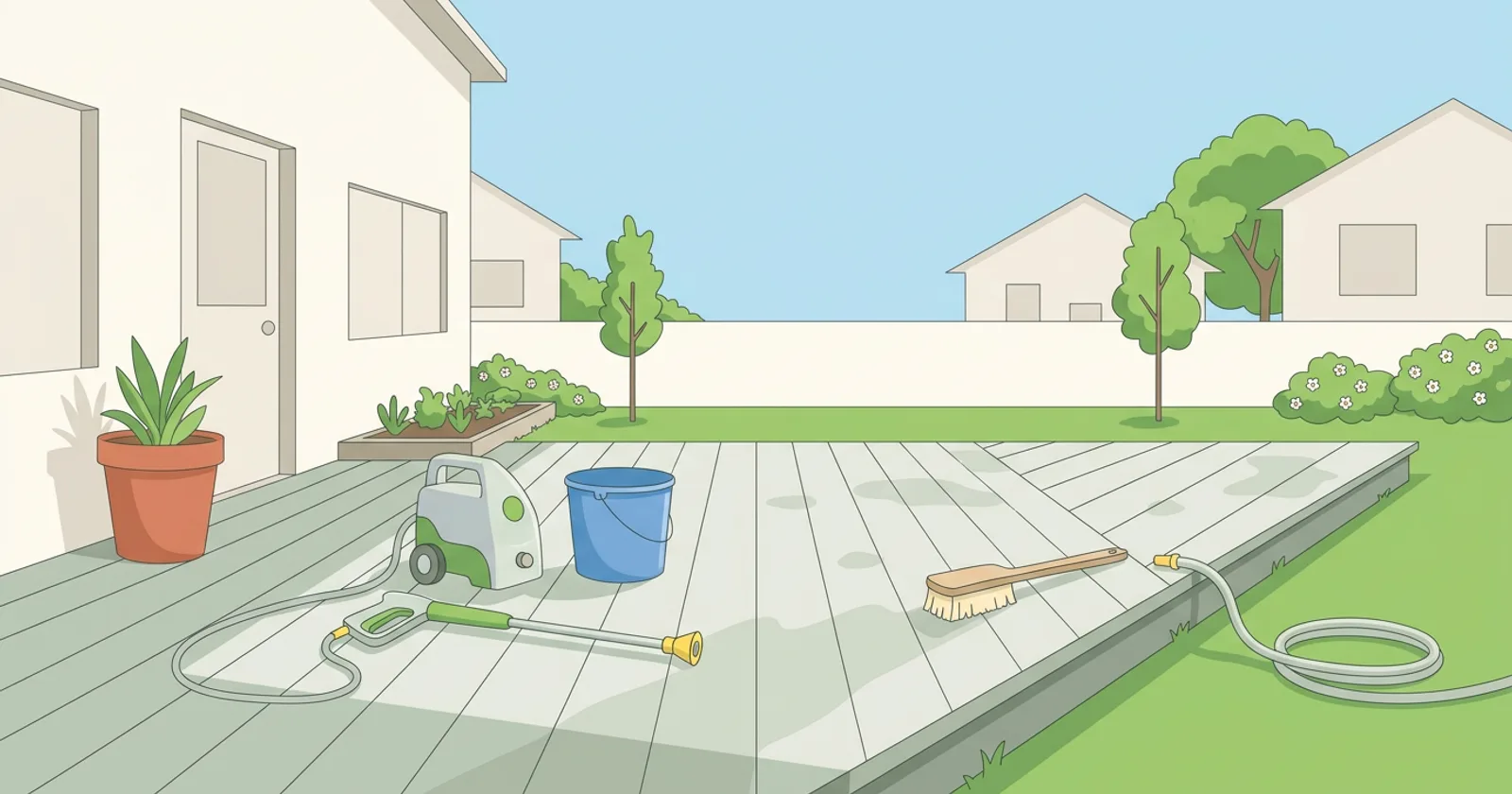
You step onto the back deck with your morning coffee, and there they are: dark freckles between the boards that you scrubbed away a few weekends ago. A homeowner on a home-improvement forum described the same letdown. Muddy footprints on fairly new composite boards came back every time the deck dried, even after power washing and dish soap.
Take a breath. The makers’ guides point to leftover grime, films from unrinsed water and trapped moisture as the usual suspects. And a composite deck isn’t wood in a plastic costume. It has its own rulebook, and the rulebook is the maker’s care guide.
What the makers allow
The care guides agree on soap, water and a soft brush. Where they differ is on pressure washers. Here’s what three makers publish:
| Maker (care guide) | Pressure washer limit | Distance and tip | Worth knowing |
|---|---|---|---|
| Trex (Transcend, Enhance, Select) | No more than 3,100 psi | Fan tip, no closer than 8 in. | Over 3,100 psi “could damage the boards and void the warranty.” Not recommended at all on its early-generation boards. |
| TimberTech (current lines) | Maximum 1,500 psi, for rinsing only | Fan tip nozzle, spray along the grain | Says not to use cleaners sold as “composite deck cleaners” on its capped boards. |
| Fiberon (FAQ; its blog says under 2,500 psi) | Under 3,000 psi, for skilled pros | Wide fan tip, 12 in. above the deck | Does not recommend power washing while mold or mildew is present. |
Notice the spread. A setting that’s fine for one deck is double the limit for another, which is why you should look up your own brand and product line before anyone turns on a washer. If you’re hiring someone, ask what psi and tip they plan to use. Our list of questions to ask a house washing company covers the rest.
What the warranty fine print rules out. One maker’s guide says sanding voids the warranty for any condition it causes, and so does pressure washing its older boards. It also says scratches from a shovel aren’t covered and to never use a metal one. Another warns that rubber-backed mats can contain chemicals that discolor the surface. And one says products with bleach or acid will lighten the boards, so test in a hidden spot.
A cleaning routine that feels more like tidying
Step one: Clear the deck and the gaps. Sweep or blow off leaves, pollen and dirt. One maker’s guide says clearing the gaps between boards helps drainage, keeps the surface dry and helps prevent mildew.
Step two: Wash with soap, water and a soft brush. That’s the first-choice method in every guide above. Work in small sections. A garden hose is all you need to rinse.
Step three: If a pressure washer comes out, stay inside the lines. Use your maker’s psi limit and a fan tip. Keep it at the stated distance, and move along the boards rather than across them. One guide says to rinse each board on its own. If you’re weighing a pro, our pressure washing cost guide shows typical prices.
Step four: Rinse until the water runs clear. This is the step behind most “it came back” stories. One maker’s guide says dirty water left to dry “will remain” as a film. Another warns that cleaner left to dry causes a white film that’s hard to remove. If your water is hard, one guide suggests drying with a cloth or a blower.
Step five: Treat stains with the right product. For tannin stains from leaves, one maker says leaching fades after at least 12 weeks of weathering. A brightener with oxalic or phosphoric acid speeds it up. For rust or ground-in dirt, the same guide says a brightener may need to sit 10 to 15 minutes before rinsing.
Why spots come back (and why it’s not your fault)
Here’s the part most people blame themselves for. One maker’s guide explains that when pollen and dirt stay on the boards long enough, “mold can feed on the biofilm.” Wash off the food, and you wash off the mold. Leave a film behind, or let debris pile up in a shady corner, and the spots return.
Pressure can make it worse. One maker says power washing pushes mold further into the material, and it doesn’t recommend power washing while mold is present. If a washer was already used, it suggests at least two rounds of cleaner. It also says you may need to repeat cleaning until you can’t see “shadows” of the spots on the wet deck.
Climate plays a big part. In Mobile, Alabama, NOAA’s comparative climate data shows average morning humidity of 87% across the year, rising to 91% in August. A deck that rarely dries out fully gives mold more time to settle in. Our Louisiana heat and humidity guide covers what that kind of climate does to the rest of a house. Humid Florida screen enclosures need the same care, per pool cage cleaning.
So the long-term fix is less elbow grease and more drying. Keep the gaps clear. Point downspouts away from the deck, as one maker advises. Skip rubber-backed mats, which one maker says can cause discoloration. If a wash goes wrong, our guide on pressure washing damage helps you sort damage from wear that was already there.
When in doubt, find the care guide for your exact product line on the maker’s website. It’s a dry read, but it’s the only rulebook your warranty follows. For how we check every number on this page, see our methodology.
Sources
- Trex, How to Clean a Trex Deck (care and cleaning guide): trex.com/care
- TimberTech, Care and Cleaning Guide (PDF): assets.timbertech.com/content/dam/wp-content/TimberTech-Care-and-Cleaning-Guide.pdf
- Fiberon, Decking Care and Maintenance FAQ: fiberondecking.com/pages/concordia-symmetry-decking-collection-faq
- Fiberon, Top 10 Composite Decking Care and Maintenance Tips: fiberondecking.com/blogs/blog/top-10-composite-decking-care-and-maintenance-tips
- NOAA NCEI, Comparative Climatic Data, relative humidity table (data through 2023): ncei.noaa.gov/sites/default/files/2024-11/relhum23.txt
- Community discussion, composite deck stains that return after drying: reddit.com/r/HomeImprovement/comments/1l6pblp