You step onto the driveway with your morning coffee, and the air already feels like a warm, wet towel. Then you notice it: a faint green blush creeping up the north wall. A week ago you barely saw it. Today it’s hard to miss.
That green isn’t just cosmetic. Here are the three most common ways summer wears on your home’s exterior, and a washing rhythm that keeps siding clean without beating it up.
The summer soup: why your siding won’t stay clean
Picture Louisiana’s air in July as a pot of gumbo left on the stove. NOAA’s 1991–2020 climate normals put the average July high at 91 to 94°F across New Orleans, Baton Rouge, Lake Charles and Shreveport. The average July low only falls to about 74 to 77°F. Those same stations average 85 to 99 days a year at 90°F or hotter.
Rain keeps things wet as well. Normal annual precipitation runs from about 51 inches in Shreveport to about 63 inches in New Orleans.
LSU AgCenter puts it plainly: any home surface “is subject to mildew when it is damp or the air is humid.”
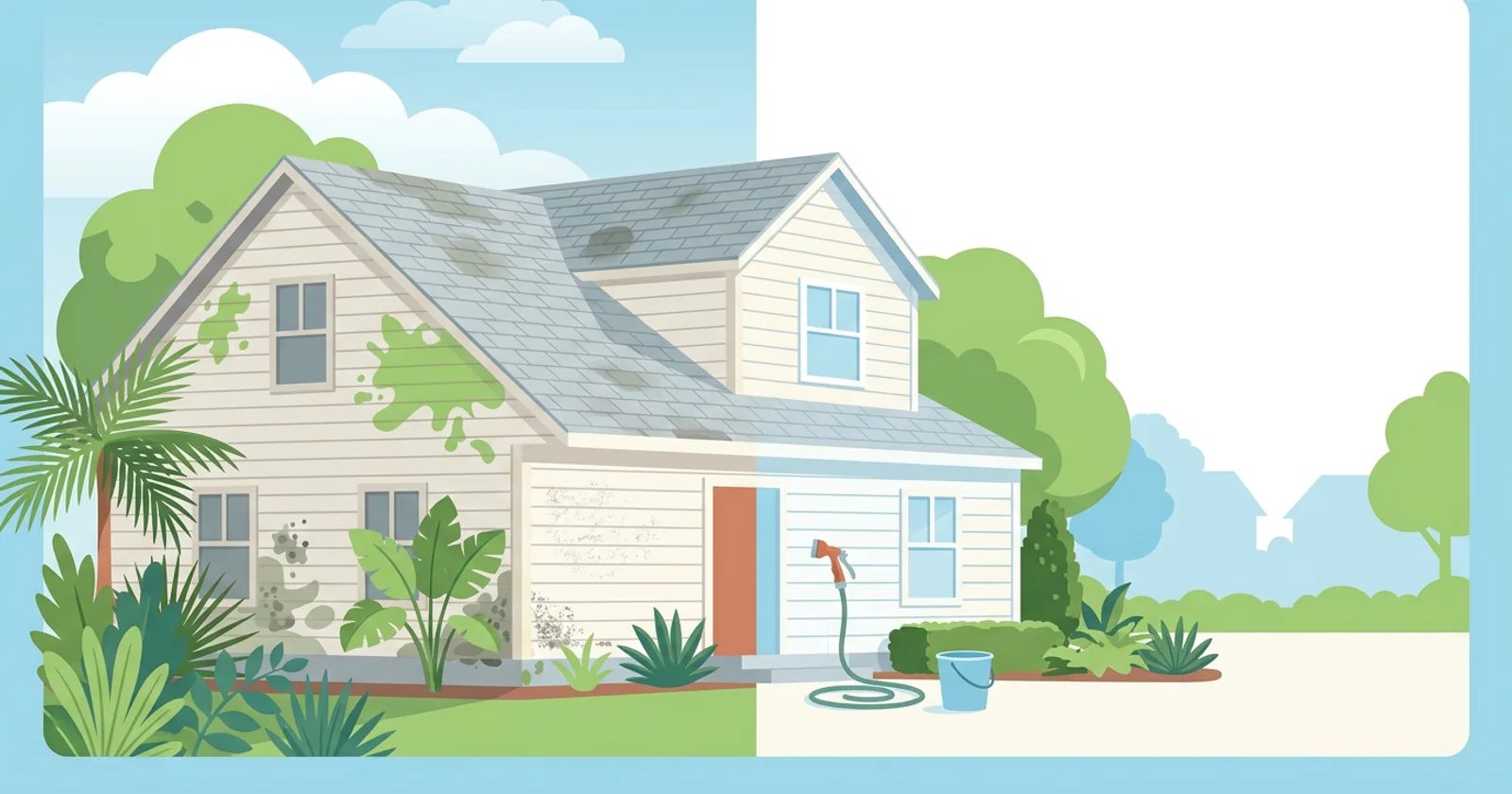
Green streaks: algae on the move
The green or dark streaks you see on roofs and other outdoor surfaces are often algae. The asphalt roofing industry group names Gloeocapsa magma as “probably the most prevalent” of the species involved. It says these algae travel through the air and grow on roofs and “other outdoor surfaces,” and that roof staining is “most widespread in the Gulf States” (and some other coastal regions).
The same group says bleach-and-water cleaning on roofs is “only temporary,” and the staining may recur. That’s why washing works better as a routine than a one-time fix. For the roof question, see whether roof cleaning is worth it.
On siding, a soft wash uses low pressure and a cleaning solution to loosen the growth, then a gentle rinse. That’s closer to what siding makers recommend than a high-pressure blast. Our guide to pressure washing mistakes homeowners make covers what goes wrong with the high-pressure approach.
Black spots: mildew digging in
If green streaks are guests who overstay, black spots are the ones who start moving the furniture. Mildew shows up as tiny black or dark brown specks.
A fiber cement maker’s cleaning bulletin says “moisture is the most important single factor in the growth of mildew.” It adds that mildew is usually found in “damp, dark areas or during prolonged humid conditions.” It also notes that mildew can look like ordinary dirt. If a wall still looks dirty after a soap-and-water wash, mildew may be the cause.
Washing also helps prevent it. LSU AgCenter says “dirt and grease are food for mildew,” so clean surfaces resist it better.
Mildew isn’t rot, and LSU AgCenter says mildew fungi “do not reduce strength.” It’s still a warning sign. The same LSU publication says conditions that favor mildew also favor the fungi that decay wood. It classifies Louisiana and most of the Deep South as “a severe-risk area for wood decay.”
If mildew keeps coming back, look for the moisture source. LSU suggests checking whether your eaves keep water off the walls and your gutters work.
Chalky paint: when the sun does the damage
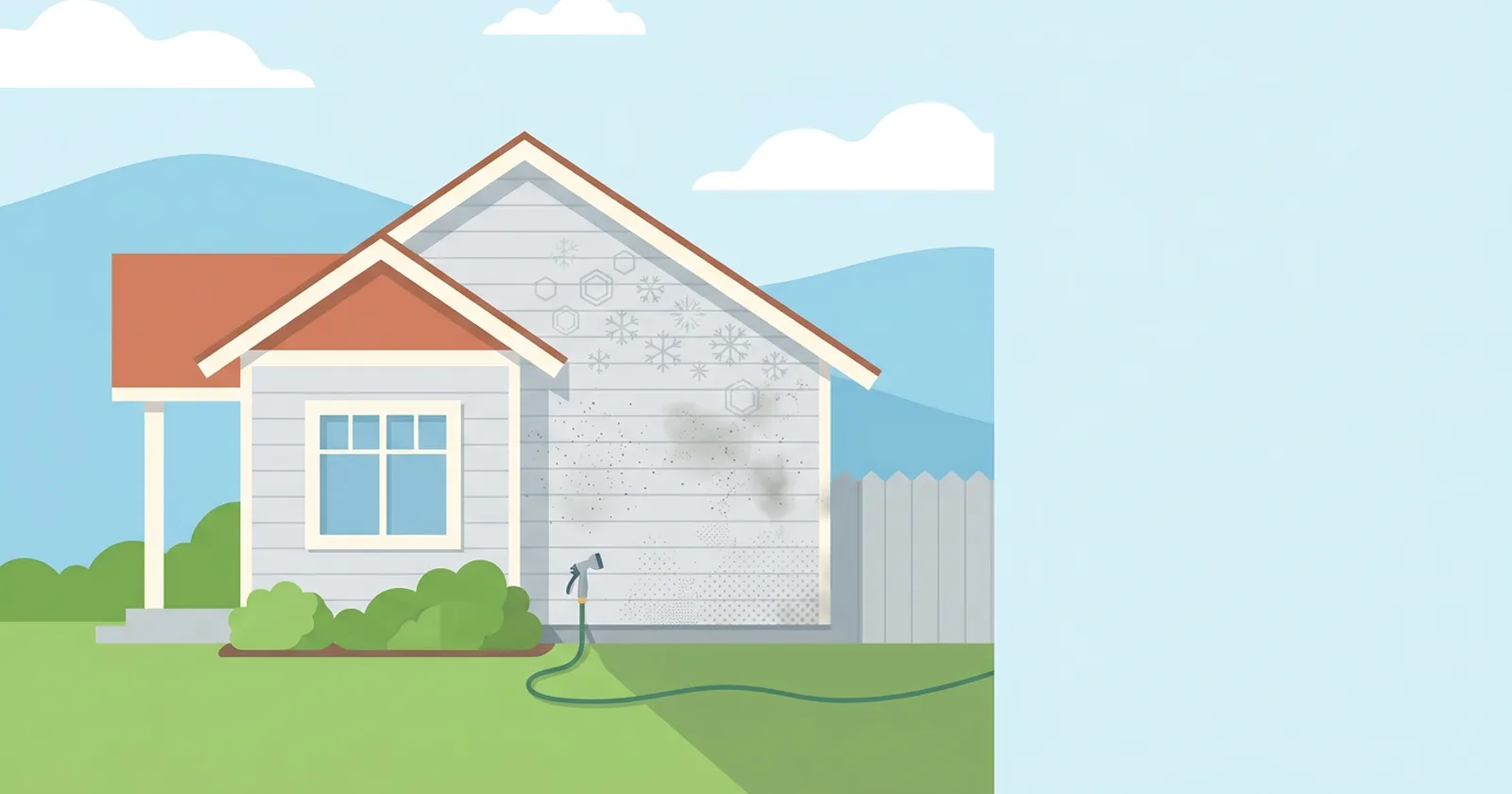
Algae and mildew get most of the attention, but the sun works on your paint every day. One major paint maker defines chalking as fine, white powder that forms on exterior paint “due to weathering.” Rub an older painted wall in August and your palm comes away white.
Some chalking is normal. The same paint maker calls it “an ideal way for paint to weather” because the powder is easy to remove. Heavy chalking is a sign the paint film is eroding. Oil-based paints tend to chalk more than latex.
Its fix is to remove chalk “by rinsing or power washing” with an appropriate cleaner, wash again if needed, then rinse well and let the surface dry.
For repainting, LSU AgCenter suggests “high quality acrylic latex paint with a fungicide additive” for low-maintenance exteriors. It also suggests zinc-oxide pigment if available.
A care schedule for Louisiana homes
A sensible rhythm, not an official schedule:
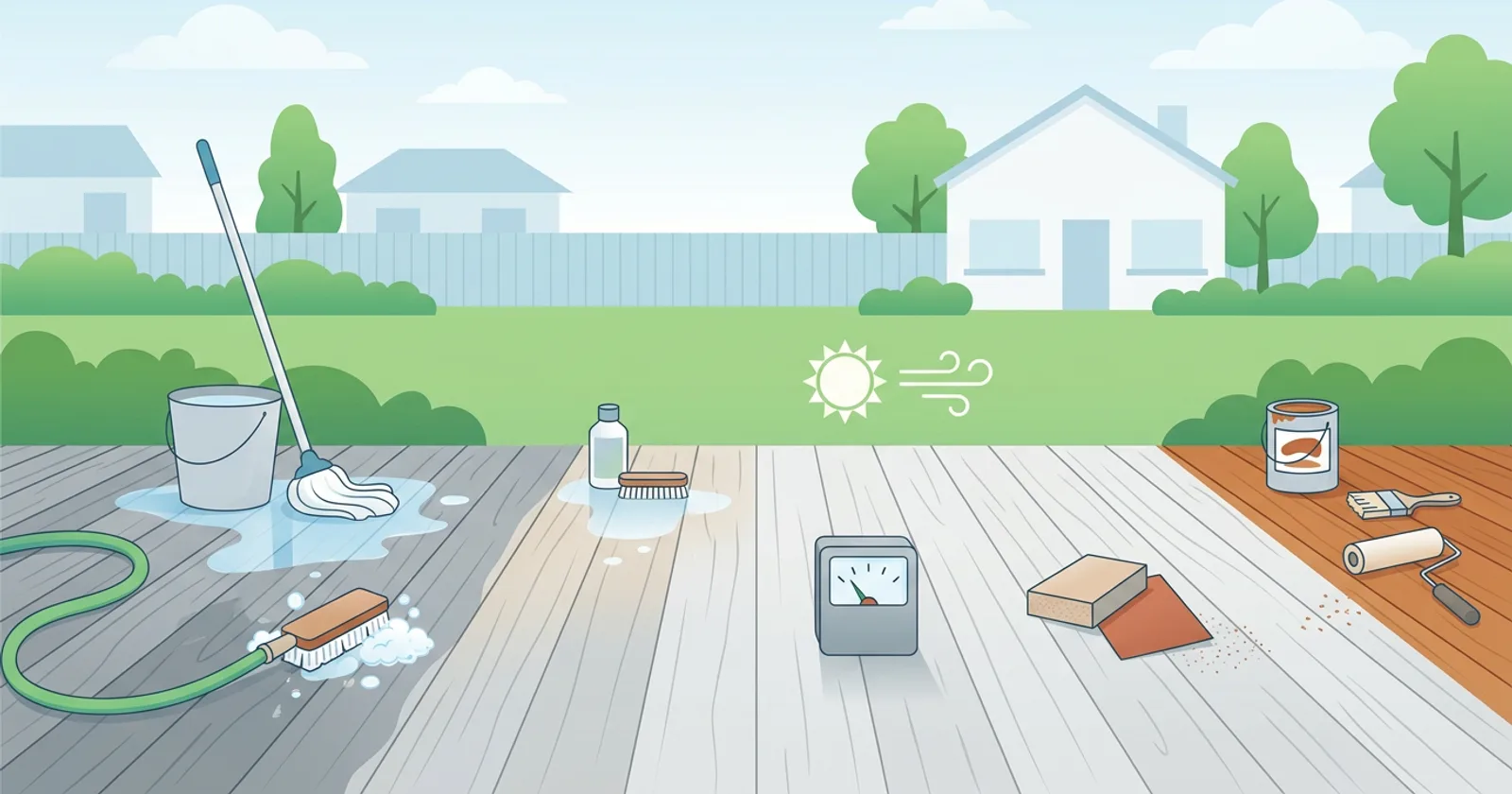
Early spring (March–April). This is a good time for a full soft wash, before the worst of the heat. Check damp, dark spots first.
Mid-summer check (July). A walk-around costs nothing. Look for green returning at the roofline and dark specks under the eaves. LSU AgCenter’s advice for mildew is “act promptly,” because it’s much harder to control once it takes over.
Late fall (October–November). Once the air loses its swampy feel, a gentle wash clears the summer’s growth.
How often? Siding makers don’t set a fixed interval. One fiber cement maker says to clean “as needed.” Your mid-summer walk-around is the real schedule. For what a professional wash costs, see our house washing cost guide, which lists providers’ published prices by size and stories, and our pressure washing cost guide for driveways and roofs. A colder climate brings other problems; see why a Montana home needs a house wash.
Keep the pressure low. The vinyl siding industry group says some makers don’t recommend power washing and others limit pressure and cleaners. The fiber cement maker keeps any pressure washer under 1500 psi, with a wide fan tip held at least 6 feet back. It also warns that damage from improper cleaning “may not be covered” by its warranty.
Between washes, keep gutters in good shape and check that your eaves keep water off the walls, as LSU AgCenter suggests. When you hire, use these questions to ask a house washing company.
How we gather and check the figures on this site is on our methodology page.
Sources
Checked on 2026-10-08:
- NOAA NCEI, U.S. Climate Normals 1991–2020, monthly and annual station files for New Orleans Intl (USW00012916), Baton Rouge Ryan (USW00013970), Lake Charles (USW00003937) and Shreveport (USW00013957): ncei.noaa.gov/data/normals-monthly/1991-2020/access and ncei.noaa.gov/data/normals-annualseasonal/1991-2020/access
- LSU AgCenter, Preventing Mildew and Decay: lsuagcenter.com/topics/family_home/hazards_and_threats/recovery_assistance/cleaning_up/mold_decay/preventing-mildew-and-decay
- LSU AgCenter, Causes and Control of Wood Decay, Degradation & Stain (Pub. 2703): lsuagcenter.com/NR/rdonlyres/C29C1E6F-2F5B-4F0D-A963-248E54EB4E83/51180/pub2703WoodDecayLowRes.pdf
- LSU AgCenter, Low-Maintenance Materials and Products: lsuagcenter.com/topics/family_home/home/design_construction/safer%20stronger%20smarter/ideal%20home/practical%20convenient/low%20maintenance/low-maintentance-and-products
- Asphalt Roofing Manufacturers Association, Algae Discoloration of Roofs: asphaltroofing.org/algae-discoloration
- Sherwin-Williams, How to Fix Exterior Paint Chalking: sherwin-williams.com/homeowners/ask-sherwin-williams/problem-solver/dirt-stain-discoloration/sw-article-dir-chalking-powder
- James Hardie Technical Bulletin #20, Cleaning James Hardie Primed and ColorPlus Technology Siding (Nov. 2018): images.homedepot-static.com/catalog/pdfImages/e2/e2a8a8f2-bb30-4b6a-9cf3-f76c4a979c8a.pdf
- Polymeric Exterior Products Association, cleaning and maintenance: polymericexteriors.org/why-polymeric/cleaning-and-maintenance