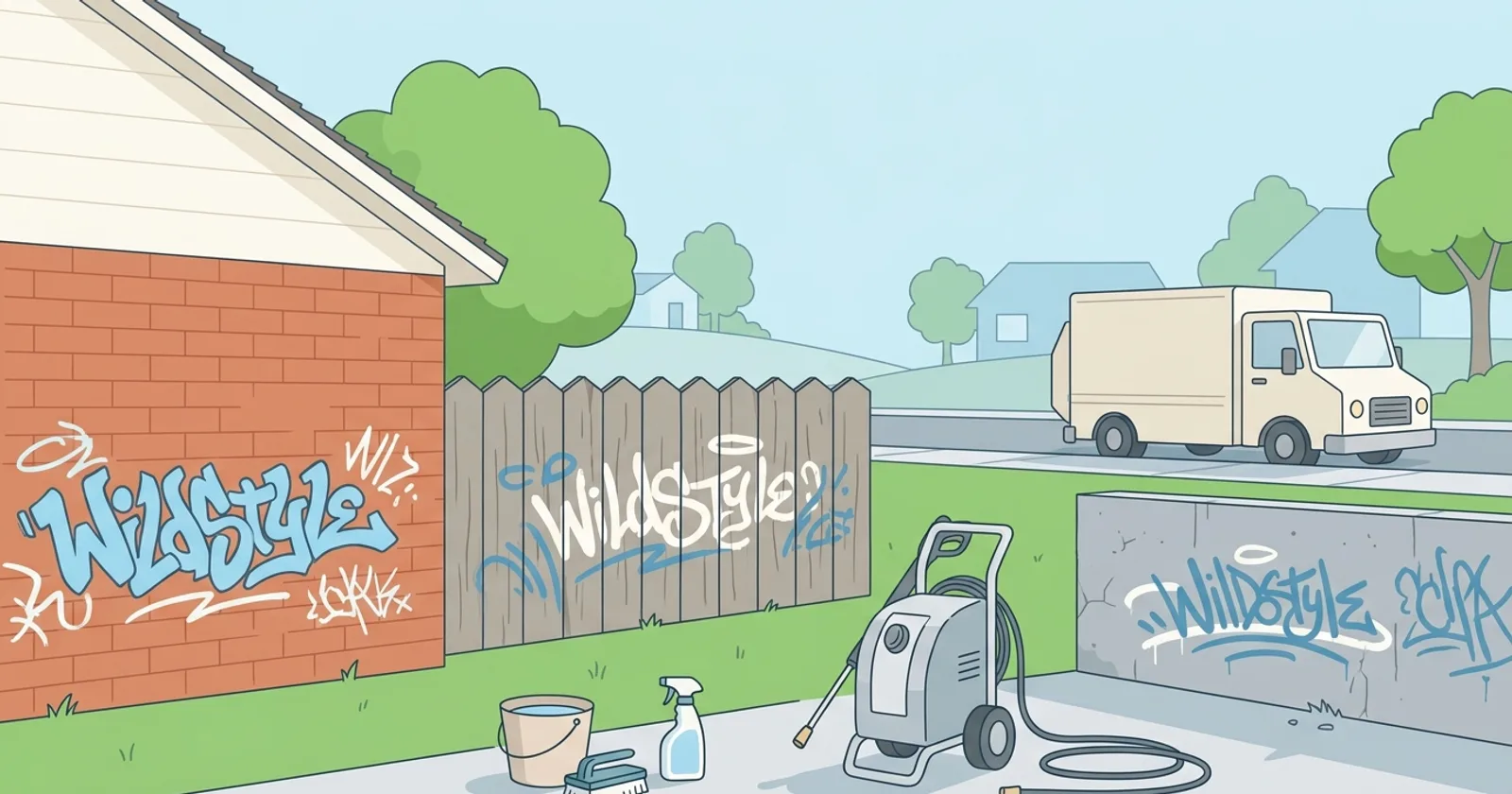
So before you rent a machine, check two things. Does your city remove graffiti for free? And what is the surface? Smooth vinyl or painted surfaces are often a fair DIY job. Bare brick, stone and older buildings usually deserve a tested chemical method or a pro.
Move fast, whatever you choose
Speed matters for two reasons. National Park Service (NPS) guidance says paint left for several weeks or months hardens and becomes harder to dissolve. It also says graffiti that isn’t removed quickly tends to attract more. One composite fence maker puts it bluntly. Once graffiti dries, a normal cleaning will almost never get it off. Take photos first, then act within days.
Check for a free city program
Two examples show how different city programs can be.
In St. Louis, you report graffiti to the city’s Citizens’ Service Bureau (314-622-4800 or the city website). A local nonprofit then removes it at no charge, paid for mostly by a federal housing grant. Its consent form is worth reading closely:
- On unpainted brick or concrete, crews use a high-pressure washer and possibly a fine sand and paint-stripper mix. The form warns of possible slight discoloration of the brick.
- On painted surfaces, crews match the color, square off the area and paint over it.
- Signing means you agree to hold the nonprofit harmless for damage.
- The city ordinance doesn’t require your written consent. Crews may proceed 14 days after the notice date.
- If the graffiti is above ground level or unsafe to reach, the owner must remove it to stay in compliance.
In Chicago, removal is free for private property owners through 311. On brick and stone, the city’s trucks blast baking soda under high water pressure. They paint over graffiti on metal or wood.
Free is hard to beat on a plain modern wall. On a historic or soft-brick building, ask what method the crew will use. Blasting is exactly what NPS guidance warns against there. In a local historic district, the NPS brief notes, many review boards require approval before cleaning work.
Why a “ghost” stays behind
Paint has two parts, pigment and binder. Both can soak into porous masonry. NPS guidance says removing one can still leave the other in or below the surface. It names red paint and the fine black pigments in spray paint as especially hard to get out.
In a February 2025 trade-forum thread, a California washer asked whether a hot bleach rinse would clear the shadow left after a removal job. One reply said bleach won’t do anything for paint. NPS lists bleach as an option only for certain dyes in markers and inks, applied in a poultice.
To make a ghost less obvious, NPS suggests cleaning each whole brick between the mortar joints, not just the painted spot. It also suggests “feathering” the edges. Some ghosts fade with time. If removing the rest would remove masonry too, the brief says it may be better to stop.
What works on each surface
| Surface | What usually works | What to avoid |
|---|---|---|
| Bare brick, stone, concrete | Tested paint remover or solvent, often as a poultice; rinse bottom up | High pressure, sandblasting, lye-based strippers, dripping aerosol removers |
| Painted brick, stucco or siding | Paint over with a matched color, squared off | A mismatched patch that draws new graffiti |
| Vinyl fence | Water and mild detergent; one maker allows a pressure washer or paint thinner if stubborn | Anything beyond the maker’s care guide |
| Composite fence | Fresh paint: a cleanser, soft brush and low-pressure rinse | More than a low-pressure wash (one maker says this can void the warranty) |
| Wood fence | A gentle method tested on a hidden spot first | High pressure; NPS says soft wood can be damaged even at low pressure |
Two cautions sit behind the table. NPS says lye-based (sodium hydroxide) strippers can cause efflorescence and staining if they aren’t neutralized. If white salts show up later, see our guide to white haze on brick. And the composite fence maker says cleansers may lighten the color. Its warranty doesn’t cover that.
If you do it yourself
Test first. An NPS maintenance guide says to try each method on a hidden patch no bigger than six by six inches.
Keep the pressure low. The same guide says hardware-store machines run about 1,600 to 3,200 psi. That can damage masonry. It recommends 100 to 400 psi with the wand at least 12 inches away. Our guide to wash damage vs damage that was already there shows what too much pressure looks like.
Protect yourself and the yard. NPS warns that solvents are toxic and flammable, so wear a respirator, gloves and eye protection. Cover plants, glass and metal. Keep solvents and paint residue out of storm drains, which many places ban. This is general guidance, not safety or legal advice. Follow the product label.
When to call a pro
Hire a pro for porous or old masonry, large areas or anything above ladder height. Ask what product they’ll use (not just bleach). Ask for a test patch you approve before the full job. NPS suggests getting the approved sample in writing. Our questions to ask a washing company work here too. For paint that came from a contractor rather than a vandal, see cleaning up paint overspray.
Should you add an anti-graffiti coating?
Maybe, on a wall that gets hit often. Sacrificial coatings come off with each cleaning and must be reapplied. Permanent ones last several cleanings. NPS warns that clear coatings can add gloss, change the color, trap moisture or yellow in sunlight. Test one on a hidden area first. Cheaper steps help too. The St. Louis nonprofit suggests keeping the property tidy and well lit at night.
Our methodology page explains how we check sources.
Sources
Based on 8 sources · How we price
- National Park Service, Preservation Brief 38: Removing Graffiti from Historic Masonry: nps.gov/orgs/1739/upload/preservation-brief-38-graffiti.pdf
- National Park Service, NCPTT, Preservation in Practice: Graffiti Removal from Historic Features (Nov 2020): nps.gov/subjects/ncptt/upload/Preservation-in-Practice_Graffiti-Removal_Nov2020.pdf
- Brightside St. Louis, graffiti removal: brightsidestl.org/what-we-do/cleaning/graffiti-removal
- Brightside St. Louis, 2023 graffiti consent form and cover letter: brightsidestl.org/wp-content/uploads/2023/02/Graffiti-2023-Consent-form-and-cover-letter-PDF.pdf
- City of Chicago, Department of Streets and Sanitation, Graffiti Removal Program: chicago.gov/city/en/depts/streets/provdrs/graffiti_blasters.html
- Trex Fencing knowledge base, graffiti on Trex fencing: trex-fencing-fds.helpscoutdocs.com/article/264-how-do-you-get-graffiti-off-of-trex-fencing
- Veranda vinyl fencing, care and maintenance: images.homedepot-static.com/catalog/pdfImages/41/41adff1b-0c8d-4802-a80a-49afab63bb1b.pdf
- Community discussion, PressureWashingResource, February 2025: pressurewashingresource.com/community/t/graffiti-removal-question/39536