Cameras and video doorbells: read the IP rating
The water rating on a camera’s spec sheet is the second digit of its IP code. One camera maker’s chart lists a 4 as splashing water, a 5 as water jets and a 6 as powerful water jets.
“Weather resistant” doesn’t mean “wash-proof.” A large smart-home maker rates its battery camera and battery doorbell IP54, and says the camera can withstand dust, rain and snow. It rates one of its outdoor cameras IP65 and still says it is not waterproof. The same maker warns that water resistance decreases or is lost over time with normal wear and tear.
A wash wand is a different test from rain. A surveillance camera maker lists high-pressure water from cleaning equipment among the things outdoor cameras can face, and says water that gets in can cause short circuits, corrosion and blurry images. It points to a separate rating, IP69K, for surviving high-pressure, high-temperature cleaning. None of the smart-home maker’s cameras or doorbells on its spec page list an IP67 or higher rating.
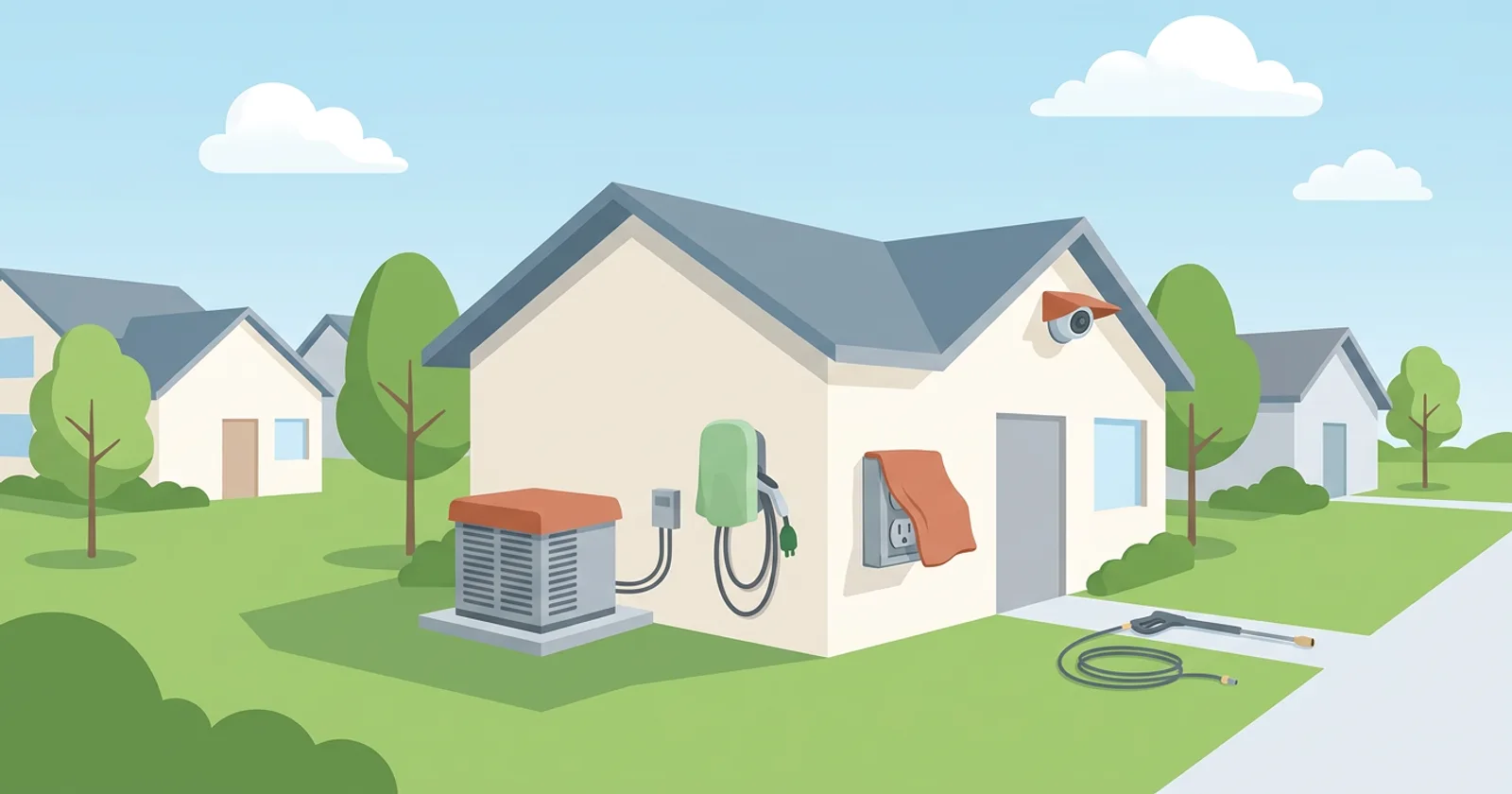
Ask the crew to work around cameras and doorbells rather than spray them directly.
Outdoor outlets: covers closed, GFCI working
A national electrical safety group says to keep outdoor outlets weather-protected with outlet covers. It also says a GFCI should be used in any indoor or outdoor area where water may come into contact with electrical products.
GFCIs come as outlets, circuit breakers or portable plug-in units, according to that group. OSHA says these devices cut power in as little as 1/40 of a second when the current leaking away exceeds 5 milliamperes. The group’s outdoor booklet gives a simple check: plug in a night light, press the test button, and the light should go off. Press reset to restore power. If the light stays on, the booklet says to contact a qualified electrician.
OSHA’s electrical safety card says that in damp locations, cords and equipment should be inspected and a GFCI used.
AC condenser: power off, gentle on the fins
The outdoor unit’s coil is a wall of thin metal fins, and they bend. One AC maker’s installation manual says the outdoor coil may be flushed with a water hose, and to ensure power is off before cleaning. It adds that ocean air can carry corrosive salt, so units near the coast need frequent inspections, and it tells owners to ask their installing contractor how often.
Another AC maker’s coil-cleaning procedure, written for technicians, says to disconnect unit power first. If a high-pressure sprayer is used, it sets limits: a nozzle angle of at least 15 degrees, spraying straight at the coil face, the nozzle at least 6 inches away, and no more than 600 psi. It also says to straighten bent fins with a fin rake.
So ask the crew whether they plan to rinse the condenser at all, what pressure their rig runs, and who will turn the power off. Asking them to skip it is also fine.
EV chargers: no direct spray
One EV charger maker says its wall unit is approved for outdoor use but not designed for complete immersion. Its manual warns never to spray water or any other liquid directly at the wall-mounted control box, never to spray the charge handle, and to keep the handle in its dock to limit moisture. It also says to turn off power at the circuit breaker before cleaning the unit.
A second maker’s user guide goes further: never clean the charging point by spraying it with water, and it names both garden hoses and high-pressure cleaners. Tell the crew the charger is off-limits, and make sure the handle is docked before they start.
If something got wet
Don’t guess. OSHA’s card says to have a qualified electrician inspect electrical equipment that has gotten wet before it is turned back on. Take photos too; our guide to wash damage versus damage that was already there explains how to document it.
Your walk-around checklist
| Item | What the maker or safety group says | Ask the crew to |
|---|---|---|
| Cameras and doorbells | Google Nest: IP54 or IP65, “not waterproof”; ACTi: IP69K is the high-pressure rating | Keep the wand off them |
| Outdoor outlets | ESFI: keep covered, use GFCI where water may reach | Close covers; test the GFCI before plugging in |
| AC condenser | Lennox: power off, hose rinse; Trane (technician procedure): max 600 psi, 6 in. away | Skip it, or power off and stay within those limits |
| EV charger | Tesla: never spray the control box; Schneider Electric: no hose or high-pressure cleaner | Treat it as off-limits; dock the handle |
| Anything that got wet | OSHA: electrician inspects before power-up | Tell you right away |
The same rule applies to other gear on the house. See whether solar panels can be pressure washed, and run through our questions to ask a house washing company on the quote call. For other prep slips, read pressure washing mistakes homeowners make. Here’s how we check every claim.
Sources
- Google Nest Help, Technical specs for Google Nest cameras and doorbells: support.google.com/googlenest/answer/9259110?hl=en
- Reolink, IP66 camera definition (IP rating chart): reolink.com/ip66-camera-definition-and-recommendation
- ACTi, Waterproof Design: acti.com/technologies/waterproof-design
- ESFI, Ground Fault Circuit Interrupters: esfi.org/ground-fault-circuit-interrupters
- ESFI, Outdoor Electrical Safety Check booklet: esfi.org/wp-content/uploads/2021/08/Outdoor-Electrical-Safety-Check-Booklet-English-AA13.pdf
- OSHA, Controlling Electrical Hazards (OSHA 3075): osha.gov/sites/default/files/publications/osha3075.pdf
- OSHA, Electrical Safety QuickCard (OSHA 3294): osha.gov/sites/default/files/publications/OSHA3294.pdf
- Lennox, 13HPX installation instructions (2011): wizard.youngsupply.com/files/100-9179.pdf
- Trane Support, Split condenser coil cleaning: support.trane.com/hc/en-us/articles/41852860052237-Split-condenser-coil-cleaning
- Tesla, Wall Connector installation manual: digitalassets.tesla.com/tesla-contents/image/upload/gen-2-wall-connector-installation-manual.pdf
- Schneider Electric, EVlink Home Smart device user guide: productinfo.schneider-electric.com/wiser_home/evlink-home-smart_device-user-guide_wiser_home/English/EVlink%20Home%20Smart_Wiser%20Home_Device%20user%20guide_0000940186.pdf