The bigger surprise is in the research. Dirty panels often lose only a little power, and when grime really sticks, more pressure isn’t what removes it.
What two panel manuals allow
Your panel model’s installation manual sets the warranty rules. Two major makers’ cleaning sections disagree on pressure and agree on most of the rest.
| Rule | REC (Alpha Pure manual and cleaning guide) | Trina Solar (Vertex manual) |
|---|---|---|
| Pressure washer | Not permitted; voids the warranty | Allowed up to 4 MPa (40 bar, about 580 PSI) |
| Steam cleaner | Not permitted | “Do not use steam cleaner” |
| Water | Deionized; rainwater or tap water as a backup | Soft water recommended, pH 6 to 8 |
| Tools | Sponge, microfiber cloth or soft brush; no knives, blades or metal sponges | Soft cloth, sponge or soft-bristled brush; nothing that wears the glass |
| Cleaners | Mild biodegradable dish soap; no acidic or alkaline detergent | Household glass cleaner for greasy dirt; no alkaline or strong acid solvents |
| When | Panels cool, such as early morning | Not in the hottest part of the day |
| Warranty | Valid only if the manual is followed | Improper cleaning voids it |
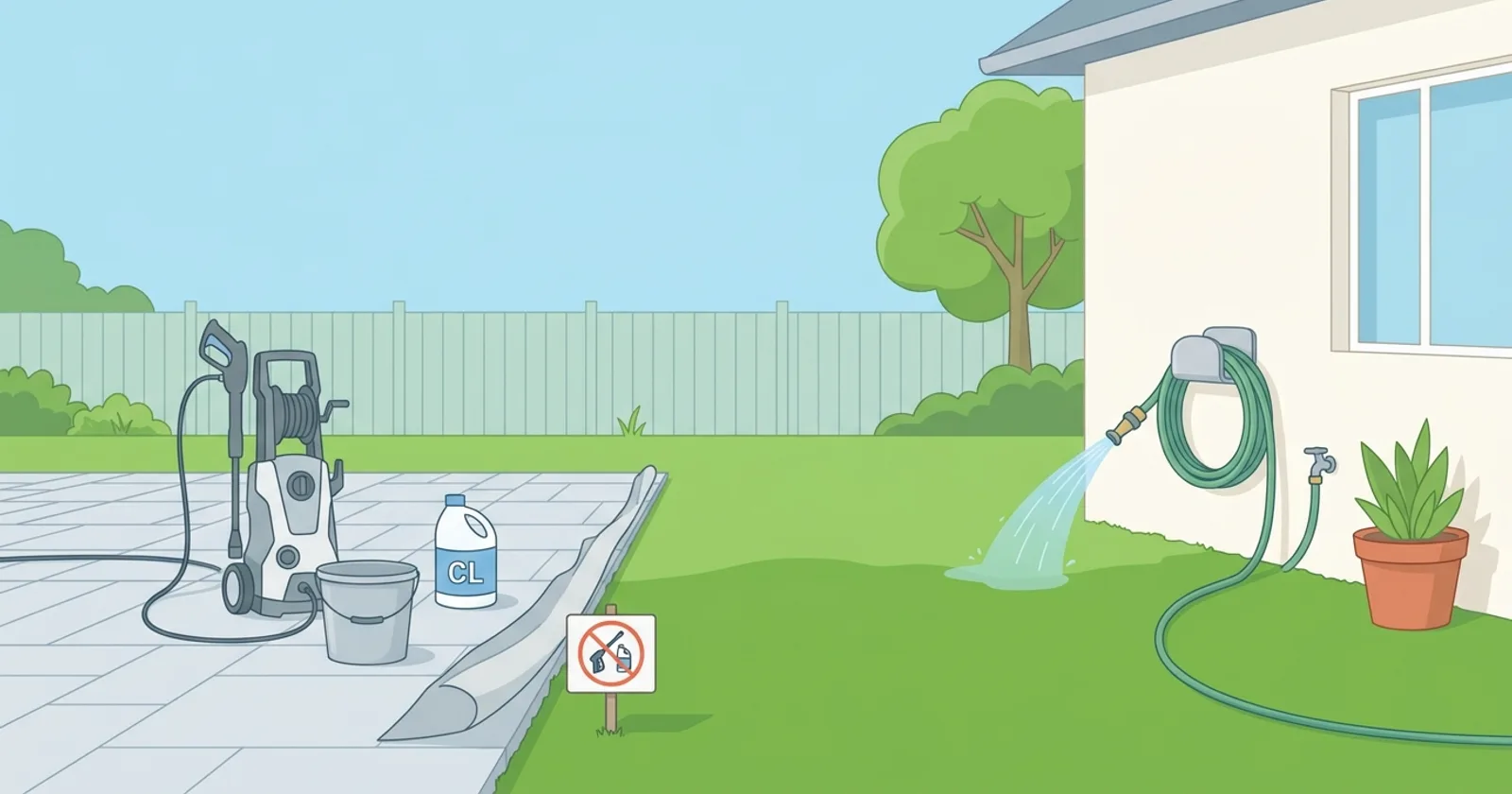
The stricter maker explains its rule. Its guide says high-pressure hoses can push past the panel’s certified load, damage the frame bonding or cells, and force water between the glass and frame. A plain garden hose at household pressure is fine, it says.
If your manual does allow pressure, check your machine’s PSI rating against the limit. Our guide to electric and gas pressure washers explains how those ratings work.
How much dirt really costs you
Researchers at NREL, the Department of Energy’s national renewable energy lab, measured soiling at stations across the country. Soiling is the share of output lost to dirt.
- Fresno: the station there kept a yearly soiling ratio of 0.98 (July 2015 to June 2016). That’s about 2% of the year’s output lost to dirt.
- Kern County, California: one station there came in at 0.92, about 8%.
Dust and long dry spells were the best predictors of soiling in the U.S. That fits Fresno. NOAA’s normals give the city about 11 inches of rain a year, but only 0.27 inches from June through August. At the Fresno station, panels stayed cleaner from November to May, when rain came more often.
Rain isn’t a cure-all, though. In a study of five North Carolina solar plants, NREL found that springtime pollen cut output by as much as 15% at its peak. Even frequent rain didn’t bring the panels back to their cleaned levels. Without planned cleaning, the researchers said, yearly losses can be on the order of 10%. Wet brush cleaning raised output by 5% to 11%.
These were soiling stations and large solar farms, not home roofs. Tilt matters too. One maker says panels below 10 degrees need more frequent cleaning, because rain doesn’t run off them as well.
Why more pressure isn’t the fix
Sticky soiling is a scrubbing problem, not a force problem. NREL examined soiled modules sent from Alabama that tested 13 to 14% below their rated output. In the lab’s work, rubbing with deionized water and a soft cloth restored a clean surface, but a pressurized garden hose did not. At one Southeast site, mold was behind the dirt that rain wouldn’t remove.
An NREL presentation on cleaning methods lists high-pressure spray as “good cleaning” that uses lots of water and “may damage modules.” It also says a lot of dirt stays behind if panels are only rinsed. It’s the same lesson as soft washing a house: let the right method do the work, not the pressure.
When cleaning pays
Start with your monitoring app: compare this month’s output with the same month last year. As a simple example, if your system makes 10,000 kWh a year, a 2% loss is 200 kWh. Multiply that by your electric rate, then compare it with the cleaning quote.
The NREL soiling paper warns that cleaning a site where soiling stays low “might not be cost effective.” On the other hand, one owner of a group of solar plants in the Southeast decided it was necessary and economical to clean at least once a year. Bird droppings are a separate case. One maker’s manual says droppings, leaves and dust usually need cleaning, because they shade the cells.
Ladder, roof or hire it out
In May 2025, a homeowner with steep 8/12 roofs asked a window-cleaning forum whether the panels could be cleaned from the ground with a long water-fed pole. The homeowner said pollen came back about 10 days after a professional cleaning. Replies said the ground was doable but awkward, and one warned against risking injury.
The manuals set the limits. Both say never to stand or walk on the panels. One tells cleaners to check panels for cracks first, because cracked modules are a shock hazard, and more so when wet. Another says that if you’re ever in doubt while cleaning, stop and get professional advice.
If you hire the job out, ask:
- What water do you use: deionized, soft or tap?
- What brush and pressure, and will you walk on the panels?
- Have you read my panel maker’s cleaning rules?
Our questions to ask a house washing company cover insurance and quotes. Our list of pressure washing mistakes homeowners make covers the wash itself. How we check our facts: our methodology page.
Sources
- REC, Quick guide to cleaning (REC solar panels): recgroup.com/sites/default/files/documents/quick_guide_cleaning_en.pdf
- REC, Alpha Pure panels installation manual (UL, Rev 18): recgroup.com/sites/default/files/2025-01/IM_RECAlpha_UL_EN.pdf
- Trina Solar, Vertex Series user manual (section 7.3, Cleaning): www-cdn.trinasolar.com/wwwstorage/sites/5/UM-M-0002-PP7-Trina-Solar-Vertex-Series-User-Manual_EN.pdf
- Micheli, Ruth and Muller, Seasonal Trends of Soiling on Photovoltaic Systems (NREL/CP-5J00-68673), archived copy: web.archive.org/web/2025/https://www.nrel.gov/docs/fy18osti/68673.pdf
- Micheli, NREL’s Effort Toward Predicting Soiling (NREL/PR-5J00-71154), archived copy: web.archive.org/web/2025/https://www.nrel.gov/docs/fy18osti/71154.pdf
- NREL, Research Finds Rain Not Enough To Wash Pollen From Solar Panels (Dec. 18, 2023): nlr.gov/news/detail/program/2023/nrel-research-finds-rain-not-enough-to-wash-pollen-from-solar-panels
- Muller et al., Pollen and Bio-Soiling in the Southeast U.S. (NREL/PO-5K00-85783): docs.nlr.gov/docs/fy23osti/85783.pdf
- NOAA NCEI, 1991–2020 annual/seasonal climate normals, Fresno Yosemite International Airport (USW00093193): ncei.noaa.gov/data/normals-annualseasonal/1991-2020/access/USW00093193.csv
- Community discussion (r/WindowCleaning, cleaning panels from the ground or a ladder, May 2025): reddit.com/r/WindowCleaning/comments/1ki5wfo