If a screen won’t budge, stop pulling. Forcing it is how frames bend and tabs snap. Here’s how to get screens out and wash them, and what pros charge to add them to a job. We also cover when a new screen is the cheaper fix.
Getting stuck screens out
Start inside. A window screen maker says most screens are built to come out from the inside. The tabs, clips or releases take under a minute once you know your window type.
Match the method to the window:
- Double-hung and single-hung. Open the sash fully and find the two tabs at the bottom (or top) of the screen. Pull both toward you at the same time while lifting. The same maker warns that pulling one side alone can bend or warp the frame.
- No tabs. The screen is usually tension-fit with springs along one edge. Press near the middle of a side to find the edge that gives. Push toward it, and tilt the other edge out. Push from the center, not the corners.
- Casement and awning. Look for corner clips. Some older casement screens are held by small screws instead.
If it still won’t move, check for dirt or old caulk along the edges. The maker says to pry gently with a plastic putty knife, never metal tools. It notes that even aluminum bends if you force it. Paint is another common culprit. In a window cleaning community thread, a cleaner described upper screens so tight that the homeowner tore some trying to pull them. Replies blamed years of paint and dirt, and one company said it adds a removal fee to the estimate.
How to wash them
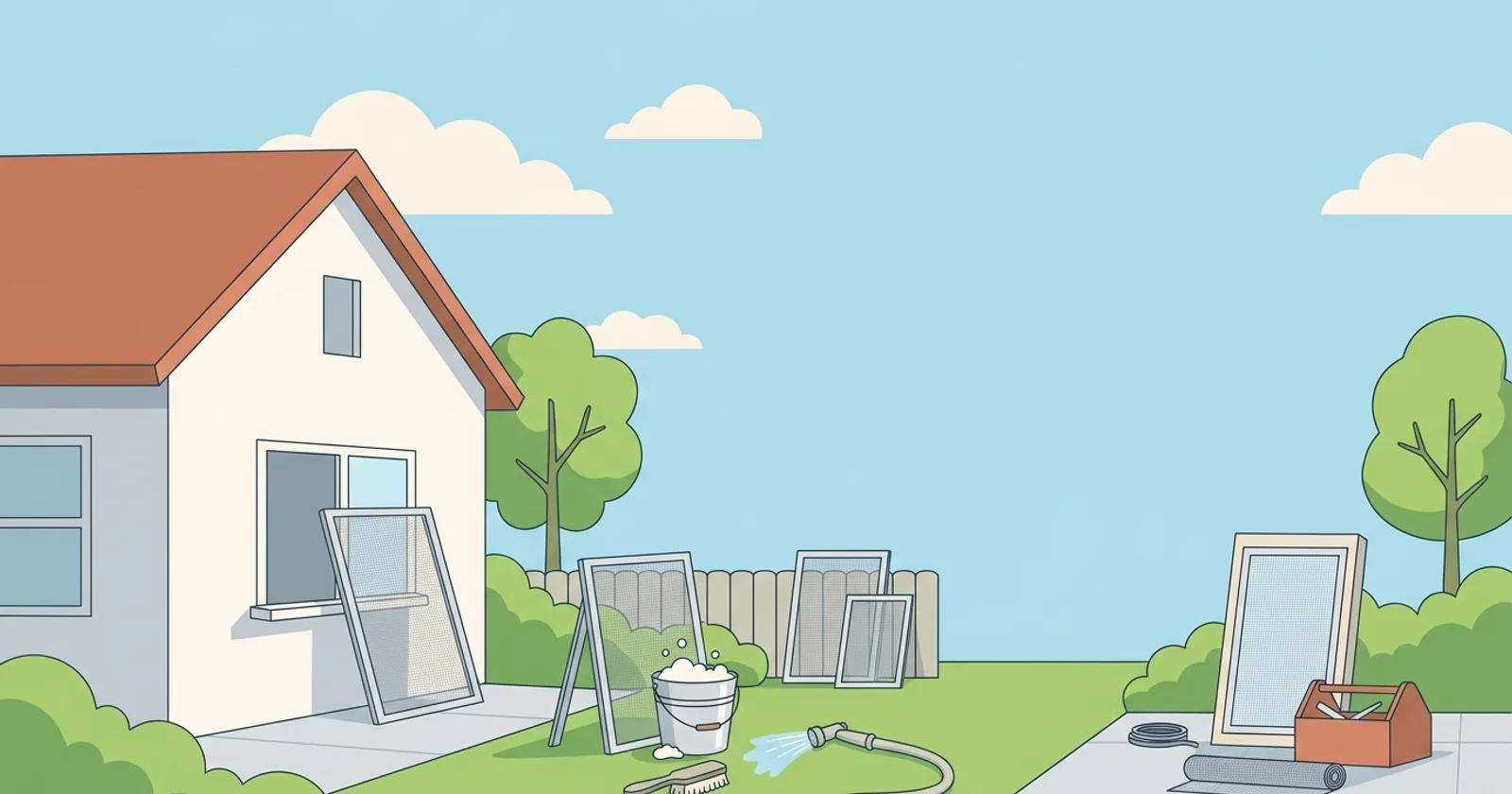
A screen maker’s how-to says most screens clean in place in about 5 to 10 minutes each. Use soap, water and a soft brush. Take them out when there’s heavy dirt or mildew. Its steps, in short:
- Vacuum both sides with a brush attachment. That lifts loose dust and pollen before anything gets wet.
- Lay the screen flat and rinse with a gentle garden hose spray, holding the nozzle at an angle.
- Scrub lightly with about a teaspoon of dish soap per gallon of warm water. For mildew spots, the same guide uses equal parts white vinegar and water.
- Rinse off all the soap, since leftover soap attracts dirt.
- Let screens air-dry completely, which it says takes 1 to 4 hours. Never put them back wet.
A window maker’s care page gives the same gentle routine. Lay the screen flat, spray lightly or vacuum with a soft brush, and let it air-dry. Don’t wipe it with a cloth. A mesh maker adds one material note. Rinse metal screening with water only. Use a mild soapy solution on vinyl-coated mesh, without hard scrubbing.
The first screen maker lists what not to use: bleach, ammonia, abrasive cleaners and pressure washers. They damage mesh, discolor frames or break down coatings. Its timing advice is twice a year, spring and fall. Clean every season if you live near the coast, in a dusty area or with heavy pollen.
If your house is getting washed anyway, pull the screens first. Wash mix and hard water dry on glass and mesh alike. See spots on your windows after a house wash for that side of it.
What pros charge for screens
| Company (area) | Published screen price | Notes |
|---|---|---|
| Prime Window Cleaning NYC (Brooklyn, NY) | $3–$5 per screen removed and washed; $2–$3 wiped in place | Hosed and brushed, then reinstalled dry |
| Excellence Cleaning Pros (Santa Clarita, CA) | $5 per screen | “Screen washing & drying” add-on to window cleaning |
| Puget Sound Soft Wash (Seattle area, WA) | Typically adds $2–$5 per screen | Their cost guide; tracks are extra |
So a house with 20 screens at $3 to $5 each adds roughly $60 to $100. Ask whether screens are in the quote, and whether they’ll come out or get wiped in place. Ask who handles stuck ones. Our questions to ask a house washing company cover the rest. The house washing cost guide covers the main job.
When to replace instead
A screen maker says standard fiberglass mesh usually lasts 10 to 15 years in moderate climates. South- and west-facing windows in sunny climates wear out faster. Aluminum mesh doesn’t break down in sun the same way. It corrodes into pinholes instead, especially near the coast.
That same maker says sun-worn fiberglass turns brittle and breaks easily. Old mesh may not survive scrubbing. If it looks worn, wash it gently or skip to replacing it. The maker also says frames usually outlast the mesh, so re-meshing a straight frame is often enough. A bent frame is a different job.
Another of its guides says a first-timer can usually replace a screen in under an hour, if you can measure accurately. Hire it out for second-story windows or oversized screens. The same maker says a two-step ladder is about the limit for DIY.
Did a screen tear during a pro wash? Our guide to telling wash damage from damage that was already there explains what to document. Large pool-cage and lanai screens are a different job. See Florida pool cage and screen enclosure cleaning.
How we gather and check figures is on our methodology page.
Sources
Based on 11 sources · How we price
Checked on 2026-10-09:
- RiteScreen, How to Clean Window Screens: ritescreen.com/blog/post/how-to-clean-window-screens.html
- RiteScreen, How to Remove Window Screens From the Inside: ritescreen.com/blog/post/how-to-remove-window-screens-from-the-inside.html
- RiteScreen, How to Remove Window Screens Without Tabs: ritescreen.com/blog/post/removing-window-screens-without-tabs.html
- RiteScreen, How Long Do Window Screen Materials Last: ritescreen.com/blog/post/window-screen-material-lifespan.html
- RiteScreen, Can You DIY Your Window Screen Replacement?: ritescreen.com/blog/post/can-you-diy-your-window-screen-replacement.html
- Marvin, Care and Maintenance: marvin.com/support/care-and-maintenance
- Phifer, Insect Screening FAQ: phifer.com/screening/faq
- Prime Window Cleaning NYC, Pricing: primewindowcleaning.com/pricing
- Excellence Cleaning Pros, Window Cleaning: excellencecleaningpros.com/window-cleaning
- Puget Sound Soft Wash, How Much Does Window Cleaning Cost in 2026?: pugetsoundsoftwash.com/how-much-does-window-cleaning-cost
- Community discussion, r/WindowCleaning (screens too tight to remove, 2026): reddit.com/r/WindowCleaning/comments/1rvbksw