Most soft washes use diluted sodium hypochlorite (SH). A Houston company says residential mixes typically run 0.5% to 1%. That’s gentle on siding, but it’s still something to keep out of water bowls, feeders and ponds.
Tell the washer first
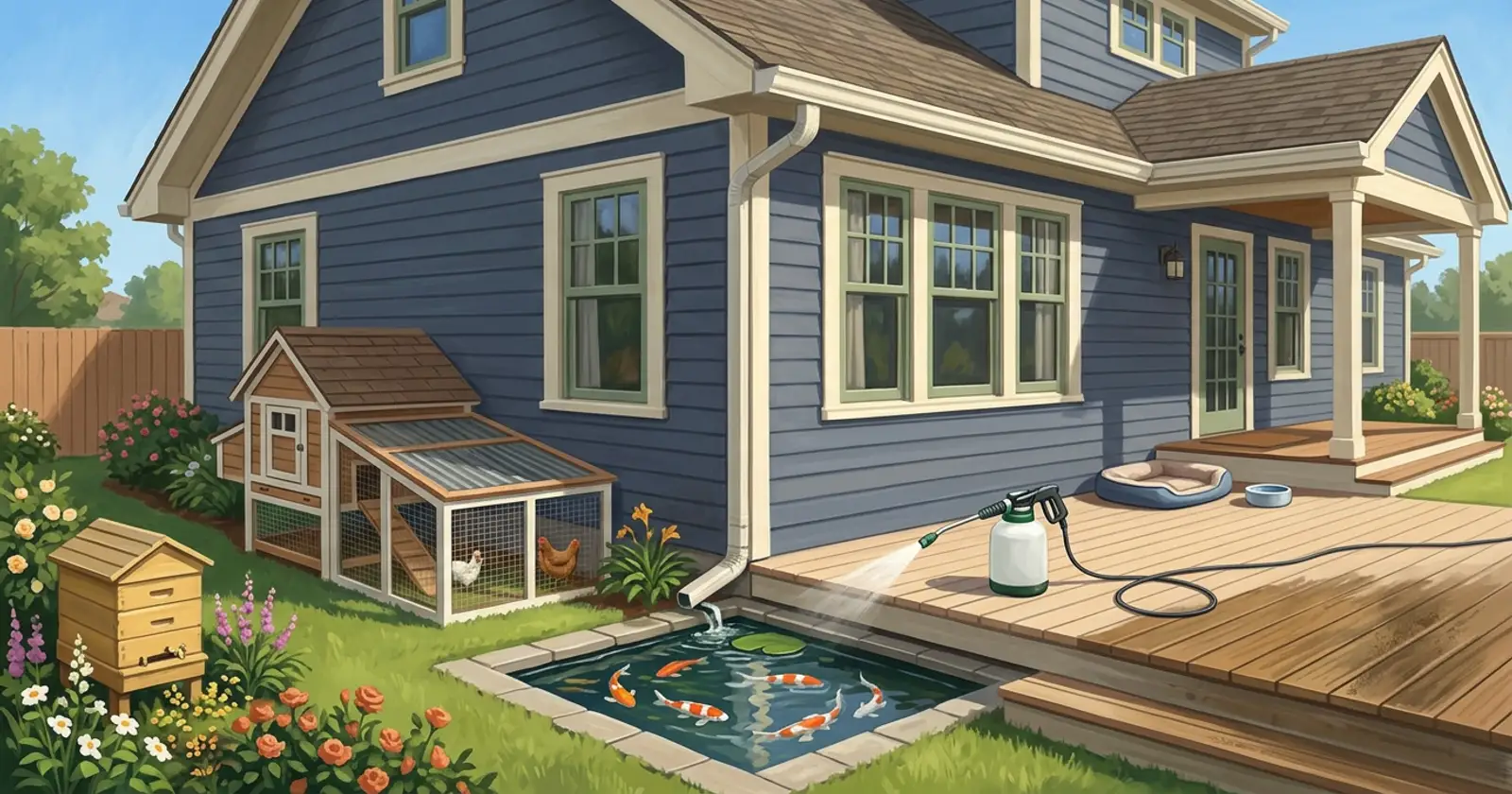
The best protection costs nothing: a walk-around before the crew starts. One soft wash equipment company’s step-by-step guide tells washers to note the koi pond, if there is one, before they pull a hose. Point out the coop, the run, the hive and the pond. Ask how the crew will rinse and where the runoff will go.
Our interview script for washing companies has more questions to ask on the phone.
A prep checklist by animal
| Animal | Before the wash | After the wash |
|---|---|---|
| Dogs and cats | Bring them inside. Take food and water dishes in. | Let them out once surfaces are dry, usually 1 to 2 hours |
| Chickens | Shut birds in the coop or a run away from the wall. Take in feeders and waterers. | Refill with fresh water. Rinse any feeder that got wet. |
| Koi and fish ponds | Show the washer the pond and any buried downspout lines that feed it | Ask the crew to rinse well so nothing washes in later |
| Honey bees | Cover the hive loosely with cloth that lets air through; screen the entrance | Remove the screen and cover once the job is done |
Dogs and cats
A Houston company’s checklist is simple: bring pets inside, close windows and doors, and take food and water dishes in. Keep pets in until treated surfaces are completely dry. It says that’s typically one to two hours for walls in Houston’s humidity, and longer for flat surfaces where the solution can collect.
Another washer gives the same window: pets are fine once the treated surfaces are dry, usually an hour or two.
Chickens
If your coop sits against the house or garage, treat the flock like any other pet, with one extra step for food. A sodium hypochlorite product label on file with the EPA tells users not to contaminate food or feed. So take feeders and waterers out of the spray zone, or cover them, before the crew starts. Shut the birds in the coop or a run on the far side of the yard until the walls are rinsed and dry.
If birds are nesting in your eaves, that’s a separate question. See our guide to bird droppings and nests.
Koi and fish ponds
Ponds need the most care. That label says the product is toxic to fish and aquatic organisms. It also says not to let it reach lakes, streams or ponds unless a discharge permit allows it.
Hidden drain lines are the surprise. One soft wash equipment company points out that runoff can travel through underground downspout lines you can’t see. If a downspout feeds the pond, ask the crew to disconnect or redirect it during the wash. Our guide to cleaning a dock without polluting the lake covers the same runoff idea on a bigger scale.
Honey bees
A house wash isn’t a pesticide spray, but bee guidance for sprays still helps. Purdue Extension suggests covering colonies with a loose cloth or tarp that lets air through. It also suggests a metal mesh screen across the entrance. It warns against fully sealing a hive, because the inside can overheat quickly.
Timing helps too. A Connecticut state guide says honey bees usually forage in daylight when it’s warmer than about 50 to 55 degrees, and not at night, so ask the washer to keep spray away from the hive during the warm daytime hours when bees are flying. If the hive sits right against the house, ask the washer to hand-rinse that wall section.
Plants and lawn
Your garden gets the same treatment as your animals: water before, during and after. If you’re also reseeding, our guide to washing around a new lawn covers timing. Doing it yourself? See renting, buying or hiring a soft wash.
Our methodology page explains how we check these sources.
Sources
Based on 6 sources · How we price
- Advantage Pro Services, Soft-Wash Safety: Chemical Choices That Protect Pets & Plants in Texas: advantageproservices.com/blog/soft-wash-safety-chemical-choices-that-protect-pets-plants-in-texas
- Elevation Exterior Cleaning, Are Soft-Wash Chemicals Safe for Plants and Pets?: elevationexteriorcleaning.com/learn/plant-pet-safety
- Soft Wash Technologies, How to Soft Wash a House: Step-by-Step: softwashtechnologies.com/blogs/education/how-to-soft-wash-a-house
- U.S. EPA, accepted label, Sodium Hypochlorite Solution 10.5% (EPA Reg. No. 37655-20002): www3.epa.gov/pesticides/chem_search/ppls/037655-20002-20110303.pdf
- Purdue Extension, Protecting Honey Bees From Area-Wide Insecticide Applications (POL-11): extension.entm.purdue.edu/publications/POL-11/POL-11.html
- Connecticut DEEP, Protecting Honey Bees: portal.ct.gov/-/media/deep/pesticides/certification/supervisor/protectinghoneybeespdf.pdf